
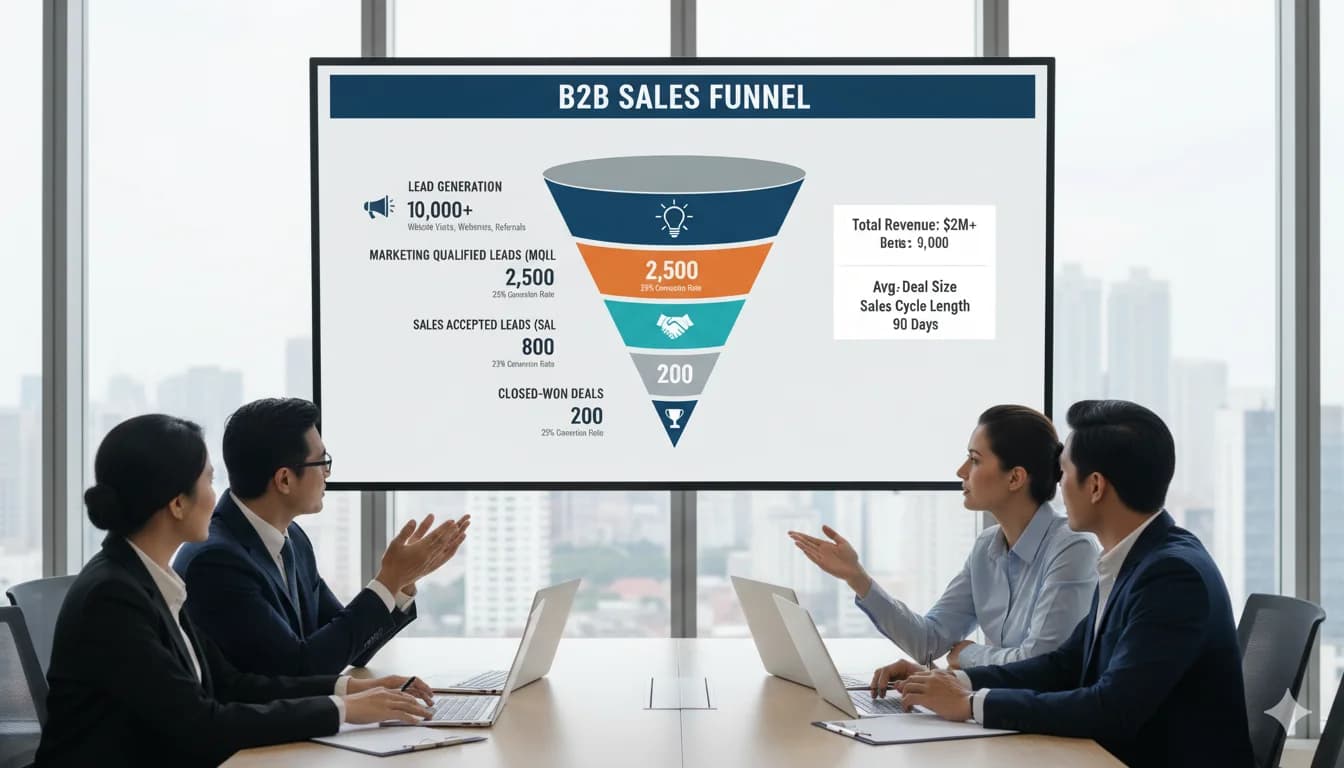
Google Ads for B2B: 10 Strategies for High-Quality Leads 2025
B2B lead generation with Google Ads. Strategies for longer sales cycles, higher ticket values and complex decision processes. With benchmarks.
Google Ads for B2B: 10 Strategies for High-Quality Leads 2025
Reality: B2B Google Ads is completely different from B2C. Longer sales cycles, higher ticket prices, multiple decision-makers. This guide shows the specific strategies.
B2B vs. B2C: The Fundamental Differences
B2C Example (E-Commerce):
- User searches "nike running shoes" → clicks ad → buys (30 min)
- Decision-maker: 1 person
- Ticket: €80-€200
- Conversion: Instant purchase
B2B Example (ERP Software):
- User searches "erp software mid-market" → reads content → downloads whitepaper → talks to sales → requests quotes → presentation → negotiation → purchase (3-12 months!)
- Decision-makers: 3-7 people (IT, Finance, C-Level)
- Ticket: €50,000-€500,000+
- Conversion: Demo request, not purchase
Google Ads Consequences:
| Factor | B2C | B2B | |--------|-----|-----| | Sales Cycle | Minutes-Days | Weeks-Months | | Conversion | Purchase | Lead (Demo, Whitepaper, Consultation) | | Ticket Size | €50-€500 | €5,000-€500,000+ | | Decision-makers | 1 | 3-7 | | Campaign Focus | Direct Response | Lead Nurturing | | Most Important Metric | ROAS | Cost per SQL |
Why B2B Google Ads Often Fails
Typical Mistakes:
- ❌ B2C strategies applied to B2B (expecting immediate conversion)
- ❌ Too aggressive CTAs ("Buy now" instead of "Request demo")
- ❌ No lead nurturing (lead comes in, then nothing)
- ❌ Wrong metrics (ROAS measured after 2 weeks with 6-month cycle)
- ❌ Too generic keywords ("software" instead of "erp software mid-market production")
Example failed B2B campaign:
SaaS company "ProjectX":
Budget: €5,000/month
Duration: 2 months
Leads: 43
Cost per Lead: €233
Sales: 0 (!)
Why? No follow-up, no nurturing sequence, C-Level not involved
→ Campaign "failed" and cancelled
Reality: B2B needs 6-12 months for ROI evaluation!
The 10 B2B Google Ads Strategies
Strategy 1: Funnel-Based Campaign Structure
Problem: B2C "bottom-of-funnel" approach doesn't work for B2B
Solution: Separate campaigns per funnel stage
TOFU (Top of Funnel) - Awareness:
Keywords: "what is [product category]", "benefits of X"
Example: "what is marketing automation"
Ad → Landing Page: Educational content (blog, guide)
Conversion: Newsletter, e-book download
CPC: Low (€1-€3)
Budget: 30% of total budget
MOFU (Middle of Funnel) - Consideration:
Keywords: "[product category] comparison", "best [product category]"
Example: "marketing automation software comparison"
Ad → Landing Page: Comparison content, case studies
Conversion: Webinar, demo request
CPC: Medium (€3-€8)
Budget: 40%
BOFU (Bottom of Funnel) - Decision:
Keywords: "[your product] price", "[competitor] alternative"
Example: "hubspot alternative", "salesforce price"
Ad → Landing Page: Product features, pricing, ROI calculator
Conversion: Sales call, quote request
CPC: High (€8-€25+)
Budget: 30%
Why separate?
- Different user intent
- Different landing pages
- Different bids
- Different success metrics
Strategy 2: Account-Based Marketing (ABM) with Google Ads
What: Focus on specific high-value accounts instead of broad lead-gen
Setup:
1. Create target account list (ICP - Ideal Customer Profile):
Companies with:
- Size: 500-2,000 employees
- Industry: Manufacturing
- Revenue: €50M-€500M
- Tech stack: SAP, Salesforce (indicates: already digitally mature)
2. LinkedIn Insight Tag + CRM integration:
- Identifies visitors from target accounts
- Retargeting to these accounts
3. High-quality custom landing pages:
- Personalized per target account
- Case studies from same industry
- ROI calculator with industry-specific data
4. Higher bids for target accounts:
Google Ads → Audiences → Customer Match
→ Upload: Company names, domains, decision-maker emails
→ Bid adjustment: +200-300%
Example:
Target: Siemens AG (dream customer)
Keyword: "production planning software"
Normal: €12 CPC
For Siemens: €36 CPC (+200%)
Landing Page: Special for Siemens with manufacturing case study
Budget: 20-40% for ABM (for high-ticket B2B)
Strategy 3: Lead Magnets instead of Direct Sale
Problem: B2B buyers not ready for sales call after first click
Solution: Give value upfront
Lead Magnet Hierarchy (by commitment):
Low Commitment (TOFU):
- Blog post (no form)
- Newsletter signup (email only)
- → CPC: €1-€3, Conversion Rate: 5-15%
Medium Commitment (MOFU):
- E-book/Whitepaper (name + email + company)
- Webinar (name + email + phone)
- ROI calculator
- → CPC: €3-€8, CR: 3-8%
High Commitment (BOFU):
- Demo request (complete form)
- Sales call booking
- Free trial (with credit card)
- → CPC: €8-€25+, CR: 1-5%
Landing Page Example (MOFU):
[Headline]
"The Ultimate Guide: Marketing Automation for B2B SaaS"

[Subheadline]
"43 pages practical knowledge: Setup, best practices, benchmarks"

[Form]
- First name
- Last name
- Email
- Company
- Number of employees (dropdown)

[CTA]
"Download for free now"

[Trust]
"Already 2,500+ downloads"
After download: Automatic email sequence (nurturing!)
Strategy 4: Long-Tail Keywords for Niche Targeting
Problem: Broad keywords = expensive CPCs + unqualified leads
Broad keyword example:
"crm software"
CPC: €15-€40
Competition: Extreme (Salesforce, HubSpot, etc.)
Intent: Unclear (SMB? Enterprise? Which industry?)
Better: Long-Tail:
"crm software real estate agents mac"
CPC: €3-€8
Competition: Low
Intent: Very specific (real estate agents, uses Mac)
Relevance: High
Long-Tail Keyword Research:
1. Industry-specific:
- "[Product] for [industry]"
- "marketing automation for b2b saas"
- "time tracking software construction"
2. Role-specific:
- "[Product] for [job title]"
- "reporting tool for cfo"
- "project management software for architects"
3. Tech stack-specific:
- "[Product] salesforce integration"
- "analytics tool google cloud"
4. Problem-specific:
- "how to [problem] solve"
- "how to consolidate customer data"
Tool: Answer The Public, AlsoAsked for long-tail ideas
Budget Allocation:
- 40% long-tail (many keywords, low CPC)
- 40% medium-tail (moderate competition)
- 20% short-tail/brand (high CPC, but important for visibility)
Strategy 5: Remarketing with Content Levels
B2B Buying Journey (typical):
Visit 1: Blog post (awareness)
Visit 2: Case study (interest)
Visit 3: Pricing page (consideration)
Visit 4: Demo request (decision)
Remarketing Sequence:
Level 1: Blog visitors (last 30 days):
- Ad: "Whitepaper: Top 10 [topic] strategies"
- Goal: Newsletter/download
- Bids: Low
Level 2: Whitepaper downloaders (last 14 days):
- Ad: "Webinar: How [customer XY] achieved 300% ROI"
- Goal: Webinar registration
- Bids: Medium
Level 3: Webinar participants (last 7 days):
- Ad: "Free demo: See [product] in action"
- Goal: Demo booking
- Bids: High
Level 4: Demo-but-not-purchased (last 30 days):
- Ad: "Questions about [product] implementation? Talk to our expert"
- Goal: Sales call
- Bids: Very high (+300%)
Setup:
- Audiences in Google Ads by URL visit
- Or: GA4 Audiences (e.g. "Whitepaper Downloaded")
- Separate display/search campaigns per level
Strategy 6: Competitor Conquesting
Strategy: Bid on competitor keywords
When sensible for B2B?
- ✅ When you have clear USPs (price, features, support)
- ✅ For customers willing to switch (common with SaaS)
- ✅ For "switch offers" (migration help, etc.)
Example Keywords:
"[competitor] alternative"
"[competitor] vs [your brand]"
"[competitor] too expensive"
"[competitor] problems"
"switch from [competitor]"
Ad Text:
HubSpot too expensive? Try [Your Product]
Same features, 40% lower price
Free migration + 3 months support free
[Request demo]
Landing Page:
- Side-by-side comparison (honest!)
- "Switch incentive" (€X discount, free migration)
- Testimonials from switchers
Caution:
- Trademark issues possible
- CPCs often 2-3x higher (competitive)
- Conversion rates lower (skeptical users)
Budget: 10-20% for competitor campaigns
Strategy 7: LinkedIn + Google Ads Combo
Problem: B2B decision-makers are on LinkedIn, not on Display Network
Solution: Multi-platform strategy
Approach 1: Google for Intent, LinkedIn for Targeting
Google Ads:
- Focus: High-intent keywords (BOFU)
- Budget: 60%
LinkedIn Ads:
- Focus: Job title + industry targeting (TOFU/MOFU)
- Budget: 40%
Remarketing Cross-Platform:
User sees LinkedIn ad → visits website
→ Google remarketing ad shows demo offer
→ Higher conversion rate (2nd touchpoint!)
Approach 2: LinkedIn Insight Tag + Google Customer Match
Setup:
- LinkedIn Insight Tag on website
- Captures companies + job titles of visitors
- Export → Google Ads Customer Match
- Retargeting these accounts on Google
Why it works?
- LinkedIn: Better targeting (job title, company size, seniority)
- Google: Higher reach + lower CPCs (€8 vs. €15+)
Strategy 8: Value-Based Bidding instead of CPA
Problem: In B2B, not all leads are equally valuable
Example:
Lead A: CMO, 500-employee company
→ Ticket potential: €100,000+
→ Value: €100,000 × 20% close rate = €20,000

Lead B: Marketing Manager, 10-employee startup
→ Ticket potential: €5,000
→ Value: €5,000 × 20% = €1,000
Strategy: Different bids by lead quality
Setup:
1. Define conversion values:
Demo (SMB): €500 value
Demo (Mid-market): €2,000 value
Demo (Enterprise): €10,000 value
2. Conversion tracking with dynamic value:
// On demo request
gtag('event', 'conversion', {
  'send_to': 'AW-XXXXXXX/XXXXX',
  'value': calculatedValue, // based on company size
  'currency': 'EUR'
});
3. Bidding strategy: "Maximize conversion value"
4. Form qualification:
[Demo Form]
Number of employees:
- 1-10 (Lead value: €500)
- 11-50 (€1,000)
- 51-200 (€2,000)
- 201-500 (€5,000)
- 500+ (€10,000)
Result: Google automatically bids higher for valuable leads!
Strategy 9: Content Syndication Ads
What: Ads linking to high-quality content pieces
Problem: B2B buyers want to inform themselves (in my experience, much of the buying journey happens BEFORE sales contact!)
Solution: Provide valuable content
Content Types for Ads:
Research Reports:
- "State of [Industry] 2025 Report"
- Independent studies with data
- → Lead magnet: Email for download
Comparison Guides:
- "[Category] Comparison: Top 10 Tools 2025"
- Objective (mention your solution, but fair!)
- → No-gate or email-gate
ROI Calculators:
- Interactive tools
- "Calculate your savings potential"
- → Result for email
Case Studies:
- "[Customer XY] achieved 300% ROI in 6 months"
- Problem → Solution → Result
- → Gated for full case study
Webinars:
- Live or on-demand
- 30-45 min expert content
- → Registration with form
Ad Strategy:
Campaign: "Content Syndication - Whitepaper"
Keywords: MOFU (consideration stage)
Ad:
"[Free] Marketing Automation Guide 2025
43 pages practical knowledge for B2B SaaS
2,500+ downloads | Download now"
→ Landing Page: Whitepaper download for email
Budget: 30-40% for content syndication (TOFU/MOFU)
Strategy 10: Multi-Touch Attribution Setup
Problem: B2B customer journey has 7-15 touchpoints!
Real customer journey example:
Day 1: Google Search Ad → Blog read
Day 5: Display Remarketing → Whitepaper download
Day 12: LinkedIn Ad → Webinar registration
Day 18: Google Search (brand) → Pricing page
Day 25: Direct visit → Demo request
Day 60: Sales calls, presentation
Day 90: Closed Won! €80,000 deal
Last-Click Attribution Problem:
- Google gives 100% credit to "Direct visit" (Day 25)
- Search Ad (Day 1) gets 0% credit
- → Wrong optimization!
Solution: Multi-Touch Attribution Model
Setup:
1. Activate GA4 data-driven attribution:
- GA4 → Admin → Attribution Settings → Data-driven
2. Google Ads attribution model:
- Google Ads → Tools → Attribution → "Data-driven"
3. CRM integration (important for B2B!):
- Connect Salesforce/HubSpot + Google Ads
- Closed Won data back to Google Ads
- Upload "Offline Conversions"
4. Custom reporting:
- GA4: Path Exploration Report (see all touchpoints)
- Google Ads: Attribution Paths Report
Result: Correct budget allocation across touchpoints
Example Insight:
Before (Last-Click):
- Brand Search: 80% credit → €4,000 budget
- Display: 5% credit → €500 budget

After (Data-Driven):
- Brand Search: 20% credit → €1,000 budget
- Display: 35% credit → €2,000 budget
B2B Lead Qualification
Problem: Many leads ≠ good leads
Solution: Lead scoring system
MQL (Marketing Qualified Lead) Criteria:
- ✅ Company size: 50+ employees
- ✅ Right job title (Manager+)
- ✅ Budget indication (form or behavior)
- ✅ Engagement (2+ pages, 3+ min on site)
SQL (Sales Qualified Lead) Criteria:
- ✅ Demo requested
- ✅ Concrete requirements stated
- ✅ Timeframe defined (<6 months)
- ✅ Budget confirmed
Lead Qualification Form:
[Demo Request]
- Name
- Email
- Phone
- Company
- Number of employees (dropdown)
- Industry (dropdown)
- "When do you want to start?"
  - Immediately
  - In 1-3 months
  - In 3-6 months
  - Just gathering info
- "What is your estimated budget?"
  - Under €10k
  - €10k-€50k
  - €50k-€100k
  - Over €100k
Lead Routing:
- SQL → Direct call from sales (within 5 min!)
- MQL → Nurturing sequence (email series)
- Unqualified → Newsletter
B2B Google Ads Benchmarks
Cost per Lead (by industry):
SaaS:
- CPL: €50-€250
- Cost per SQL: €150-€800
- CAC: €3,000-€15,000
Professional Services (Consulting, Agencies):
- CPL: €30-€150
- Cost per SQL: €80-€400
- CAC: €1,000-€8,000
Manufacturing/Industrial:
- CPL: €80-€300
- Cost per SQL: €200-€1,000
- CAC: €5,000-€30,000+
Conversion Rates:
- TOFU (Content Download): 5-15%
- MOFU (Webinar): 3-8%
- BOFU (Demo): 1-5%
- Lead → SQL: 20-40%
- SQL → Customer: 15-30%
Campaign Performance:
- Search CTR: 2-6%
- Display CTR: 0.3-0.8%
- LinkedIn CTR: 0.4-0.9%
Common B2B Google Ads Mistakes
Mistake 1: Too Quick Judgment
❌ Problem: "After 2 months no ROI → shut down campaign" ✅ Reality: B2B sales cycle = 3-12 months! ✅ Solution: Run min. 6 months for fair evaluation
Mistake 2: Direct Sales Pitch
❌ Problem: Ad → "Buy now" landing page ✅ Solution: Lead magnets, value upfront, nurturing
Mistake 3: No CRM Integration
❌ Problem: Leads come in, but no tracking to Closed Won ✅ Solution: Connect CRM + Google Ads, upload offline conversions
Mistake 4: Consumer Keywords for B2B
❌ Problem: "project management tool" (consumer intent) ✅ Solution: "project management software for agencies" (B2B intent)
Mistake 5: No Lead Nurturing
❌ Problem: Lead comes → one email → then nothing ✅ Solution: 6-12 email nurturing sequence (automated)
B2B Google Ads Budget Guide
By Company Stage:
Startup (<€1M ARR):
- Budget: €2,000-€5,000/month
- Focus: Long-tail keywords, content syndication
- Expectation: 20-50 MQLs/month, 5-15 SQLs
Growth (€1M-€10M ARR):
- Budget: €5,000-€20,000/month
- Focus: Full funnel, remarketing, competitor
- Expectation: 50-200 MQLs/month, 15-60 SQLs
Enterprise (€10M+ ARR):
- Budget: €20,000-€100,000+/month
- Focus: ABM, multi-channel, brand
- Expectation: 200-1,000+ MQLs/month, 60-300+ SQLs
ROI Timeline:
- Month 1-3: Investment (no returns)
- Month 4-6: First closed deals
- Month 7-12: Positive ROI
- Month 12+: Scaling
Tools for B2B Google Ads
Attribution:
- Google Analytics 4 (free)
- HubSpot Attribution (from €800/month)
- Ruler Analytics (from €199/month)
CRM + Marketing Automation:
- HubSpot (from €45/month)
- Salesforce (from €25/user/month)
- Pipedrive (from €12.50/month)
Lead Enrichment:
- Clearbit (from €99/month)
- ZoomInfo (from €500/month)
- Leadfeeder (from €55/month - shows company visitors)
ABM:
- Demandbase (custom pricing)
- 6sense (custom pricing)
- Terminus (from €2,500/month)
Conclusion
B2B Google Ads = Patience + Strategy
Start Roadmap:
Month 1-2:
- ✅ Set up funnel structure (TOFU/MOFU/BOFU)
- ✅ Create lead magnets (whitepaper, webinar)
- ✅ CRM + tracking setup
- ✅ First campaigns (long-tail keywords)
Month 3-4:
- ✅ Start remarketing
- ✅ Implement nurturing sequences
- ✅ Multi-touch attribution setup
Month 5-6:
- ✅ ABM for top accounts
- ✅ Competitor campaigns
- ✅ Scaling based on data
Month 6-12:
- ✅ First closed deals
- ✅ ROI evaluation
- ✅ Further scaling
Expectation: 50-200 MQLs/month with €5,000-€20,000 budget after 6+ months!
FAQ about Google Ads for B2B
What does Google Ads cost for B2B?
B2B Google Ads budgets by company stage: Startups (<€1M ARR): €2,000-€5,000/month, 20-50 MQLs, €50-€250 CPL. Growth stage (€1M-€10M): €5,000-€20,000/month, 50-200 MQLs, €80-€200 CPL. Enterprise (€10M+): €20,000-€100,000+/month, 200-1,000+ MQLs. B2B needs higher budgets because: Higher CPCs (€3-€25+), longer sales cycles (6-12 months to ROI), fewer but more valuable conversions.
What is a good cost per lead for B2B?
Good CPL depends on ticket size and industry: SaaS: €50-€250 CPL (MQL), €150-€800 cost per SQL. Professional Services: €30-€150 CPL, €80-€400 SQL. Manufacturing/Industrial: €80-€300 CPL, €200-€1,000 SQL. Important: Don't just measure MQL costs! Crucial: Cost per SQL (Sales Qualified Lead) and CAC (Customer Acquisition Cost). Rule of thumb: CAC should be < 1/3 of Customer Lifetime Value.
How long does it take for B2B Google Ads to become profitable?
B2B Google Ads ROI timeline: Month 1-3: Investment phase, generate leads, set up nurturing - no returns expected. Month 4-6: First closed deals (depending on sales cycle). Month 7-12: Break-even to positive ROI. Month 12+: Scaling. Problem: Many quit after 2-3 months! Reality: B2B sales cycles = 3-12 months. Minimum: Run 6 months for fair evaluation.
Which keywords work best for B2B?
Best performing B2B keywords: 1) Long-tail: "[product] for [industry]" (e.g. "crm software real estate agents") - low CPCs, high relevance. 2) Intent keywords: "[category] comparison", "best [solution] for [use case]". 3) Problem keywords: "how to solve [problem]". 4) Competitor: "[competitor] alternative". Avoid: Too broad keywords ("software", "marketing") = expensive CPCs + unqualified leads. Focus: Specificity > volume!
Should I use Shopping or Search Ads for B2B?
Search Ads are the main focus for B2B! Shopping Ads are for e-commerce, not B2B services/SaaS. B2B campaign types: 1) Search Ads (80% budget) - high-intent keywords, 2) Display Remarketing (15%) - nurturing, 3) YouTube (5%) - brand awareness (optional). Performance Max only with caution for B2B - less control, better for direct response. LinkedIn Ads often better than Google Display for TOFU/MOFU (job title targeting!).
What are lead magnets and why do I need them for B2B?
Lead magnets = valuable content for contact data. B2B buyers are not ready for sales call after first click! Lead magnet types: TOFU: E-books, guides (email only). MOFU: Whitepapers, webinars, ROI calculators (email + company). BOFU: Demos, trials (complete form). Strategy: Give value upfront → build trust → nurturing → then sales. Without lead magnets: Low conversion rates (<1%). With lead magnets: 3-15% CR depending on funnel stage!
What is ABM (Account-Based Marketing) and how does it work with Google Ads?
ABM = Focus on specific high-value target accounts instead of broad lead-gen. Setup: 1) Define ICP (e.g. manufacturing companies, 500-2,000 employees, €50M-€500M revenue), 2) Create target account list, 3) Google Ads Customer Match: Upload account domains/emails, 4) Increase bids for target accounts (+200-300%), 5) Personalized landing pages per account/industry. Best for: High-ticket B2B (€50k+ deals), enterprise sales. Budget: 20-40% for ABM.
How do I measure B2B Google Ads success correctly?
B2B metrics (by importance): 1) Cost per SQL (Sales Qualified Lead) - most important metric! 2) CAC (Customer Acquisition Cost), 3) SQL → Customer Rate (15-30% good), 4) Lead Quality Score, 5) Customer Lifetime Value (CLV), 6) CLV:CAC Ratio (>3:1 good). DON'T just measure: MQL count (can be unqualified), ROAS after 2 weeks (sales cycle!). Critical: CRM integration for offline conversion tracking (Closed Won data back to Google Ads).

Mijo Jurisic
Google Ads consultant & founder of MJ Marketing. Five-plus years of hands-on practice — from a self-taught start to the Google Premier Partner programme with 500+ direct Google Ads clients and €20M+ in managed media spend.
Share this article: