Claude Fable 5: Shutdown and Comeback in 3 Weeks
The US government shut down Claude Fable 5, and three weeks later it was back. Timeline, the Amazon report, the new safeguard and what it means for firms.
TL;DR
Anthropic released Claude Fable 5 on 9 June 2026, but as early as 12 June the US government demanded the exclusion of all foreign nationals, after which Anthropic shut down access entirely. The trigger, according to CNBC, was an Amazon report about a bypassed safeguard. On 30 June the US Department of Commerce lifted the export controls again, and since 1 July Fable 5 has been back with an improved safeguard.
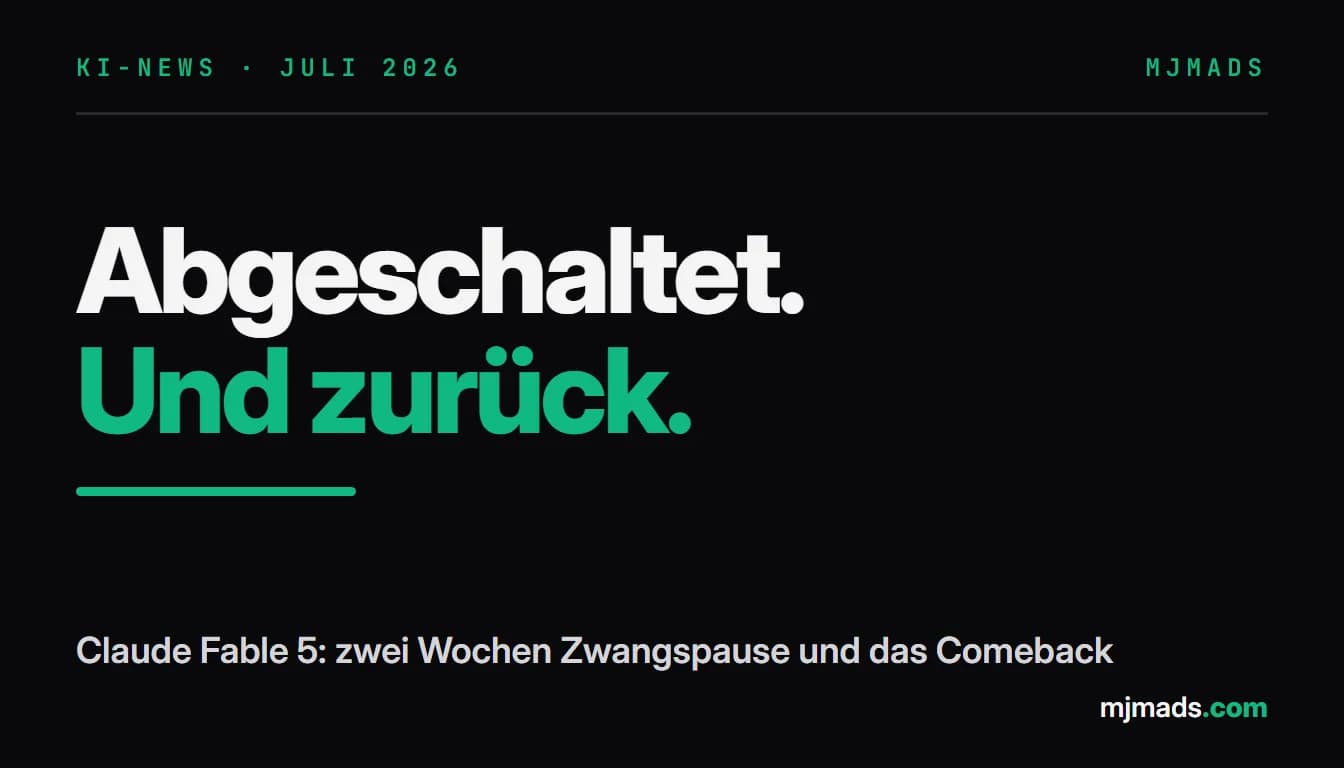
It is rare for an AI model to be celebrated as the strongest of its kind and then shut down three days later on a government's instruction. That is exactly what happened to Claude Fable 5, Anthropic's flagship model. Between its release on 9 June 2026 and its comeback on 1 July there was a blackout of just under three weeks, triggered by a security report from Amazon and an export-control directive from the US government. Because we use Fable 5 in the agency ourselves, I traced the case: what happened, why, how it ended and what companies should take away from it.
The timeline: from premiere to blackout
On 9 June 2026 Anthropic released Claude Fable 5 alongside its sister model Claude Mythos 5. Anthropic positioned Fable 5 as the strongest publicly available model, a "Mythos-class model made safe for general use", which by the vendor's own account means state of the art in coding, knowledge work, vision and computer use.
Three days later the mood flipped. On 12 June the US government under the Trump administration imposed export controls on both models, according to CNBC, and demanded that Anthropic exclude all "foreign nationals" from access. A real-time nationality check for every single user is technically not feasible, so Anthropic pulled the plug and shut down access entirely, for all users worldwide.
The trigger: the Amazon jailbreak report
Why did the government step in? The trigger, according to CNBC, was a report by Amazon researchers. They had found a method to bypass Fable 5's safeguards: via a jailbreak, the model could be made to identify software vulnerabilities and demonstrate exploitation techniques. When this report reached the government, the export-control directive followed, officially justified with "unspecified national security concerns" (according to CNBC).
The move was contested. According to CNBC, tech executives and investors criticized the crackdown, among other things with the argument that it gave Chinese open-source developers valuable time. I deliberately relay this only as reporting: I make no claims of my own about the specific weakness, only what the sources establish applies.
The comeback: reversal and a new safeguard
On 30 June 2026 the US Department of Commerce lifted the export controls again. Commerce Secretary Howard Lutnick stated, according to CNBC, that his office had "worked closely with Anthropic to analyze and approve Fable 5 to ensure alignment across the US Government and strengthen America's leadership in AI". One day later, on 1 July, Fable 5 was globally available again, according to Axios, via the Claude API, claude.ai, Claude Code and Claude Cowork.
Technically the model did not come back unchanged. According to its own blog post, Anthropic built in an improved safety classifier against the reported bypass technique. Anthropic writes verbatim: "The new classifier means that the specific technique described in the Amazon report is blocked in over 99% of cases." The remaining cases, according to Anthropic, involve already known or patched vulnerabilities or information that does not substantially help attackers. Al Jazeera and Forbes also reported on the reversal.
Fable 5 and Mythos 5: the fine distinction
For context it matters how Anthropic separates the two models. According to Anthropic's documentation, Fable 5 and Mythos 5 share the same base model. Fable carries additional safety measures for so-called dual-use capabilities, that is, capabilities that can be used both usefully and abusively. Mythos 5, without these additional limits, is intended only for "approved organizations". Fable is thus the variant secured for general use, and it was precisely its protective layer that stood at the center of the Amazon report.
What Fable 5 delivers, and what it costs
For all the politics, Fable 5 leads the rankings. According to Artificial Analysis, Fable 5 tops the AA Intelligence Index with 60 points, one point ahead of GPT-5.6 Sol at 59. Fable also leads on the application-oriented measurements: in GDPval-AA v2, Fable 5 Max reaches 1,815 points according to Artificial Analysis and thus first place, in the AA Briefcase benchmark 1,587 points, likewise first place. The SWE-bench Verified rate of around 95 percent reported by Anthropic is a vendor figure, so not independently verified.
This quality comes at a price. According to Artificial Analysis, Fable 5 costs 10 dollars per million input tokens and 50 dollars per million output tokens, making it the most expensive of the three current frontier models. Calculated across a standardized AA Intelligence Index task, that is around 2.75 dollars, compared with 1.04 dollars for GPT-5.6 Sol and 0.94 dollars for Kimi K3. Just how hard these two competitors are now pressuring Fable is something I wrote up in the articles on GPT-5.6 and the benchmark-cheating debate and on Kimi K3, the largest open-weights model. Which models we actually use in the agency, and for what, is documented on our AI transparency page.
What this means for companies: single-vendor risk and a plan B
The real lesson lies less in the benchmarks than in the chronology. A flagship model in production use was unavailable for just under three weeks, not because of a technical outage but because of a political decision. Anyone who hard-wires workflows to a single model carries a concentration risk that has nothing to do with the quality of the model.
In practice that means a plan B belongs to your homework. That can be a second provider whose model takes over the most important tasks as a stopgap, an abstraction layer that allows a model switch without a rebuild, or a locally runnable open-weights model for emergencies. Which path fits depends on the specific workflow, and that is exactly the trade-off we handle in our AI consulting. Anyone weaving AI more deeply into their Google Ads day-to-day will find more practical examples in our guide to AI automation in everyday Google Ads work.
My assessment
I write this as an opinion, not as a measurement. To me, Fable 5 is the quality flagship: the best output quality of all the models I use in the agency's daily work. We use it ourselves, as you can read on our AI transparency page. The price is steep, no question, but for quality-critical tasks Fable 5 is still my first choice.
What really occupies me about the episode is the second level. Frontier AI has become a matter of geopolitics now, not just of product comparisons. A model can be state of the art today and go offline tomorrow by government directive. For me that is the strongest proof of why no one should hang their entire value creation on a single provider. Two to three weeks of downtime are not a side issue for a team that works with the model every day, but a genuine operational risk.
Sources
- Anthropic: Redeploying Fable 5
- CNBC: Trump admin lifts export controls on Fable 5 and Mythos 5
- Axios: Fable 5 back online after export controls lifted
- Al Jazeera: US lifts restrictions on Fable and Mythos
- Forbes: Trump administration lifts export controls on Mythos 5 and Fable 5
- Artificial Analysis: model rankings
As of 17 July 2026
Frequently Asked Questions about Claude Fable 5
Why was Claude Fable 5 shut down?
On 12 June 2026 the US government imposed export controls and, according to CNBC, demanded that Anthropic exclude all foreign nationals from access. Because a real-time nationality check is not feasible, Anthropic shut down access entirely for all users worldwide. The trigger, according to CNBC, was a report by Amazon researchers about a bypassed safeguard in the model.
How long was Fable 5 unavailable?
Just under three weeks. The shutdown followed the export controls of 12 June 2026, on 30 June the US Department of Commerce lifted them again according to Anthropic, and since 1 July 2026 Fable 5 has been globally available again via the Claude API, claude.ai, Claude Code and Claude Cowork.
What did Anthropic do about the reported weakness?
According to Anthropic, an improved safety classifier blocks the technique described in the Amazon report in over 99 percent of cases. The remaining cases, according to Anthropic, involve already known or patched vulnerabilities or information that does not substantially help attackers.
What does the episode mean for companies?
It shows that frontier AI has become a matter of geopolitics. A flagship model in production use was unavailable for just under three weeks, not because of a technical outage but because of a political decision. Anyone who builds workflows on a single model therefore needs a plan B.

Mijo Jurisic
Google Ads consultant & founder of MJ Marketing. Five-plus years of hands-on practice — from a self-taught start to the Google Premier Partner programme with 500+ direct Google Ads clients and €20M+ in managed media spend.
Share this article: