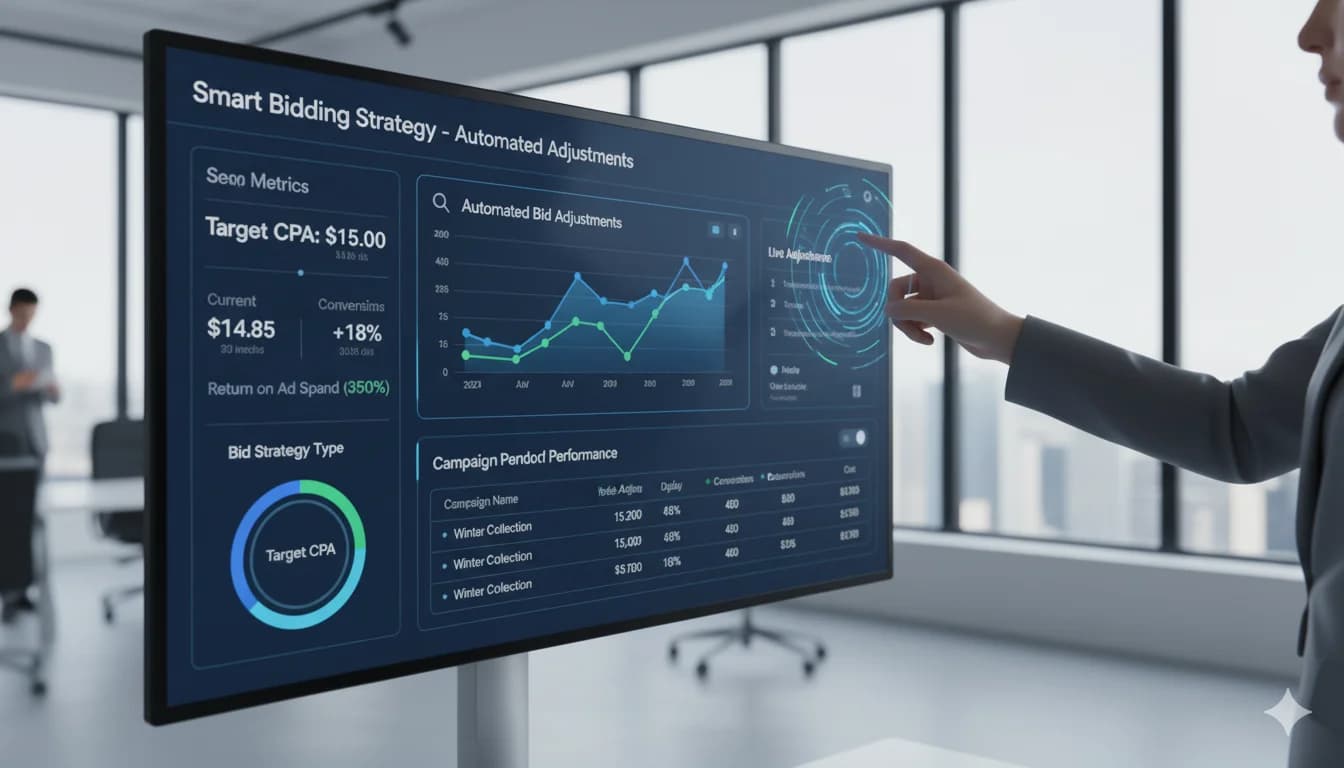

AI & Automation in Google Ads: Smart Bidding Guide 2026
How to profitably use AI-powered bidding strategies, automated campaign types, and machine learning in Google Ads.
Google Ads has fundamentally changed: What used to be manual keyword bids and hours of optimization is increasingly being taken over by AI. Smart Bidding, Performance Max, automatic assets — the question is no longer whether to use AI, but how to control it correctly.
This guide shows what AI can do in Google Ads, where its limits are, and how to get the most out of automated strategies.
What Does AI in Google Ads Actually Mean?
Google's AI algorithms analyze hundreds of signals in real time for every auction:
- Device type and operating system
- Time of day and day of week
- Search query (semantic meaning, not just keywords)
- User location
- Demographic characteristics
- Past behavior on your website
- Remarketing status (has the user been on your site before?)
- Competitive landscape in the auction
- Seasonal signals
A human advertiser cannot manage this complexity manually. This is exactly where AI's advantage lies.
Smart Bidding Strategies Overview
1. Maximize Conversions
What it does: Spends as much budget as possible to maximize the number of conversions.
When to use:
- No cost targets defined
- Budget should be fully utilized
- As an entry into Smart Bidding (before enough data for Target CPA)
2. Target CPA
What it does: Keeps average cost per conversion at your defined target.
When to use:
- When you know what a lead/purchase can cost
- At least 30–50 conversions in the last 30 days
Best practice: Don't set Target CPA too aggressively. Start with actual historical CPA × 1.1.
3. Target ROAS
What it does: Optimizes bids for a specific return on ad spend.
When to use:
- E-commerce with conversion values
- When you know that e.g. 400% ROAS is profitable
- At least 50+ conversions with values in the last 30 days
4. Maximize Conversion Value
What it does: Maximizes total conversion value within the budget.
Ideal for: Shops with different product prices — AI prioritizes high-value conversions.
Prerequisites for Successful Smart Bidding
AI is only as good as the data it works with. Smart Bidding strategies often fail because the foundations are missing.
Prerequisite 1: Correct Conversion Tracking
The AI optimizes for what you define as a conversion. Errors here cost a lot of money.
What must be set up correctly:
- Conversion tracking via Google Tag (not URL-based)
- De-duplication activated
- Correct conversion value (for e-commerce: dynamic value, not static)
- No micro-conversions as primary goal (e.g., no "50% scroll" as main conversion)
Prerequisite 2: Sufficient Conversion Volume
| Strategy | Minimum Conversions | |---|---| | Maximize Conversions | 0 (can be started immediately) | | Target CPA | 30–50 in 30 days | | Target ROAS | 50+ in 30 days (with values) | | Maximize Conv. Value | 50+ in 30 days (with values) |
Prerequisite 3: Realistic Goals
A common mistake: Target CPA is set too low. The AI can't set bids high enough and the ad barely appears.
Rule of thumb: Start with historical CPA + 15–20%, then slowly reduce.
Performance Max: Full AI Automation
Performance Max (PMax) uses all Google channels (Search, Display, YouTube, Gmail, Discover, Shopping, Maps) in one campaign.
What PMax Does Well
✓ Reach across all Google channels ✓ Finds conversions you wouldn't have found manually ✓ Ideal for e-commerce with Google Shopping integration ✓ Works well with high conversion volume
What PMax Doesn't Do Well
✗ Transparency: Little insight into where budget flows ✗ Control: Barely possible to weight specific channels ✗ Brand protection: Tends to use budget for brand searches ✗ Small budgets: Often inefficient below £900/month
Best Practices for Performance Max
Asset quality is crucial:
- At least 15 headlines, 4 descriptions, 5 images, 5 logos
- Upload video (otherwise Google often auto-generates poor quality videos)
- Set audience signals (your CRM list, website visitors)
Protect brand campaigns: Create a parallel standard search campaign for your brand name with a higher priority. PMax shouldn't "steal" your brand searches.
Recommended Smart Bidding Rollout
Phase 1: Collect data (4–6 weeks)
  → Manual CPC or Maximize Clicks
  → Check and optimize conversion tracking
  → Build up 30–50 conversions

Phase 2: First Smart Bidding activation
  → Switch to Maximize Conversions
  → Observe learning phase (7–14 days)
  → No interventions during learning phase

Phase 3: Goal-based bidding (after 4–6 weeks)
  → Switch to Target CPA with realistic goal
  → CPA target: historical CPA + 15%
  → Monitor weekly, optimize monthly

Phase 4: Advanced (after 3+ months)
  → Gradually lower Target CPA (max 15% every 2 weeks)
  → Implement seasonal adjustments
  → Evaluate portfolio strategies for campaign groups
Where Manual Control Is Still Needed
AI is powerful, but not omnipotent. These areas still require human attention:
- Brand strategy and messaging — AI optimizes for conversions, not brand consistency
- Negative keywords — Smart Bidding doesn't prevent irrelevant search terms
- Seasonal adjustments — for predictable events (Black Friday, trade shows), set manual seasonal adjustments
- New markets and products — no historical data yet, start with Manual CPC
- Very high budgets / competitive markets — excessive automation can lead to budget waste
Checklist: Optimizing AI & Smart Bidding
- [ ] Conversion tracking fully and correctly set up
- [ ] At least 30 conversions in 30 days available
- [ ] Realistic Target CPA based on historical data
- [ ] Learning phase indicators understood (don't intervene!)
- [ ] Performance Max asset groups with complete assets
- [ ] Brand campaign protects own brand keywords
- [ ] Negative keywords regularly updated
- [ ] Auto-created assets reviewed monthly
Conclusion
AI in Google Ads is not a threat to advertisers — it's a powerful tool that, when used correctly, brings enormous efficiency gains. The art lies in giving AI the right framework: correct tracking, sufficient data, realistic goals.
Those who control AI rather than blindly trusting it will achieve the best results.
Want to optimize your Smart Bidding strategy? Talk to us now.

Mijo Jurisic
Google Ads consultant & founder of MJ Marketing. Five-plus years of hands-on practice — from a self-taught start to the Google Premier Partner programme with 500+ direct Google Ads clients and €20M+ in managed media spend.
Share this article: