
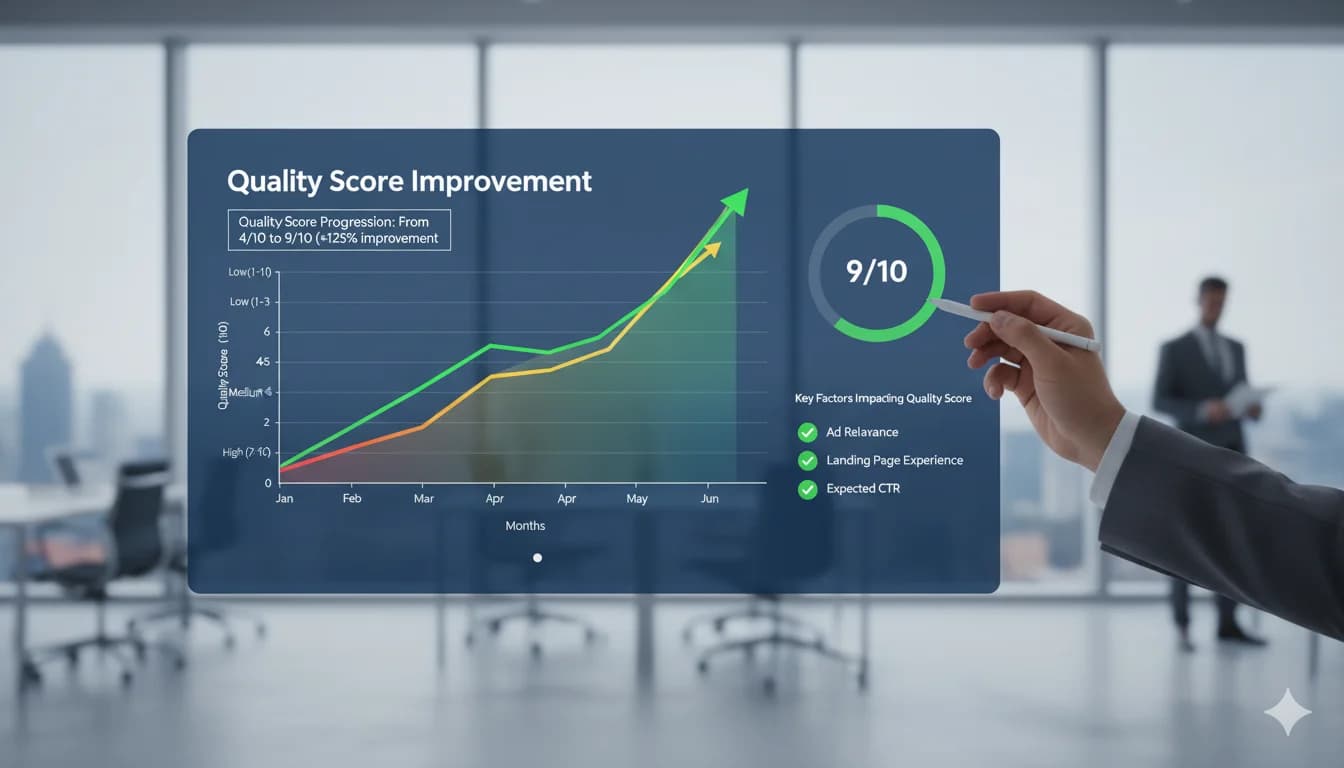
Improve Google Ads Quality Score: From 3/10 to 9/10
Increase Quality Score = lower CPCs + better ad position. Practical guide with 12 immediately actionable strategies for higher Quality Scores.
Improve Google Ads Quality Score: From 3/10 to 9/10
Reality: Quality Score = most important cost lever in Google Ads. QS 9/10 instead of 5/10 = 50% lower CPCs! This guide shows how to go from 3/10 to 9/10.
What is Quality Score?
Definition: Google's rating of your keywords, ads, and landing pages' relevance (scale 1-10)
Why important?
Ad Rank formula:
Ad Rank = Bid × Quality Score

Example:
Your ad: €2 bid × QS 9 = Ad Rank 18
Competitor: €3 bid × QS 5 = Ad Rank 15
→ You win despite lower bid!
CPC impact:
Quality Score 5/10: CPC €2.00
Quality Score 7/10: CPC €1.40 (-30%!)
Quality Score 9/10: CPC €1.00 (-50%!)
With €10,000/month budget:
- QS 5/10: 5,000 clicks
- QS 9/10: 10,000 clicks (+100%!)
- Same budget, double clicks!
The 3 Quality Score Components
1. Expected CTR (Click-Through Rate) - 40% weight
- How likely is a user to click your ad?
- Based on historical performance
2. Ad Relevance - 30% weight
- How well does your ad match the search term?
- Is keyword present in ad?
3. Landing Page Experience - 30% weight
- Is landing page relevant?
- Good load time?
- Mobile-friendly?
- Good content?
Ratings per component:
- "Above average" ✅ (goal!)
- "Average" 😐
- "Below average" ❌ (problem!)
Check Quality Score
Where to find?
Google Ads → Campaigns → Keywords (tab)
→ Modify columns → Quality Score → Add:
  - Quality Score
  - Quality Score (hist.)
  - Expected CTR
  - Ad Relevance
  - Landing Page Experience
Interpretation:
QS 8-10: ✅ Excellent (low CPCs)
QS 6-7: 😐 Ok (average CPCs)
QS 4-5: ⚠️ Needs improvement (high CPCs)
QS 1-3: ❌ Critical (very high CPCs, pause!)
The 12 Strategies for QS Improvement
Strategy 1: Improve Keyword-Ad Match
Problem: Keyword "men's running shoes" → ad about "sports shoes in general"
❌ Poor relevance:
Keyword: "nike men's running shoes"
Ad:
  Buy Sports Shoes Cheap
  Large selection of sports shoes
  Order online now
→ Ad Relevance: Below average
✅ Good relevance:
Keyword: "nike men's running shoes"
Ad:
  Nike Men's Running Shoes | Sale
  Premium running shoes by Nike
  Free shipping over €50
→ Ad Relevance: Above average
Best practice: Keyword in ad text min. 2x (headline + description)
Dynamic Keyword Insertion (DKI):
Ad:
  Headline: "Buy {KeyWord:Running Shoes} Cheap"

User searches "nike running shoes" → Ad: "Buy Nike Running Shoes Cheap"
User searches "adidas running shoes" → Ad: "Buy Adidas Running Shoes Cheap"
Setup:
{KeyWord:Fallback Text}
- Keyword = Capitalizes Each Word
- keyword = lowercase
- KEYWORD = UPPERCASE
Caution: Don't use with Broad Match (inappropriate insertions!)
Strategy 2: SKAG (Single Keyword Ad Groups)
Problem: 50 keywords in one ad group = no relevance
Bad example:
Ad Group: "Shoes"
Keywords:
- running shoes
- sneakers
- trainers
- sports shoes
- athletic shoes
- ... (50 more)

Ad (generic):
  Buy Shoes Online
  → Doesn't fit any keyword really well!
SKAG structure:
Ad Group 1: "Nike Men's Running Shoes"
Keywords:
- "nike men's running shoes" (Phrase)
- [nike men's running shoes] (Exact)
- +nike +men's +running +shoes (Broad Modifier)

Ad:
  Nike Men's Running Shoes | Sale
  → Perfect relevance!
Advantages:
- ✅ Higher ad relevance
- ✅ Higher CTR (more relevant ads)
- ✅ Better landing page match
- ✅ Quality Score 7-9 instead of 4-6
Effort: More ad groups, but worth it!
Strategy 3: Use Negative Keywords Aggressively
Problem: Irrelevant clicks = low CTR = poor QS
Example:
Keyword: "men's running shoes" (Broad Match)
Also triggers:
- "men's running shoes used" (you don't sell)
- "men's running shoes review" (info search, no purchase)
- "men's running shoes repair" (service, no sale)
→ User doesn't click → CTR drops → QS drops
Solution: Add negative keywords!
Typical negative keywords:
- "free", "gratis"
- "used", "second hand"
- "repair", "fix"
- "guide", "tutorial"
- "review", "test", "rating" (expensive + low purchase intent)
- "diy", "make your own"
- "rent", "lease"
- "salary", "wage" (job seekers)
Setup:
Google Ads → Campaign → Keywords → Negative Keywords
→ Add at campaign level
Weekly review:
Google Ads → Campaign → Search Terms
→ Add irrelevant terms as negative
Strategy 4: Increase CTR Through Better Ads
CTR = most important QS factor!
Ad best practices:
1. Use numbers & percentages:
❌ "Large selection"
✅ "Over 500 models"

❌ "Discount available"
✅ "Up to -40% sale"
2. Use call-to-action:
❌ "Running shoes available"
✅ "Get running shoes now"

Other CTAs:
- "Order now"
- "Secure sale"
- "Try free"
- "Get quote"
3. Highlight USPs:
- "Free shipping over €50"
- "30-day return policy"
- "24h express shipping available"
- "★★★★★ 4.8/5 (1,234 reviews)"
4. Create urgency:
- "Today only: -40%"
- "Limited quantity"
- "Last day: Free shipping"
5. Use all ad extensions:
- Sitelinks (4x)
- Callouts (4x)
- Structured Snippets (2x)
- Call extensions
- Location extensions (local)
- Price extensions
- Review extensions
Result: CTR from 2% to 5% = QS from 5/10 to 8/10!
Strategy 5: Maximize Landing Page Relevance
Problem: Ad about "Nike Men's Running Shoes" → Landing Page = Homepage (generic)
❌ Poor landing page:
Keyword/Ad: "Nike Men's Running Shoes Size 42"
Landing Page: Homepage (all products)
→ User must search
→ High bounce rate
→ Poor landing page experience
✅ Good landing page:
Keyword/Ad: "Nike Men's Running Shoes Size 42"
Landing Page: /nike-running-shoes-men?size=42
→ Directly relevant products (filtered!)
→ User finds what they need immediately
→ Excellent landing page experience
Best practices:
1. Mention keyword on landing page:
<h1>Nike Men's Running Shoes</h1>
Text: "Our Nike running shoes for men offer..."
→ Google sees relevance!
2. Above-the-fold content:
- Main product/offer immediately visible
- No long scrolling required
- CTA above-the-fold
3. Dedicated landing pages:
- Own LP per ad group
- Not: Everything to homepage
Example structure:
Ad Group: "Nike Men's Running Shoes"
→ Landing Page: /nike-running-shoes-men

Ad Group: "Adidas Men's Running Shoes"
→ Landing Page: /adidas-running-shoes-men
Strategy 6: Optimize Page Speed
In practice: Every extra second of load time tends to drag down conversions noticeably = worse QS!
Test:
Google PageSpeed Insights → Enter URL
Benchmark:
0-2 seconds: ✅ Excellent
2-3 seconds: 😐 Ok
3-5 seconds: ⚠️ Slow
5+ seconds: ❌ Critical (Quality Score suffers!)
Quick fixes:
1. Compress images:
Tool: TinyPNG.com
Before: 5 MB → After: 500 KB
→ 90% smaller, minimal quality loss
2. Enable browser caching:
# .htaccess (Apache)
<IfModule mod_expires.c>
  ExpiresActive On
  ExpiresByType image/jpg "access plus 1 year"
  ExpiresByType image/jpeg "access plus 1 year"
  ExpiresByType image/png "access plus 1 year"
  ExpiresByType text/css "access plus 1 month"
  ExpiresByType application/javascript "access plus 1 month"
</IfModule>
3. Use CDN:
Cloudflare (free)
→ Static files (images, CSS, JS) from edge servers
→ 30-50% faster load times
4. Lazy loading:
<img src="image.jpg" loading="lazy" />
→ Images only load when visible
5. Minify CSS/JS:
Tools: Autoptimize (WordPress Plugin)
→ Removes whitespace, compresses code
Goal: < 2 seconds load time = "Above average landing page experience"
Strategy 7: Optimize Mobile Landing Pages
Today the majority of Google searches happen on mobile!
Mobile checklist:
1. Responsive design ✅:
- No horizontal scrolling
- Text readable without zoom (min. 16px)
- Buttons large enough (min. 48x48px)
2. Mobile page speed ✅:
Goal: < 2 seconds on 3G
Test: PageSpeed Insights (Mobile tab)
3. Click-to-call ✅:
<a href="tel:+491234567890">
  Call now: 0123-456789
</a>
→ One tap = call
4. Minimized forms ✅:
❌ 12 fields (name, address, etc.)
✅ 3 fields (name, email, phone)
5. No Flash/pop-ups ✅:
- Flash = not supported
- Intrusive pop-ups = Google penalty
Test:
Google Mobile-Friendly Test
→ Enter URL
→ Should show "Mobile-friendly"
Strategy 8: Use Historical Performance
Problem: New keyword/ad = no QS history
Strategy: Keep old well-performing keywords/ads!
Example:
Keyword "men's running shoes" active for 2 years
→ QS 8/10 (historical CTR good!)

You delete and recreate
→ QS back to 5/10 (no history!)
→ CPCs increase 40%!
Best practice:
- ✅ Pause old keywords, don't delete
- ✅ Pause underperformers, but keep history
- ✅ For ad changes: New ad in parallel, delete old only after 2-4 weeks
A/B testing correctly:
Step 1: Add new ad (parallel to old)
Step 2: Run 2-4 weeks
Step 3: Pause worse one (don't delete!)
→ Good ad keeps QS history
Strategy 9: Use Match Types Cleverly
Problem: Broad Match = many irrelevant clicks = low CTR = poor QS
Match types by control:
Broad Match (wide):
Keyword: running shoes
Triggers: "best running shoes", "where to buy sneakers", "shoe store near me"
→ Least control
→ Lowest CTR
→ Worst QS
Broad Match Modifier (+):
Keyword: +running +shoes +men
Triggers: "running shoes for men", "men's running shoes buy"
Doesn't trigger: "women's running shoes" (missing +men)
→ More control
Phrase Match (""):
Keyword: "men's running shoes"
Triggers: "nike men's running shoes", "men's running shoes cheap"
Doesn't trigger: "men's trainers"
→ High control
Exact Match ([]):
Keyword: [men's running shoes]
Triggers: only "men's running shoes" (+ close variants)
→ Highest control
→ Highest CTR (relevance!)
→ Best QS
Recommendation for high QS:
80% budget: Phrase + Exact Match (high control = high CTR = high QS)
20% budget: Broad Match Modifier (discovery, find new keywords)
0% budget: Pure Broad Match (too imprecise)
Strategy 10: Optimize Account Structure
Problem: Chaotic structure = poor relevance
❌ Poor structure:
Campaign: "All Products"
  Ad Group: "Shoes"
    Keywords: running shoes, sneakers, boots, sandals, ... (100 keywords)
    Ads: Generic shoe ads
→ Low relevance = QS 4-5
✅ Good structure:
Campaign: "Running Shoes"
  Ad Group: "Nike Men's Running Shoes"
    Keywords:
      - [nike men's running shoes]
      - "nike men's running shoes"
    Ads: Nike men's running shoe ads
    Landing Page: /nike-running-shoes-men

  Ad Group: "Nike Women's Running Shoes"
    Keywords: [nike women's running shoes]
    Ads: Nike women's running shoe ads
    Landing Page: /nike-running-shoes-women
→ High relevance = QS 8-9
Structure principles:
- Granularity: Specific ad groups
- Thematic grouping: Similar keywords together
- Max. 10-20 keywords per ad group
- Min. 3 ads per ad group (A/B testing)
- Dedicated landing pages
Strategy 11: Optimize Ad Rotation
Problem: Poor ads keep running = QS drops
Ad rotation settings:
Campaign → Settings → Ad Rotation

Option 1: "Optimize" (recommended)
→ Google shows better ads more frequently
→ Higher average CTR = higher QS

Option 2: "Don't optimize: Rotate evenly"
→ A/B testing (but: worse ads lower average QS!)
Best practice:
Phase 1 (first 2-4 weeks): "Rotate evenly"
→ A/B testing, collect data

Phase 2 (after 4 weeks): Switch to "Optimize"
→ Pause worse ads (don't delete!)
→ Only best ads run = highest CTR = highest QS
Strategy 12: Improve Conversion Rate
Indirect: Higher conversion rate = better user signals = better QS
CR optimizations:
1. Landing page CRO:
- Clear headlines
- Strong CTAs (large, high contrast)
- Trust elements (reviews, certificates)
- Simple forms (max. 5 fields)
- Fast load time (<2 sec)
2. Maximize relevance:
Ad promises "20% discount"
→ Landing page MUST show 20% discount!
Otherwise: High bounce rate = worse QS
3. Mobile optimization:
- Touch-friendly (large buttons)
- Click-to-call
- Minimized forms
Connection:
Poor LP (CR 1%):
→ Users stay briefly (30 sec)
→ Google: "LP not relevant"
→ QS drops

Good LP (CR 5%):
→ Users stay longer (2 min+)
→ Google: "LP relevant!"
→ QS increases
QS Improvement Timeline
Reality: QS doesn't change overnight!
Week 1-2:
- Implement changes (better ads, LP optimization, etc.)
- No QS increase visible yet (Google needs data!)
Week 3-4:
- First QS improvements (5/10 → 6/10)
- CTR increases (2% → 3%)
Month 2-3:
- Significant improvement (6/10 → 8/10)
- CPCs drop (€2 → €1.40)
Month 3-6:
- Stabilization at high level (8-9/10)
- CPCs 40-50% lower than at start
Important: Patience! QS needs time + data.
Quality Score Myths
Myth 1: "QS is directly manipulable"
❌ False: You can't directly set QS ✅ True: You can optimize the 3 components (CTR, relevance, LP)
Myth 2: "CTR doesn't matter, only conversions count"
❌ False: CTR = most important QS factor (40% weight!) ✅ True: High CTR = high QS = low CPCs = more conversions with same budget
Myth 3: "Pause/delete doesn't hurt QS"
❌ False: Deleting keywords/ads = historical data gone ✅ True: Pause instead of delete (history remains!)
Myth 4: "QS 10/10 is the goal"
❌ False: QS 10/10 very difficult + not always necessary ✅ True: QS 7-9 is excellent (diminishing returns after 8)
Myth 5: "Account-level QS exists"
❌ False: No global account QS ✅ True: QS is per keyword (also for historical domain, but mainly keyword-level)
Tools for QS Optimization
Analysis:
- Google Ads Quality Score Columns (built-in, free)
- Optmyzr Quality Score Tracker (from €99/month)
Landing page speed:
- Google PageSpeed Insights (free)
- GTmetrix (free)
- WebPageTest (free)
Mobile testing:
- Google Mobile-Friendly Test (free)
- Responsive Design Checker (free)
Keyword research:
- Google Keyword Planner (free)
- SEMrush (from €119.95/month)
- Ahrefs (from $99/month)
Conclusion
Quality Score = cheapest way to lower CPCs!
Priorities:
Week 1 (quick wins):
- ✅ Include keywords in ads (better relevance)
- ✅ Add negative keywords (higher CTR)
- ✅ Check landing page speed (<2 sec!)
Week 2-4 (structure):
- ✅ Structure campaigns/ad groups more granularly
- ✅ Create SKAGs for top keywords
- ✅ Make landing pages more dedicated
Month 2-3 (optimization):
- ✅ A/B test ads (increase CTR)
- ✅ Optimize mobile landing pages
- ✅ Improve conversion rate
Expectation: QS from 5/10 to 8/10 in 2-3 months = CPCs -40%!
FAQ: Google Ads Quality Score
What is the Google Ads Quality Score?
Quality Score (QS) = Google's rating of your keywords, ads, and landing pages' relevance on scale 1-10. 3 components: 1) Expected CTR (40%), 2) Ad Relevance (30%), 3) Landing Page Experience (30%). Important because: Higher QS = lower CPCs + better ad position. Example: QS 9/10 instead of 5/10 = 50% lower CPCs! Ad Rank = Bid × QS, so QS 9 with €2 bid can beat QS 5 with €3 bid.
How can I quickly improve my Quality Score?
3 quick wins: 1) Include keywords in ads (min. 2x - headline + description) → better ad relevance. 2) Use negative keywords aggressively (avoid irrelevant clicks) → higher CTR. 3) Optimize landing page speed to <2 sec (compress images, CDN, caching) → better LP experience. More: Dedicated landing pages per ad group, tighter match types (Phrase/Exact instead of Broad), add ad extensions. Important: QS needs 3-4 weeks for visible changes!
Why is my Quality Score low (3-4)?
5 main reasons: 1) Low CTR (ads not relevant/attractive enough). 2) Keyword not in ad (poor ad relevance). 3) Broad Match + no negative keywords = many irrelevant clicks. 4) Generic landing page (homepage instead of dedicated LP). 5) Slow landing page (>3 sec load time). Check: Google Ads → Keywords → Columns: Quality Score components shows exactly WHICH component is below average (CTR, ad relevance, LP experience).
How long does it take to improve Quality Score?
Timeline: Week 1-2: Implement changes, no visible QS increase yet (Google needs data). Week 3-4: First improvements (+1-2 points). Month 2-3: Significant improvement (5/10 → 8/10 realistic). Important: Patience! QS doesn't change overnight. Google needs min. 100-200 impressions per keyword for reliable QS rating. Faster improvement with: High-volume keywords (more data), large changes (completely new LP vs. small tweaks).
What's more important: CTR or conversion rate for Quality Score?
CTR is MUCH more important! CTR = 40% of QS weight, directly measured. Conversion Rate = indirectly relevant (user signals like time-on-site, bounce rate influence LP experience). Strategy: 1) Primarily optimize CTR (better ads, higher relevance, extensions), 2) Secondarily optimize CR (better landing page). Mistake: Focus on CR, ignore CTR → QS stays low despite good conversions. Correct: Both important, but CTR = more direct QS lever.
Should I pause keywords with low QS?
Depends! Pause when: QS 1-3 + high CPCs + unprofitable → YES, pause (wasting money). Don't pause when: QS 4-5, but profitable (despite high CPCs) → optimize instead of pause. Best practice: Pause keywords (DON'T delete - historical data!), create parallel new ad group with: 1) tighter match types (Exact/Phrase), 2) better ads, 3) dedicated landing page. After 4 weeks QS often 6-8 instead of 4!
What are SKAGs and how do they help Quality Score?
SKAG = Single Keyword Ad Group = ad group with only 1 keyword (in 3 match types: Exact, Phrase, Broad Modifier). Advantage: Maximum relevance - ad perfectly optimized for 1 keyword, higher CTR, better LP match. Example: Instead of ad group "Shoes" (50 keywords, generic ad, QS 5) → 50 SKAGs with dedicated ad per keyword (QS 7-9). Disadvantage: More work (many ad groups). Recommendation: SKAGs for top 20% most important keywords (80% budget).
How important is landing page speed for Quality Score?
VERY important! Page Speed = core component of "Landing Page Experience" (30% QS weight). In practice: every extra second of load time tends to lower conversions noticeably → worse LP experience → lower QS. Benchmark: <2 sec = above average (✅), 2-3 sec = average (😐), >3 sec = below average (❌). Check: Google PageSpeed Insights. Quick fixes: Compress images (TinyPNG), CDN (Cloudflare free), caching, minify CSS/JS. Goal: <2 sec = QS +1-2 points possible!

Mijo Jurisic
Google Ads consultant & founder of MJ Marketing. Five-plus years of hands-on practice — from a self-taught start to the Google Premier Partner programme with 500+ direct Google Ads clients and €20M+ in managed media spend.
Share this article: