The 22 AI models in this comparison cost between $0.10 and $10 per million input tokens and between $0.47 and $50 per million output tokens as of 8 October 2026. The most expensive are GPT-6 Astra and Claude Fable 5.1, which have exactly the same list prices. The cheapest are GPT-6 Luna, Claude Haiku 5.5 and Qwen 3.8 Flash. Every number comes straight from the provider's own pricing page, with a link and the retrieval date.
I built this overview because the pricing pages are hard to compare. Every provider handles caching, batch discounts and long contexts differently, some run promotional prices, and one has peak hours. Here everything sits in one unit: US dollars per one million tokens on the standard tier. Which models I actually use day to day, with measured usage figures, is on the page how I use AI. That page is about usage, not prices. As for adoption across the economy: according to Destatis, 26% of companies with 10 or more employees used AI in 2025, more on that in my statistics on AI use in companies.
As of: All prices retrieved on 8 October 2026 from the providers' official pricing and model pages. Standard tier in US dollars per 1 million tokens, excluding taxes and enterprise discounts. I update the table every month.
- models from 8 providers
- 22
- flagship, mid-tier and small model where listed
- input per 1M tokens
- $0.10 to $10
- cheapest to most expensive model
- output per 1M tokens
- $0.47 to $50
- a gap of more than 100x
- batch discount
- 50%
- at OpenAI, Anthropic, Google and Mistral
Source: Official provider pricing pages, retrieved 8 Oct 2026
Prices at a glance
The two charts show the output and input price of all 22 models, each sorted from highest to lowest. For marketing text work, the output price usually matters more, because for 21 of the 22 models it is three to just over eight times the input price (my own calculation from the table below). Only Grok 4.3 sits at twice the input price.
- GPT-6 Astra50.00 USD
- Claude Fable 5.150.00 USD
- Claude Opus 5.520.00 USD
- Kimi K315.00 USD
- Gemini 3.1 Pro Preview12.00 USD
- GPT-6.1 Sol10.00 USD
- Claude Sonnet 5.510.00 USD
- Mistral Medium 3.57.50 USD
- Grok 4.76.00 USD
- Qwen 3.8 Max6.00 USD
- Kimi K2.64.00 USD
- DeepSeek V4 Pro3.96 USD
- Gemini 3.8 Flash3.75 USD
- Gemini 3.5 Flash-Lite2.50 USD
- Grok 4.32.50 USD
- Mistral Large 42.09 USD
- Qwen 3.7 Plus1.60 USD
- DeepSeek V4.1 Flash1.20 USD
- Mistral Small 40.60 USD
- GPT-6 Luna0.50 USD
- Claude Haiku 5.50.50 USD
- Qwen 3.8 Flash0.47 USD
Source: Official provider pricing pages, retrieved 8 Oct 2026
Standard tier, short context. DeepSeek at peak price, Gemini 3.8 Flash and Mistral Large 4 at their listed promotional price.
Data as table
| Model | Values in USD |
|---|---|
| GPT-6 Astra | 50.00 USD |
| Claude Fable 5.1 | 50.00 USD |
| Claude Opus 5.5 | 20.00 USD |
| Kimi K3 | 15.00 USD |
| Gemini 3.1 Pro Preview | 12.00 USD |
| GPT-6.1 Sol | 10.00 USD |
| Claude Sonnet 5.5 | 10.00 USD |
| Mistral Medium 3.5 | 7.50 USD |
| Grok 4.7 | 6.00 USD |
| Qwen 3.8 Max | 6.00 USD |
| Kimi K2.6 | 4.00 USD |
| DeepSeek V4 Pro | 3.96 USD |
| Gemini 3.8 Flash | 3.75 USD |
| Gemini 3.5 Flash-Lite | 2.50 USD |
| Grok 4.3 | 2.50 USD |
| Mistral Large 4 | 2.09 USD |
| Qwen 3.7 Plus | 1.60 USD |
| DeepSeek V4.1 Flash | 1.20 USD |
| Mistral Small 4 | 0.60 USD |
| GPT-6 Luna | 0.50 USD |
| Claude Haiku 5.5 | 0.50 USD |
| Qwen 3.8 Flash | 0.47 USD |
What stands out is how closely the two big US providers track each other. GPT-6 Astra and Claude Fable 5.1 both cost $10 and $50, GPT-6.1 Sol and Claude Sonnet 5.5 both $2 and $10, GPT-6 Luna and Claude Haiku 5.5 both $0.10 and $0.50. For these pairs the difference is not in the list price but in the fine print: caching, long-context surcharges and batch terms.
- GPT-6 Astra10.00 USD
- Claude Fable 5.110.00 USD
- Claude Opus 5.54.00 USD
- Kimi K33.00 USD
- GPT-6.1 Sol2.00 USD
- Claude Sonnet 5.52.00 USD
- Gemini 3.1 Pro Preview2.00 USD
- Grok 4.72.00 USD
- Qwen 3.8 Max2.00 USD
- Mistral Medium 3.51.50 USD
- DeepSeek V4 Pro1.32 USD
- Grok 4.31.25 USD
- Kimi K2.60.95 USD
- Gemini 3.8 Flash0.75 USD
- Mistral Large 40.68 USD
- Qwen 3.7 Plus0.40 USD
- Gemini 3.5 Flash-Lite0.30 USD
- DeepSeek V4.1 Flash0.30 USD
- Mistral Small 40.15 USD
- Qwen 3.8 Flash0.15 USD
- GPT-6 Luna0.10 USD
- Claude Haiku 5.50.10 USD
Source: Official provider pricing pages, retrieved 8 Oct 2026
Standard tier without caching, short context. DeepSeek at peak price, Gemini 3.8 Flash and Mistral Large 4 at their listed promotional price.
Data as table
| Model | Values in USD |
|---|---|
| GPT-6 Astra | 10.00 USD |
| Claude Fable 5.1 | 10.00 USD |
| Claude Opus 5.5 | 4.00 USD |
| Kimi K3 | 3.00 USD |
| GPT-6.1 Sol | 2.00 USD |
| Claude Sonnet 5.5 | 2.00 USD |
| Gemini 3.1 Pro Preview | 2.00 USD |
| Grok 4.7 | 2.00 USD |
| Qwen 3.8 Max | 2.00 USD |
| Mistral Medium 3.5 | 1.50 USD |
| DeepSeek V4 Pro | 1.32 USD |
| Grok 4.3 | 1.25 USD |
| Kimi K2.6 | 0.95 USD |
| Gemini 3.8 Flash | 0.75 USD |
| Mistral Large 4 | 0.68 USD |
| Qwen 3.7 Plus | 0.40 USD |
| Gemini 3.5 Flash-Lite | 0.30 USD |
| DeepSeek V4.1 Flash | 0.30 USD |
| Mistral Small 4 | 0.15 USD |
| Qwen 3.8 Flash | 0.15 USD |
| GPT-6 Luna | 0.10 USD |
| Claude Haiku 5.5 | 0.10 USD |
On the input side the field is more spread out. Five models sit at exactly $2, including the flagships from Google, xAI and Alibaba Cloud. The flagships from Mistral and DeepSeek cost considerably less than the mid-tier models from OpenAI and Anthropic.
The eight providers in detail
For each provider I picked the current flagship, a mid-tier model and a small model, as long as the official pricing page lists one. Where there is no small model, I say so. Specialist models for code, images or audio are not part of this comparison.
OpenAI: GPT-6 Astra, GPT-6.1 Sol and GPT-6 Luna
OpenAI's pricing page lists three models as its flagship line. GPT-6 Astra costs $10 for input, $1 for cached input and $50 for output. GPT-6.1 Sol comes in at $2, $0.10 and $10, GPT-6 Luna at $0.10, $0.01 and $0.50. According to the model pages, all three have a context window of 1,050,000 tokens and up to 128,000 output tokens. For GPT-6.1 Sol, OpenAI promises performance close to Astra at a lower cost, which is a vendor claim.
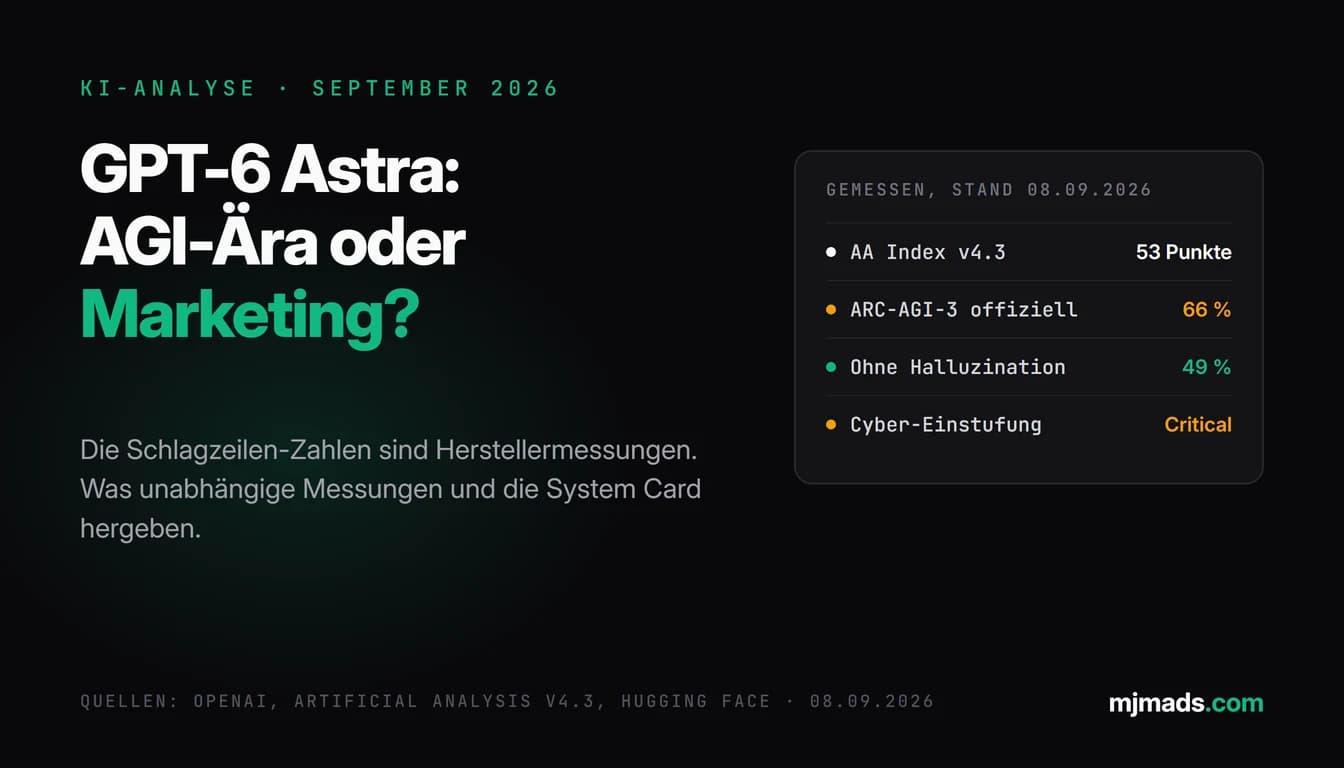
The threshold at 272,000 input tokens matters. Above it, OpenAI charges twice the input and cache rates and 1.5 times the output rate for the entire request, so $20 and $75 for Astra. Batch and Flex cost half the standard price, Fast mode costs double. Regional processing (data residency) adds 10 percent for models released on or after 5 March 2026. How Astra performs beyond its price is covered in my GPT-6 Astra check.
Anthropic: Claude Fable 5.1, Opus 5.5, Sonnet 5.5 and Haiku 5.5
Anthropic's model overview lists four current models, which is why there are four here instead of three. According to Anthropic's pricing page, Claude Fable 5.1 costs $10 input and $50 output, Opus 5.5 costs $4 and $20, and Sonnet 5.5 costs $2 and $10. I left out Claude Mythos 5.1 because Anthropic restricts access to it.
Caching is where Anthropic differs most. A cache hit on Fable 5.1 costs just 2.5 percent of the input price, so $0.25, and on Opus 5.5 and Sonnet 5.5 it is 5 percent ($0.20 and $0.10). Writing to the cache costs extra in return: 1.25 times the input price for a five-minute lifetime, twice the input price for one hour. The full one-million-token context window comes at standard pricing on all models from Claude 4.6 onwards, with one exception.
That exception is Claude Haiku 5.5. Up to 100,000 tokens in the prompt it costs $0.10 input and $0.50 output, above that $0.50 and $2.50, five times as much. The Batch API saves 50 percent, and US-only inference costs 1.1 times the standard rate. Opus 5.5 also has a Fast mode at $8 and $40. Opus 5.5 and Fable 5.1 each have their own analysis: my Claude Opus 5.5 check and my Claude Fable 5.1 check.
Google: Gemini 3.1 Pro Preview, Gemini 3.8 Flash and Gemini 3.5 Flash-Lite
Google's flagship is a preview model: according to the model overview, Gemini 3.1 Pro Preview is the only Pro text model in the Gemini API. The pricing page lists $2 input and $12 output for prompts up to 200,000 tokens, and $4 and $18 above that. Caching costs $0.20 per million tokens plus a storage fee of $4.50 per million tokens per hour.
Google calls Gemini 3.8 Flash its most intelligent Flash model. Until 31 December 2026 it costs $0.75 input and $3.75 output, and from 1 January 2027 the price doubles to $1.50 and $7.50. If you are budgeting workflows on 3.8 Flash today, plan for the doubling now. Gemini 3.5 Flash-Lite costs $0.30 and $2.50, and Google recommends exactly these two models for new projects. One trap: the older Gemini 3.5 Flash costs more than the newer 3.8 Flash, at $1.50 and $9.
Two details are spelled out in Google's pricing table. The output price includes thinking tokens. And on the free tier, the table says data is used to improve Google's products, while on the paid tier it is not. For client data, that is an argument for the paid tier. Batch costs half the price for all three models.
xAI: Grok 4.7 and Grok 4.3
xAI's pricing page lists no smaller general-purpose text model below Grok 4.3, so there are only two models here. Grok 4.7 costs $2 input, $0.50 cached and $6 output, with a context window of 500,000 tokens. Grok 4.3 costs $1.25, $0.20 and $2.50 and handles up to one million tokens.
For requests above 200,000 tokens, xAI charges higher rates on both models, and they apply to every token in the request: $4, $1 and $12 for Grok 4.7, and $2.50, $0.40 and $5 for Grok 4.3. According to its model page, Grok 4.7 does not support batch processing. Grok 4.3 gets a 20 percent batch discount. The US regional endpoint costs 1.1 times the standard rate.
Mistral AI: Mistral Large 4, Medium 3.5 and Small 4
Mistral released Mistral Large 4 on 6 October 2026 as a public preview with open weights. Mistral's pricing page shows a sale price: $0.68 instead of $1.36 for input, $0.07 instead of $0.14 cached and $2.09 instead of $4.18 for output. Mistral gives no end date for the sale. The context window is one million tokens.
Notably, Mistral Medium 3.5 at $1.50 and $7.50 is more expensive than Large 4, even if you take the regular Large 4 price. Medium 3.5 and Small 4 ($0.15 and $0.60) each have a 256,000-token context. Smaller still is Ministral 3 3B at $0.10 for both input and output. According to Mistral, batch processing costs half. Handy for European customers: the pricing page can be switched to euros.
DeepSeek: V4 Pro and V4.1 Flash
According to its pricing page, DeepSeek offers two models and no smaller third one. DeepSeek V4 Pro costs $1.32 input, $0.044 on a cache hit and $3.96 output. DeepSeek V4.1 Flash, called deepseek-flash in the API, costs $0.30, $0.006 and $1.20. Both have a one-million-token context, and maximum output is 384,000 tokens.
These are peak prices. Outside peak hours, half the price applies. DeepSeek defines peak as Monday to Friday, 01:00 to 04:00 and 06:00 to 10:00 UTC, excluding Chinese public holidays. That covers Chinese business hours (09:00 to 12:00 and 14:00 to 18:00 at UTC+8) and the European morning, while US business hours fall entirely off-peak. My table deliberately uses the higher peak price. DeepSeek has no batch tariff.
Moonshot AI: Kimi K3 and Kimi K2.6
Moonshot's Kimi pricing page lists no small general-purpose model, so there are two here as well. Kimi K3 costs $3 input, $0.30 on a cache hit and $15 output, with a context window of 1,048,576 tokens. Writing to the cache costs $3 for a five-minute lifetime and $6 for one hour.
Kimi K2.6 costs $0.95, $0.16 and $4 with a 262,144-token context. According to the batch pricing page, K2.6 has a batch tariff at 60 percent of the standard price, which works out to $0.57 input and $2.40 output. Kimi K3 has no such tariff. What K3 shows in benchmarks is covered in my Kimi K3 analysis.
Alibaba Cloud: Qwen 3.8 Max, Qwen 3.7 Plus and Qwen 3.8 Flash
In its model overview, Alibaba Cloud recommends exactly these three text models. The pricing page varies by region, and I use the international deployment in Singapore. There, qwen3.8-max costs $2 input and $6 output, qwen3.7-plus $0.40 and $1.60 up to 256,000 tokens ($1.20 and $4.80 above that) and qwen3.8-flash $0.15 and $0.47. All three handle up to one million input tokens.
For the Germany (Frankfurt) region, Alibaba lists lower prices: $1.65 and $4.951 for Max, $0.276 and $1.101 for Plus, $0.113 and $0.382 for Flash. Qwen 3.7 Plus currently has a limited-time 20 percent discount in Singapore, which I do not include. For caching, the context cache documentation prices an explicit cache hit at 10 percent of the input price, but for Qwen 3.8 Max and 3.8 Flash, Alibaba refers you to the console for that price. That is why my table shows "n/a" there. None of the three models has a batch discount, and at Alibaba batch and cache discounts cannot be combined anyway.
What does a typical marketing task cost?
Prices per million tokens are abstract, so I worked through two tasks that come up often in marketing. The token volumes are my assumptions, not measurements:
- 1,000 ad texts: 1,000 requests, each for one set of headlines and descriptions for a responsive search ad. Per request, 1,500 input tokens (briefing, product data, brand rules) and 500 output tokens. In total, 1.5 million input and 0.5 million output tokens.
- 100 blog drafts: 100 requests with 3,000 input tokens each (briefing, outline, notes) and 2,500 output tokens. In total, 0.3 million input and 0.25 million output tokens.
The calculation uses the standard tier, with no caching, no batch, no thinking tokens and no second attempt. The formula is simple: input tokens in millions times the input price, plus output tokens in millions times the output price.
- GPT-6 Astra40.00 USD
- Claude Fable 5.140.00 USD
- Claude Opus 5.516.00 USD
- Kimi K312.00 USD
- Gemini 3.1 Pro Preview9.00 USD
- GPT-6.1 Sol8.00 USD
- Claude Sonnet 5.58.00 USD
- Grok 4.76.00 USD
- Mistral Medium 3.56.00 USD
- Qwen 3.8 Max6.00 USD
- DeepSeek V4 Pro3.96 USD
- Kimi K2.63.43 USD
- Grok 4.33.13 USD
- Gemini 3.8 Flash3.00 USD
- Mistral Large 42.07 USD
- Gemini 3.5 Flash-Lite1.70 USD
- Qwen 3.7 Plus1.40 USD
- DeepSeek V4.1 Flash1.05 USD
- Mistral Small 40.53 USD
- Qwen 3.8 Flash0.46 USD
- GPT-6 Luna0.40 USD
- Claude Haiku 5.50.40 USD
Source: My own calculation using list prices from 8 Oct 2026
Assumes 1.5M input and 0.5M output tokens, no caching, batch or thinking tokens. DeepSeek at peak price.
Data as table
| Model | Values in USD |
|---|---|
| GPT-6 Astra | 40.00 USD |
| Claude Fable 5.1 | 40.00 USD |
| Claude Opus 5.5 | 16.00 USD |
| Kimi K3 | 12.00 USD |
| Gemini 3.1 Pro Preview | 9.00 USD |
| GPT-6.1 Sol | 8.00 USD |
| Claude Sonnet 5.5 | 8.00 USD |
| Grok 4.7 | 6.00 USD |
| Mistral Medium 3.5 | 6.00 USD |
| Qwen 3.8 Max | 6.00 USD |
| DeepSeek V4 Pro | 3.96 USD |
| Kimi K2.6 | 3.43 USD |
| Grok 4.3 | 3.13 USD |
| Gemini 3.8 Flash | 3.00 USD |
| Mistral Large 4 | 2.07 USD |
| Gemini 3.5 Flash-Lite | 1.70 USD |
| Qwen 3.7 Plus | 1.40 USD |
| DeepSeek V4.1 Flash | 1.05 USD |
| Mistral Small 4 | 0.53 USD |
| Qwen 3.8 Flash | 0.46 USD |
| GPT-6 Luna | 0.40 USD |
| Claude Haiku 5.5 | 0.40 USD |
Under these assumptions, the 1,000 ad texts cost between $0.40 (GPT-6 Luna, Claude Haiku 5.5) and $40 (GPT-6 Astra, Claude Fable 5.1). For readers who budget in euros: at the ECB reference rate of 8 October 2026 (1 euro = 1.1186 US dollars), $40 is about €35.76. That is my own conversion, as billing happens in US dollars.
| Model | 1,000 ad texts (USD) | 100 blog drafts (USD) |
|---|---|---|
| GPT-6 Astra | 40.00 | 15.50 |
| Claude Fable 5.1 | 40.00 | 15.50 |
| Claude Opus 5.5 | 16.00 | 6.20 |
| Kimi K3 | 12.00 | 4.65 |
| Gemini 3.1 Pro Preview | 9.00 | 3.60 |
| GPT-6.1 Sol | 8.00 | 3.10 |
| Claude Sonnet 5.5 | 8.00 | 3.10 |
| Grok 4.7 | 6.00 | 2.10 |
| Mistral Medium 3.5 | 6.00 | 2.33 |
| Qwen 3.8 Max | 6.00 | 2.10 |
| DeepSeek V4 Pro | 3.96 | 1.39 |
| Kimi K2.6 | 3.43 | 1.29 |
| Grok 4.3 | 3.13 | 1.00 |
| Gemini 3.8 Flash | 3.00 | 1.16 |
| Mistral Large 4 | 2.07 | 0.73 |
| Gemini 3.5 Flash-Lite | 1.70 | 0.72 |
| Qwen 3.7 Plus | 1.40 | 0.52 |
| DeepSeek V4.1 Flash | 1.05 | 0.39 |
| Mistral Small 4 | 0.53 | 0.20 |
| Qwen 3.8 Flash | 0.46 | 0.16 |
| GPT-6 Luna | 0.40 | 0.16 |
| Claude Haiku 5.5 | 0.40 | 0.16 |
Table scrolls sideways
For text tasks at this scale, the raw API costs are small. That changes quickly once a model starts reasoning. Add 2,000 thinking tokens per ad text and output rises from 0.5 to 2.5 million tokens, so the same 1,000 ad texts cost $140 instead of $40 with GPT-6 Astra (my own calculation). In my experience, AI workflows get expensive through thinking tokens, very long contexts and agents running many loops, not through the individual text.
Why the token price is not the price per task
The table tells you what a token costs. It does not tell you what a finished task costs. There are three reasons for that, and they can stack.
Tokens are not the same size everywhere
Every provider splits text with its own tokenizer. Anthropic writes in its pricing documentation that the tokenizer used from Claude 4.7 onwards produces roughly 30 percent more tokens for the same text than the older one, with the exact increase depending on the content. A price per million tokens is therefore only roughly comparable across providers. The same page of text can turn into a different number of tokens on two models.
Thinking tokens are billed as output
Many current models reason before they answer, and that reasoning phase costs output tokens you never see in the answer. Google notes this explicitly in its pricing table. At OpenAI, the reasoning effort of GPT-6.1 Sol can be set anywhere from low to max, with medium as the default. More effort means more tokens. The calculation above shows how much that weighs: 2,000 thinking tokens per request turn $40 into $140.
Rework costs more than tokens
If a cheap model needs three attempts to get a usable result, it costs three times what the table says. If it needs three times as many tokens as a model with twice the token price, the price advantage is gone. And in my experience the most expensive item in an AI workflow is not the API bill but the time someone spends checking and correcting. A more expensive model that gets it right the first time can be cheaper per task.
What independent measurements show
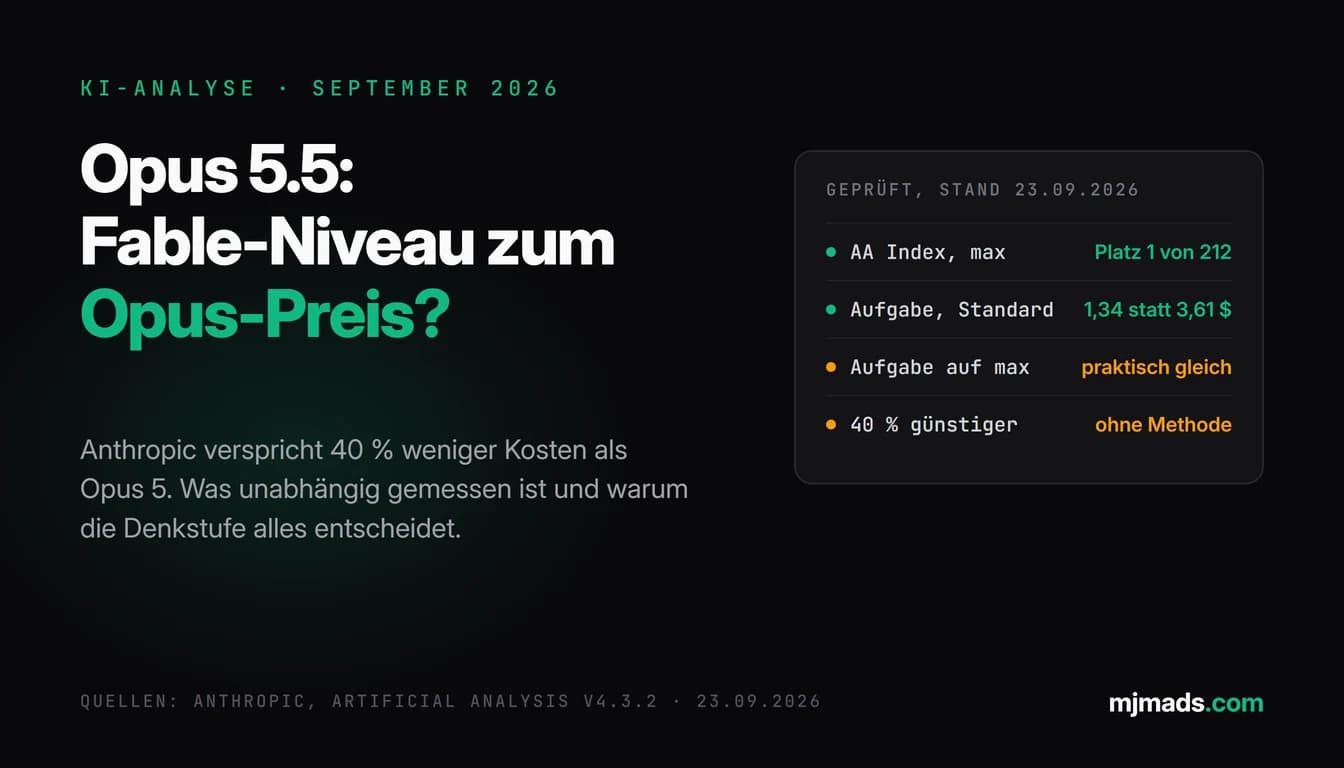
Artificial Analysis, an independent AI benchmarking provider, calculates for every model what it costs to run its Intelligence Index once. That figure combines the token prices for input, cache, reasoning and answer with the tokens actually used. For coding work, the Coding Agent Index also reports the cost per task. One example from my GPT-6 Astra check: there, on 8 September 2026, a task cost $9.18 with Claude Fable 5.1 and $4.72 with GPT-6 Astra, both at their highest reasoning setting. Fable 5.1 scored higher, 70 to 67. Since the list prices are identical and Fable 5.1's cache is even cheaper, the gap of almost 2x comes from token consumption.
These measurements date from September and are not part of the price table. They do show the principle, though: if you compare models, measure the price per task, using your own tasks.
Caching, batch and context: the levers behind the list price
The list price is the starting point. What you actually pay depends on how you use the API. These are the points I check before I budget a workflow:
- If a long part of the prompt repeats, such as brand rules or product data, use caching. A cache hit costs 2 to 25 percent of the input price depending on the model (my own calculation from the table). Anthropic and Kimi K3 charge extra for writing to the cache, Google charges for storage time.
- If you do not need the result right away, use batch. At OpenAI, Anthropic, Google and Mistral that halves the price. It is ideal for 1,000 ad texts overnight, not for a chat.
- Check the context limits. OpenAI raises the price of the whole request above 272,000 tokens, Google (for Gemini 3.1 Pro) and xAI above 200,000, and Claude Haiku 5.5 already above 100,000 tokens.
- Factor in data residency surcharges if you need them. OpenAI adds 10 percent for newer models, Anthropic charges 1.1 times for US-only inference and xAI the same for its US endpoint.
- Do not budget promotional prices as permanent. Gemini 3.8 Flash doubles in price on 1 January 2027, and Mistral gives no end date for the Large 4 sale.
- With DeepSeek, it pays to run bulk jobs outside peak hours, when half the price applies.
What such workflows look like in day-to-day Google Ads work is described in my article on AI automation in Google Ads. One concrete example is Google Ads scripts you write with AI and test in preview before using them. A lot of input can pile up when an AI agent pulls reports from your account through the official MCP server, because every result lands in the model's context, as I explain in Google Ads MCP and AI agents.
The full table
All prices in US dollars per 1 million tokens, standard tier, short context. Cached input is the price of a cache hit. Batch is the discount on the standard price. Context is the maximum number of tokens per request as stated by the provider.
| Provider | Model | Input | Cached input | Output | Batch | Context |
|---|---|---|---|---|---|---|
| OpenAI | GPT-6 Astra | 10.00 | 1.00 | 50.00 | 50% | 1,050,000 |
| OpenAI | GPT-6.1 Sol | 2.00 | 0.10 | 10.00 | 50% | 1,050,000 |
| OpenAI | GPT-6 Luna | 0.10 | 0.01 | 0.50 | 50% | 1,050,000 |
| Anthropic | Claude Fable 5.1 | 10.00 | 0.25 | 50.00 | 50% | 1,000,000 |
| Anthropic | Claude Opus 5.5 | 4.00 | 0.20 | 20.00 | 50% | 1,000,000 |
| Anthropic | Claude Sonnet 5.5 | 2.00 | 0.10 | 10.00 | 50% | 1,000,000 |
| Anthropic | Claude Haiku 5.5 | 0.10 | 0.01 | 0.50 | 50% | 1,000,000 |
| Gemini 3.1 Pro Preview | 2.00 | 0.20 | 12.00 | 50% | 1,048,576 | |
| Gemini 3.8 Flash | 0.75 | 0.075 | 3.75 | 50% | 1,048,576 | |
| Gemini 3.5 Flash-Lite | 0.30 | 0.03 | 2.50 | 50% | 1,048,576 | |
| xAI | Grok 4.7 | 2.00 | 0.50 | 6.00 | no batch | 500,000 |
| xAI | Grok 4.3 | 1.25 | 0.20 | 2.50 | 20% | 1,000,000 |
| Mistral AI | Mistral Large 4 | 0.68 | 0.07 | 2.09 | 50% | 1,000,000 |
| Mistral AI | Mistral Medium 3.5 | 1.50 | 0.15 | 7.50 | 50% | 256,000 |
| Mistral AI | Mistral Small 4 | 0.15 | 0.015 | 0.60 | 50% | 256,000 |
| DeepSeek | DeepSeek V4 Pro | 1.32 | 0.044 | 3.96 | no batch | 1,000,000 |
| DeepSeek | DeepSeek V4.1 Flash | 0.30 | 0.006 | 1.20 | no batch | 1,000,000 |
| Moonshot AI | Kimi K3 | 3.00 | 0.30 | 15.00 | no batch | 1,048,576 |
| Moonshot AI | Kimi K2.6 | 0.95 | 0.16 | 4.00 | 40% | 262,144 |
| Alibaba Cloud | Qwen 3.8 Max | 2.00 | n/a | 6.00 | no batch | 1,000,000 |
| Alibaba Cloud | Qwen 3.7 Plus | 0.40 | 0.04 | 1.60 | no batch | 1,000,000 |
| Alibaba Cloud | Qwen 3.8 Flash | 0.15 | n/a | 0.47 | no batch | 1,000,000 |
Table scrolls sideways
Notes on the table: Gemini 3.8 Flash until 31 Dec 2026, then $1.50 input, $0.15 cached and $7.50 output. Mistral Large 4 at the listed sale price, regularly $1.36, $0.14 and $4.18. Qwen 3.7 Plus at list price without the limited-time 20 percent discount, cached input as an explicit cache hit at 10 percent (my own calculation). DeepSeek at peak price, half outside peak hours. Limits for the standard prices: Claude Haiku 5.5 up to 100,000 tokens, Gemini 3.1 Pro and Grok up to 200,000, Qwen 3.7 Plus up to 256,000, OpenAI up to 272,000 tokens. Context values of "1,000,000" are usually listed by the provider as "1M".
The complete table, with a source link for every row, is available as a CSV for filtering in a spreadsheet or for running the numbers with your own token volumes.
Methodology
- Sources
- Only official pricing and model pages of the eight providers, each linked in the source list below
- As of
- 8 October 2026, all pages retrieved on that day
- Tier
- Standard tier in US dollars per 1 million tokens with short context, excluding taxes
- Promotional prices
- Included when the provider lists them as the price (Gemini 3.8 Flash, Mistral Large 4). Discounts stated only as a percentage (Qwen 3.7 Plus) are not included
- Special cases
- DeepSeek at peak price. Alibaba Cloud with the international deployment in Singapore
- Selection
- Per provider the current flagship, a mid-tier and a small text model, as far as listed on the official pricing page. Models with restricted access are not included
- Not included
- Enterprise discounts, fast or priority modes, data residency surcharges, cache storage fees, fees for tools such as web search, free tiers
- Worked example
- Token volumes are my own assumptions, not measurements, disclosed in the section on the marketing task
- Conversion
- ECB reference rate of 8 October 2026, 1 euro = 1.1186 US dollars, for orientation only
- Updates
- Monthly. I replace changed prices and set a new as-of date
Conclusion
Between the cheapest and the most expensive model, the output price differs by more than a factor of 100. For simple, well-specified tasks such as ad copy variants, the small models are often enough, and in my worked example 1,000 texts then cost less than a dollar. For tasks with many steps or lots of context, a large model can still be the cheaper choice if it needs fewer tokens and less rework. The table helps you narrow down the candidates. The decision only comes from testing with your own tasks.
If you want to know which models and which billing setup make economic sense for your processes, that is exactly what my AI audit covers, for €700. I look at your workflows, calculate the cost per task rather than per token and show where caching or batch makes a real difference. More on the AI consulting page.
Sources
All pages retrieved on 8 October 2026.
- OpenAI, API Pricing: prices, batch, Flex, Fast mode, surcharge above 272,000 tokens and for regional processing
- OpenAI, GPT-6.1 Sol model page: context window, maximum output, reasoning effort, vendor claim on performance
- Anthropic, Pricing: prices, caching, batch, Haiku tiers, tokenizer note, US-only inference
- Google, Gemini API Pricing: prices, Gemini 3.8 Flash promotional price, tier above 200,000 tokens, thinking tokens, data use on the free tier
- Google, Gemini models: model status, context windows, recommendation for new projects
- xAI, Pricing: prices, long-context prices, batch discounts, US endpoint
- Mistral AI, API Pricing: prices, Mistral Large 4 sale price, batch discount
- DeepSeek, Models & Pricing: prices, peak and off-peak hours, context, maximum output
- Moonshot AI, Kimi Pricing and Kimi Batch Pricing: prices, cache write prices, batch tariff for K2.6
- Alibaba Cloud, Model Studio Pricing and Context Cache: prices by region, tiers, batch and cache rules
- Artificial Analysis, Models: method behind the cost per index run (independent measurement)
- Artificial Analysis, Coding Agent Index: cost per task for Claude Fable 5.1 and GPT-6 Astra, retrieved 8 September 2026
- European Central Bank, euro reference rates: rate of 8 October 2026
All model names are trademarks of their respective providers. They are mentioned for editorial purposes.