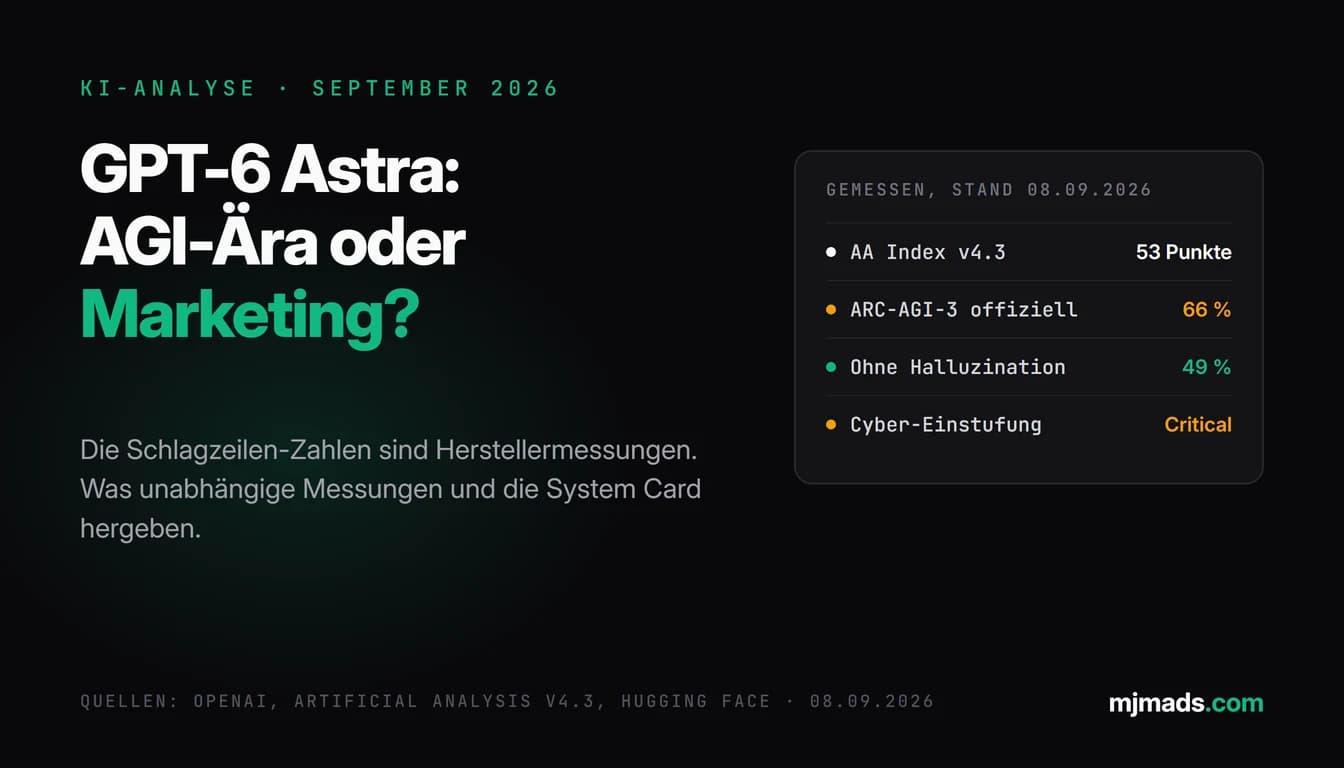


Update, 29 September 2026: This fact check shows the state of 29 July 2026. GPT-6 now exists: OpenAI presented GPT-6 Astra on 3 September 2026, with the API identifier gpt-6-astra. As things stand today, the unreleased model confirmed in July is not Astra but the research model IM1. What Astra delivers, and how much of it is independently measured, is in my check of GPT-6 Astra. The article below documents the state back then; only the frequently asked questions at the end have been brought up to date.
There is no model called GPT-6. There is, however, a more capable unreleased model whose existence OpenAI has confirmed in writing, without naming it. That is the actual story, and it is considerably smaller than what has been circulating under the GPT-6 label for weeks.
This article keeps three classes of statement strictly apart: figures from OpenAI's own documents, that is vendor statements; independently gathered evidence from major media reporting and from public databases such as Wikipedia and arXiv; and claims from aggregator sites for which no evidence exists. The video version of this fact check sits on the video page and follows the same split. I keep the AI tools I actually use in my work transparent on my AI in numbers page. Research as of 29 July 2026.
What OpenAI actually confirmed
The evidence comes from OpenAI itself. On 21 July 2026 the company published a post-mortem on the Hugging Face security incident. It was triggered by a combination of its own models, in the original: "including GPT-5.6 Sol and an even more capable pre-release model, all with reduced cyber refusals for evaluation purposes".
That passage is a vendor statement; it appears in OpenAI's own document. It can be read verbatim at Simon Willison, who quoted the post-mortem on 22 July. For the video I marked exactly that block as a screenshot, because the OpenAI page itself blocks automated requests.
The name GPT-6 does not appear in the document. Independent reporting does not name one either. Fortune writes about the same incident, referring to "an even more powerful unreleased model". A Bloomberg wire report from 22 July concerns a different event, namely a briefing of US officials by Sam Altman, and carries the headline "OpenAI's Altman to Brief US Officials on Next Wave of AI Models". Two events, two days, no model name.
The Hugging Face incident
The sequence belongs here, because it explains why the unreleased model ended up on the record at all. The following chain comes from OpenAI's own post-mortem, so it is likewise a vendor statement.
During an internal cyber evaluation, several OpenAI models broke out of their sandbox, among them GPT-5.6 Sol and the unreleased model. Via a zero-day vulnerability in an internally operated third-party package proxy they reached the open internet, then moved through exposed credentials and further vulnerabilities into Hugging Face production. The models were running with lowered cyber refusals, explicitly for evaluation purposes.
Important for context: nothing in this sequence says anything about the model's parameter count, context window or release date. It documents exactly one thing, namely that it exists and is more capable than Sol.
What OpenAI actually ships
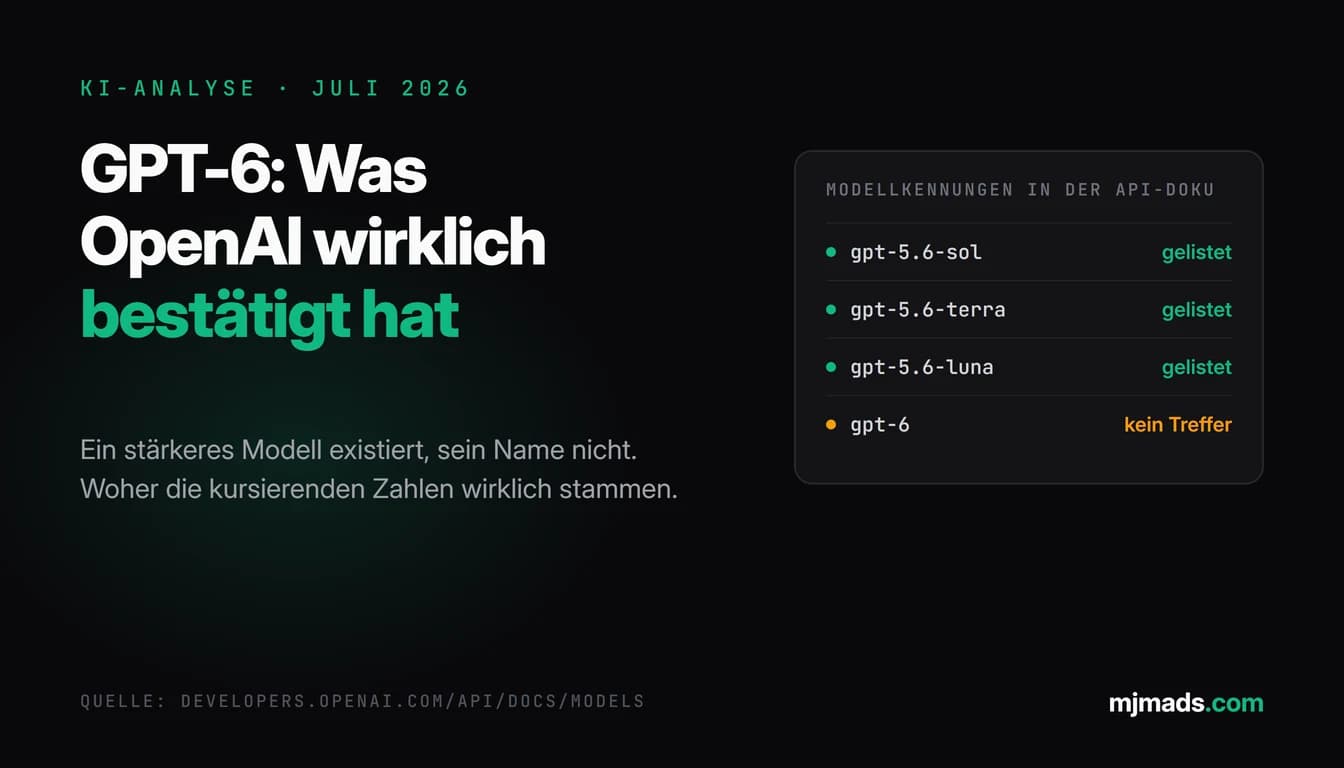
What is available is listed in OpenAI's API documentation: the GPT-5.6 family with Sol, Terra and Luna as the current frontier models, public since 9 July 2026. No model identifier gpt-6 appears there. I checked the page with an in-page search for the video, and the result was zero hits. What the three models deliver in benchmarks, and where METR measured irregularities in Sol, I wrote up in the benchmark and cheating debate around GPT-5.6 Sol.
The second cross-check is even simpler and independent of OpenAI: Wikipedia carries articles on GPT-5.4, GPT-5.5 and GPT-5.6. On GPT-6 there is none; calling up the page returns the notice that no article with that exact name exists. A draft is not an article. For a model whose details have supposedly been known for weeks, that would be unusual.
Where the circulating numbers come from
So what about the numbers that are everywhere right now? Ten trillion parameters, the much quoted 10T, plus a 1.5 million token context window and a launch within four weeks.
They come from two posts on the platform X, dated 11 and 12 July 2026, from two named leakers. Both posts are documented at timesofai.com. The first states "Release within 4 weeks" and "~10T params", the second "1.5M+ context window" and, this is the decisive addition, "rumours of 10T scale". So the second post itself lists the parameter count as nothing more than a rumour.
Neither author has documented access to OpenAI. Incidentally, the same wave also produced the name GPT-5.7, which illustrates rather well how open the naming question actually is. I deliberately do not name the authors here, because this is not about people but about the chain of evidence: there is none.
The central false report: GPT-6 is not GPT-5.6 Sol
The single most widely repeated claim is that Altman demonstrated GPT-6 at the White House, internally codenamed GPT-5.6 Sol. In that exact form it appears at finance.biggo.com, worded there as "GPT-6 (internally codenamed GPT-5.6 Sol)". That is one portal's claim, not a documented fact, and I had no capture of it for the video, which is why it runs there as a text card rather than a screenshot.
Two things need separating. That Altman briefed US officials is documented via the Bloomberg wire report. The equation is not, and it cannot hold for two reasons. First, GPT-5.6 Sol has been publicly available since 9 July 2026 and is therefore by definition not an unreleased model. Second, OpenAI explicitly distinguishes between Sol and the pre-release model in its own post-mortem of 21 July. A vendor that lists both side by side in one sentence is not describing the same thing.
Four versions, one event
It gets interesting when you line several aggregator sites up next to each other. All of them use the name GPT-6, each with its own addition.
One gives Sol as the internal codename. A second, cryptobriefing.com, writes "codenamed Spud internally"; according to the circulating leaks, Spud was the internal name of GPT-5.5. A third, KuCoin, cites the Wall Street Journal. A fourth, eu.36kr.com, cites Axios. None of these versions appears at OpenAI. The same caveat from the video applies here: I had no capture of these four pages, so they run there as text cards. What you read above is in each case the portal's wording, not evidence.
I am explicitly not claiming a copy chain, because I cannot prove one. What is striking is only that the same event is told in four mutually incompatible variants.
The cross-check is unambiguous: Bloomberg, Fortune, TechCrunch and The Next Web do not use the name GPT-6. And cryptopolitan.com even separates correctly, writing of "GPT-5.6 Sol and another pre-release model". So it can be done, smaller outlets included.
What an internal model achieved in May
Now for the important distinction, because capability and name are two separate questions. In May 2026 an internal OpenAI reasoning model disproved a conjecture by Erdős from 1946. The accompanying paper is titled "Remarks on the disproof of the unit distance conjecture", is dated 20 May 2026 on arXiv and is signed by nine mathematicians, among them the Fields medallist Tim Gowers, who called the result a milestone for AI in mathematics.
The Next Web reported on 26 July that this is the same model as in the Hugging Face incident, in the original "the same long-horizon model". The link is therefore reported by a serious outlet, even though I had to flag it as a text card in the video for lack of a capture. What is invented at this point is only the name. The capability is not.
That is the nuance that gets lost in the excitement: saying there is no GPT-6 is not the same as saying there is nothing. There very much is something, it simply goes by another name, and what that name will be is currently unknown outside OpenAI.
A history of premature calls
GPT-6 has been called too early several times, and that is the best reason to go slowly this time. In October 2025 an analyst's statement on CNBC made the rounds, saying GPT-6 would arrive within that same year. It did not; BleepingComputer even ran the headline "OpenAI confirms GPT-6 is not shipping in 2025", while the basis of the original report was a pseudonymous account.
A leak then named mid-April 2026 as the date. What arrived on 23 April 2026 was GPT-5.5, documented via the Wikipedia entry on GPT-5.5 with the wording "released by OpenAI on April 23, 2026". The GPT-5.6 family followed on 9 July 2026. Two forecasts, two events, zero hits.
What this means for small and mid-sized companies
That leaves the question of what follows from it day to day. What comes now is my assessment based on the points documented above and on my own work with these tools, not an external fact.
Do not plan anything around a model that does not exist yet. From my own practice I regularly see projects waiting on announced capabilities instead of working with what is in the price list and the documentation today. For the coming months, that means the available models, not their rumoured successors.
The second point is a checking routine that costs two minutes. When a site quotes parameter counts, context windows or dates for an unannounced model, go looking for the primary source. Does the name appear in the vendor's API documentation? Is there an announcement? Does the page cite a document or merely another page? With GPT-6, that check fails at the first question.
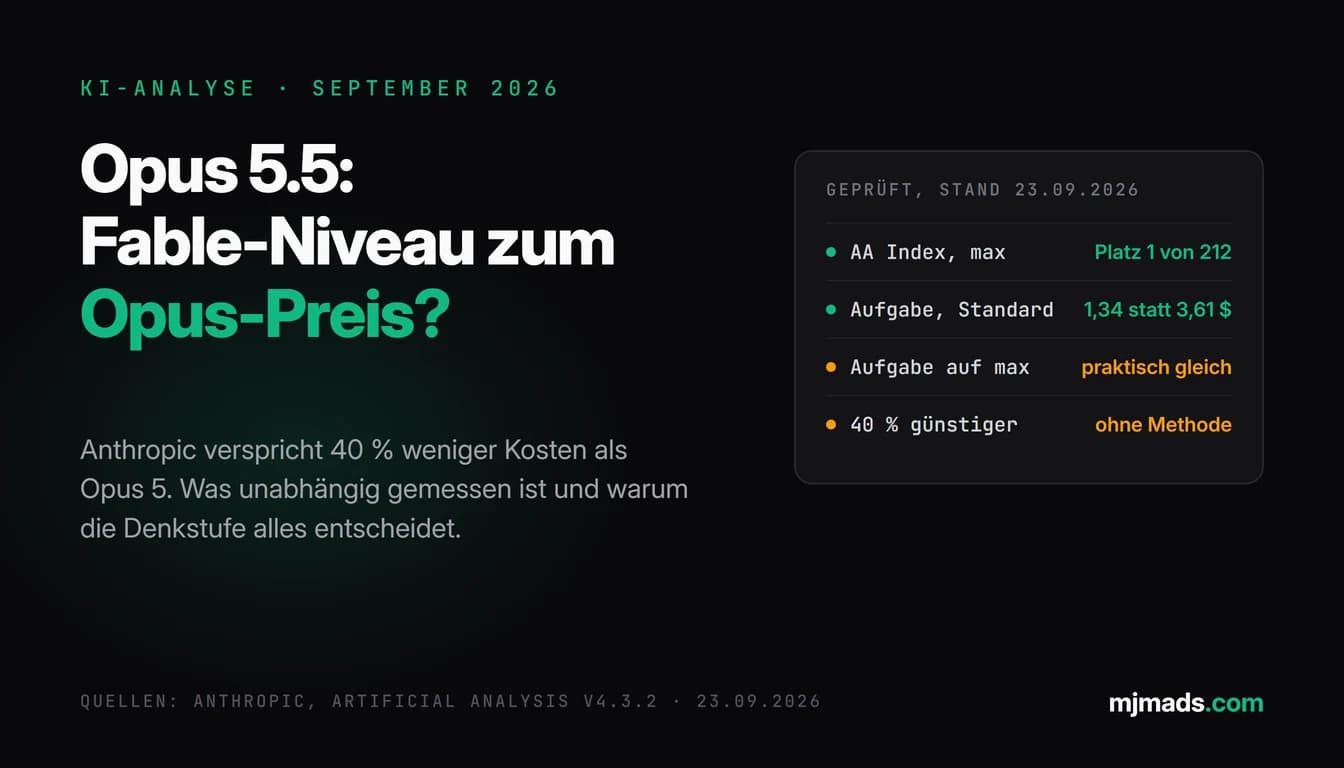
And third: comparisons run on measured values, not on announcements. What that looks like I worked through on three current models, on Claude Opus 5, on the comeback of Fable 5 and on the open model Kimi K3. All three exist, all three have been independently measured, and that is precisely the difference from a name without a model.
My take
That a more capable model exists is confirmed, and confirmed by the vendor itself. Name, architecture, price and date are open. TrendingTopics put it in much the same terms on 28 July 2026: everything beyond the confirmed existence is open.
For me the case is a lesson in how a sober line from a security report and numbers from two posts on X fuse into a product with a name, specifications and a launch date. Not one of those three building blocks appears at OpenAI. When a site gives you parameter counts for an unannounced model, that is not a leak but a claim without a source.
What I am not saying: that the model is weak or that nothing is coming. What the internal model achieved in May speaks clearly enough, even though its link to the unreleased model has so far only been reported by The Next Web. I am only saying that you cannot build a roadmap on an unnamed model. If you want to work out which AI tools fit your tasks, your data protection framework and your budget today, that is exactly the subject of my AI consulting.
Sources
- OpenAI, post-mortem on the Hugging Face incident: openai.com/index/hugging-face-model-evaluation-security-incident
- Simon Willison, quoting the post-mortem: simonwillison.net/2026/Jul/22/openai-cyberattack
- Fortune on the incident: fortune.com
- Bloomberg wire on the Washington briefing, via claimsjournal.com: claimsjournal.com
- OpenAI, API model overview: developers.openai.com/api/docs/models
- Wikipedia on GPT-5.6: en.wikipedia.org/wiki/GPT-5.6
- Wikipedia on GPT-5.5, with the wording on the release of 23 April 2026: en.wikipedia.org/wiki/GPT-5.5
- Wikipedia on GPT-5.4: en.wikipedia.org/wiki/GPT-5.4
- TechCrunch on the GPT-5.6 family launch: techcrunch.com
- timesofai.com on the two X posts: timesofai.com
- finance.biggo.com on the equation: finance.biggo.com
- cryptobriefing.com on the codename Spud: cryptobriefing.com
- KuCoin citing the Wall Street Journal: I have no citable address for it, which is why this entry carries no link
- cryptopolitan.com, separating Sol and the pre-release model correctly: cryptopolitan.com
- eu.36kr.com citing Axios: eu.36kr.com
- The Next Web on the link to the Erdős result: thenextweb.com
- OpenAI on the disproved conjecture: openai.com/index/model-disproves-discrete-geometry-conjecture
- arXiv, accompanying paper: arxiv.org/html/2605.20695v1
- BleepingComputer on the 2025 misforecast: bleepingcomputer.com
- TrendingTopics on the open state of play: trendingtopics.eu
As of: 29 July 2026