


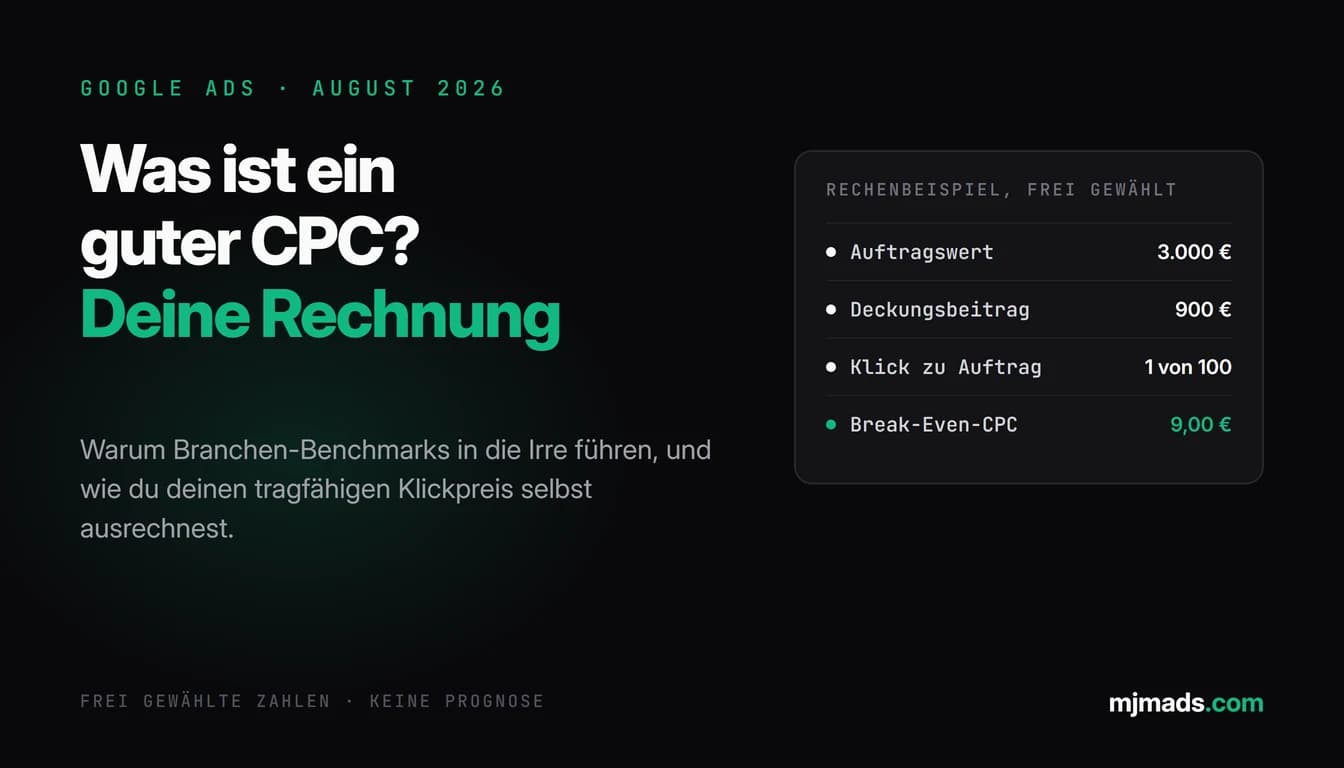
"So what is a good CPC?" That question comes up in almost every first call, usually within the first ten minutes, and almost always a number is expected. Two euros? Five? My honest answer is an uncomfortable one: that number does not exist, at least not as a universal value. What does exist is a calculation you can run yourself in ten minutes. After that you know your good click price. Not your industry's, yours.
Some framing first: this is a practitioner's view from live accounts of small and medium-sized businesses. I deliberately do not put an industry table with fixed click prices next to it, because tables like that feed exactly the misunderstanding this article is meant to clear up. Where I am estimating, I say so.
Why industry benchmarks mislead
Picture two accounts. Both pay €4 per click.
The first belongs to a plumbing business selling bathroom renovations. A single job runs into four figures, and even if only one in a hundred enquiries closes, that one job carries an entire monthly budget. Four euros per click is cheap for this account.
The second belongs to an online shop with an average basket of €25 and a thin retail margin. For €4 per click to work out, roughly every second visitor would have to order. That does not happen in any shop I know. Four euros per click is a losing deal for this account.
Same figure, opposite meaning. That is exactly why the question "what are others in my industry paying?" helps you so little. There is a second problem on top: what appears as an industry value in such compilations averages across countries, device types, keyword match types, campaign types and time periods. From my market observation, click prices between the cheapest and the most expensive search term differ by a multiple even inside a single account. A single average cannot capture that.
What benchmarks are still good for: a rough sanity check before you start. If your calculation says you can pay at most 40 cents per click, and the Keyword Planner shows bid ranges in euros for your terms, then you know before spending a single euro that search campaigns in this form will be difficult for you. That is a sensible use. A target value it is not.
The calculation that sets your click price
A click price is not a price, it is an investment with an expected return. So you calculate backwards, from the money that ends up staying with you back to the individual click.
You need four numbers, and you already have all four in house:
- Your average order or basket value.
- Your contribution margin on it, meaning what is left after cost of goods, materials and direct costs.
- The conversion rate of your website, meaning how many out of 100 visitors enquire or order.
- Your closing rate, meaning how many enquiries actually turn into orders. In a shop this step drops out, there the order is already the close.
That forms a single chain: 100 clicks produce a certain number of enquiries, those produce a certain number of orders, those produce a certain contribution margin. That contribution margin divided by 100 is the value of one single click. That is where your break-even sits.
A worked example with freely chosen numbers
Important upfront: the values below are freely chosen to show the calculation. They are not a forecast, not an industry value and not a promise. The benefit only appears once you put your own numbers in.
The trades business from above, doing bathroom renovations:
| Figure | Value in the example |
|---|---|
| Average order value | €3,000 |
| Contribution margin on it | 30%, i.e. €900 |
| Website conversion rate (click to enquiry) | 4% |
| Closing rate (enquiry to order) | 25% |
| Enquiries from 100 clicks | 4 |
| Orders from 100 clicks | 1 |
| Contribution margin from 100 clicks | €900 |
| Break-even click price | €9.00 |
At €9 per click this business pays exactly what it earns. That is not a target, that is the pain threshold. If the advertising is supposed to produce profit, you need room below it: at a target click price of €4.50, half the contribution margin stays in the company and you have air for weaker months.
Now the same calculation for the online shop: €25 basket, 40 percent contribution margin, so €10 per order, conversion rate 2 percent. From 100 clicks you get 2 orders and €20 in contribution margin. Break-even sits at 20 cents per click. The same €4 click that is a good deal for the trades business costs twenty times what it can bring in here.
That is the entire answer to the question in the title. A good CPC is a click price noticeably below your break-even. Everything else is opinion. If you would rather not run the numbers by hand, the click price calculator does it for you, and the full cost picture around click prices is in the article what Google Ads really costs.
What actually drives your click price
You determine the maximum click price you can carry. The auction determines the actual CPC, and five factors play the leading roles there.
Competition. The more advertisers bid on the same term, the more expensive it gets. How much pressure sits on your terms is not something you feel, it is something you read in the auction insights of your account. This is the one of the five you cannot change.
Ad quality. Alongside your bid, the auction weighs the expected quality and relevance of ad and landing page. According to Google, higher quality ads can often lead to lower CPCs. The Quality Score in your account is not itself an input in the auction. It is Google's diagnostic tool and shows you how your ad quality compares to other advertisers. From my practice, ad quality is the lever with the best ratio of effort to effect, because it works on the price and on Ad Rank at the same time. How strongly that moves in your account is something only your account can show.
Keyword match types. How broadly your keyword match types are set co-determines which auctions you end up in at all. Broad match keywords put you into many foreign auctions, some with a completely different price structure. The average CPC in the report then says little, because it averages across two worlds.
Location and device. Between a metro area and the surrounding region there are, in my experience, clear differences, and the same goes for mobile versus desktop. If your click price looks inexplicably high, it is worth looking at the split by region and device before you touch the bid.
Season and timing. In phases where everyone advertises at once, the price rises. That is not an account error, it is normal demand. What matters is that you do not mistake an expensive phase for a structural problem.
Of these five you can directly improve two, ad quality and match types. Two you can steer, location and device plus timing. One you can only price in, competition.
When a high click price is good
The most expensive search terms in an account are often the most profitable ones. That sounds contradictory but it is logical: terms become expensive where many providers make money, and that is close to the purchase. "Emergency drain cleaning" costs more than "drain blocked what to do", because behind the first one there is a job and behind the second one there is a how-to article.
If your break-even is €9 and a purchase-ready term costs you €6, that is a good deal, even though €6 looks like a lot on paper. In a case like that I would not lower the bid, I would check whether I can get more of exactly this traffic.
When a low click price is bad
The reverse case is more common than people think. An account reports a very low average CPC, and a look at the search terms report shows why: the clicks come from general knowledge questions, from searches for instructions, from price comparisons without buying intent, or from terms that merely sound similar. This traffic is only cheap per click. Per enquiry it is the most expensive in the whole account.
That is why I do not steer accounts by CPC but by three other figures:
- Cost per enquiry. The CPA connects click price and conversion rate. A CPC of €6 at a 5 percent conversion rate beats a CPC of €1 at 0.5 percent.
- Value per click. Revenue or contribution margin divided by clicks. You compare that figure directly with your actual click price, and the question is answered immediately.
- Share of enquiries that become orders. Two campaigns with the same CPA can differ sharply here. Without that feedback loop from sales or the CRM you optimise for enquiries instead of revenue.
What does not appear in that list is the click price as a goal in its own right. It is an intermediate figure, not a measure of success.
What you can do this week
Three steps you do not need anyone else for:
- Gather the four numbers. Order value, contribution margin, website conversion rate, closing rate. Rough values are enough to start with, they get more precise with every month.
- Work out break-even and target. Break-even is the pain threshold, the target sits below it. How far below is your decision, based on how much safety margin you need.
- Hold both against your account. Open the search terms report and sort by cost. Which terms sit above your target without delivering? That is your task list for next week.
If this calculation shows that the click price you can carry is very low, that is no reason to give up. It is a pointer to where the lever sits: usually with the conversion rate of the landing page or with the order value, rarely with the bid.
My conclusion
There is no good CPC, there is only yours. The question "what are others paying?" is convenient but leads to wrong decisions regularly, because it ignores margin, order value and conversion rate, which are exactly the figures that make a click price assessable in the first place. The calculation, by contrast, costs you ten minutes and applies to your business.
If you would rather not run this alongside everything else: that is what ongoing Google Ads management is for, from €1,000 per month. From working in many accounts I know the range of click prices, which helps with putting numbers in context. The figures that count still come out of your business, not out of a table.
Status: August 2026


