"Is Google Ads worth it for my business?" Thousands of business owners and marketing managers ask themselves this question every day. The answer isn't one-size-fits-all but depends on various factors. In this guide, I'll show you how to determine with simple calculations whether Google Ads will be profitable for your business.
The Basic Formula: How to Calculate Your Google Ads ROI
Understanding the ROI Formula
ROI (Return on Investment) shows you how profitable your Google Ads investment is:
ROI = (Profit - Investment) / Investment × 100
Simply put:
ROI = (Revenue from Google Ads × Profit Margin - Google Ads Costs) / Google Ads Costs × 100
Practical Example
Your Online Shop:
- Google Ads budget: €3,000 ($3,600)/month
- Generated revenue: €15,000 ($18,000)/month
- Your profit margin: 30%
- Profit: €15,000 × 0.30 = €4,500 ($5,400)
ROI Calculation:
ROI = (€4,500 - €3,000) / €3,000 × 100 = 50%
Result: For every euro invested, you get €1.50 back. That's profitable!
The Google Ads ROI Calculator: Step by Step
Step 1: Determine Your Key Metrics
Before starting Google Ads, you need these numbers:
1. Average Order Value / Deal Value
How to determine?
- E-Commerce: Total revenue ÷ Number of orders
- Service provider: Average deal value
- B2B: Average deal value
Examples:
- Online sports apparel shop: €85 ($102)
- Plumber: €2,500 ($3,000)
- B2B SaaS: €5,000 ($6,000) (annual value)
2. Your Profit Margin
How to calculate?
Profit Margin = (Sales Price - Costs) / Sales Price × 100
Typical margins by industry (rough guide from my practice):
- E-Commerce: 20-40%
- Services: 40-60%
- SaaS: 70-90%
- Trades: 30-50%
- Consulting: 60-80%
3. Conversion Rate (Your Website Performance)
Conversion Rate = Percentage of website visitors who become customers
Typical conversion rates (rough guide from my practice, your own data comes first):
- E-Commerce: 1-3%
- B2B Lead Generation: 2-5%
- Local service providers: 3-10%
- High-ticket services: 5-15%
Important: Without website tracking, you can't determine your conversion rate. Google Ads conversion tracking via the Google tag is enough for that. According to Google, Google Analytics 4 is an optional data source that pays off if you already use it.
4. Expected Cost-per-Click (CPC) in Your Industry
Cost-per-click varies greatly by industry (rough orientation from my practice, check your keywords in Keyword Planner):
Cheap industries (CPC €0.50-2 or $0.60-2.50):
- Fashion & apparel
- Lifestyle products
- Content websites
Medium industries (CPC €2-5 or $2.50-6):
- E-Commerce (general)
- Local services
- Trades
Expensive industries (CPC €5-20 or $6-24):
- Insurance
- Real estate
- Legal consulting and specialist lawyers
- B2B software
Very expensive industries (CPC €20-50+ or $24-60+):
- Financial services
- Medical treatments
Step 2: Calculate Break-Even Point
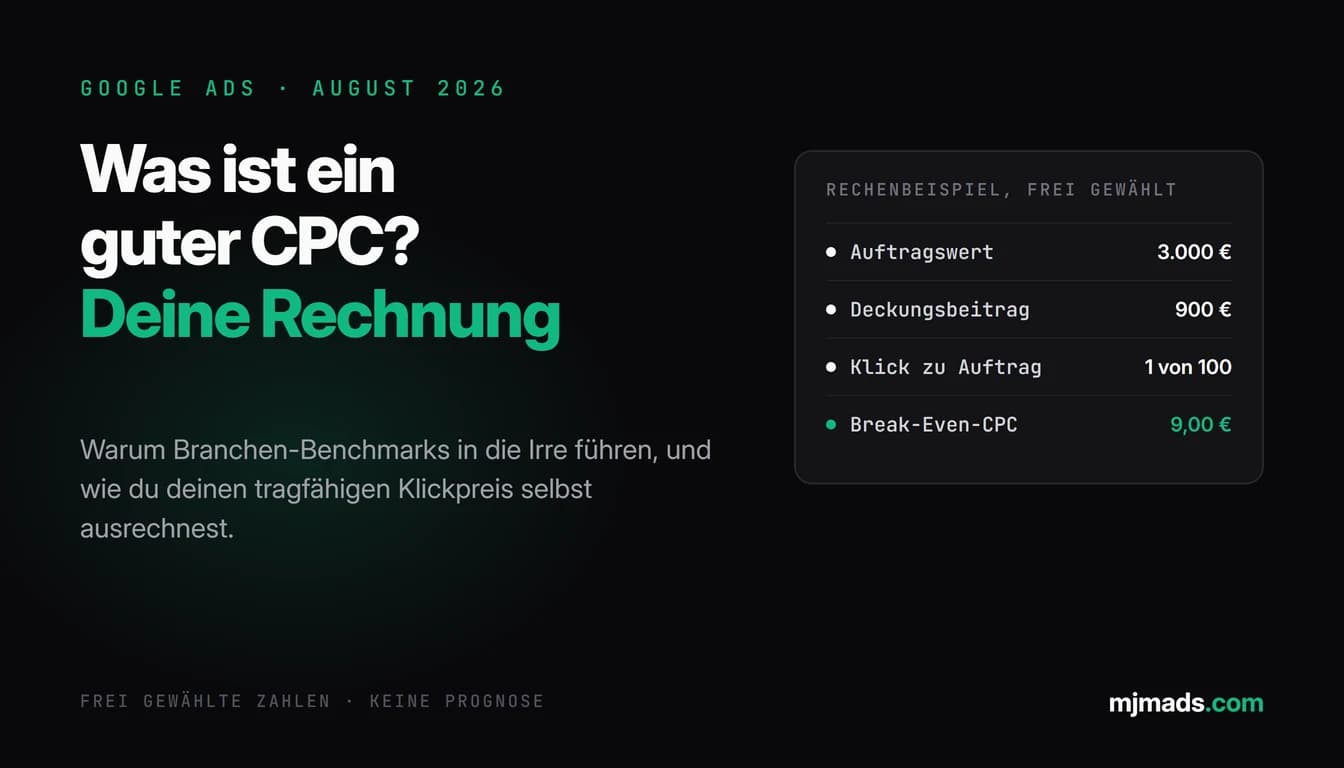
The Break-Even Point shows you when Google Ads becomes profitable.
Formula: Cost-per-Acquisition (CPA) Target
Your maximum CPA (what you can pay for a customer):
Maximum CPA = Average Order Value × Profit Margin
Online shop example:
- Order value: €100 ($120)
- Profit margin: 30%
- Maximum CPA: €100 × 0.30 = €30 ($36)
Meaning: You can spend up to €30 ($36) to acquire a customer without making a loss.
Calculate Required Conversion Rate
If you know your expected cost-per-click (CPC), calculate the needed conversion rate:
Required CR = (CPC / Maximum CPA) × 100
Example:
- Your CPC: €2 ($2.40)
- Your max. CPA: €30 ($36)
- Required CR: (€2 / €30) × 100 = 6.67%
But: 6.67% is very high for an online shop. In my experience many shops sit well below that, so check your own conversion rate in Analytics.
Realistic CPA at Your Current Conversion Rate
Expected CPA = CPC / Conversion Rate
With 2% conversion rate:
- CPC: €2 ($2.40)
- Expected CPA: €2 / 0.02 = €100 ($120)
Problem: Your maximum CPA was only €30 ($36), but the realistic one is €100 ($120). Google Ads would be not profitable.
Step 3: Create ROI Forecast
Now we combine everything for a realistic forecast:
Example: E-Commerce Online Shop
Your numbers:
- Monthly budget: €3,000 ($3,600)
- Average CPC: €1.50 ($1.80)
- Expected conversion rate: 2%
- Average order value: €85 ($102)
- Profit margin: 30%
Calculations:
- Expected clicks: €3,000 / €1.50 = 2,000 clicks
- Expected conversions: 2,000 × 0.02 = 40 orders
- Generated revenue: 40 × €85 = €3,400 ($4,080)
- Profit: €3,400 × 0.30 = €1,020 ($1,224)
- Costs: €3,000 ($3,600)
- Net result: €1,020 - €3,000 = -€1,980 loss (-$2,376)
ROI: (€1,020 - €3,000) / €3,000 × 100 = -66% ROI
Result: With these numbers, Google Ads would be not profitable.
What Would Need to Change?
Each calculated as the only lever, with all other values unchanged:
Option 1: Improve conversion rate
- Required CR for break-even: 5.9%
- Actions: Landing page optimization, better UX, stronger CTAs
Option 2: Higher order value
- Required order value: €250 ($300) instead of €85 ($102)
- Actions: Upselling, cross-selling, bundle offers
Option 3: Better profit margin
- Required margin: around 88% instead of 30%, hardly achievable through margin alone
- Actions: Better purchasing terms, premium positioning
Option 4: Lower CPC
- Required CPC: €0.51 ($0.61) instead of €1.50 ($1.80)
- Actions: Better Quality Score, long-tail keywords
When Is Google Ads Worth It? The 5 Decision Factors
1. Your Customer Lifetime Value (CLV)
The most important metric: How much is a customer worth over their entire "lifetime"?
Calculate CLV
CLV = Average Order Value × Purchase Frequency × Customer Lifespan
E-Commerce example:
- Order value: €80 ($96)
- Purchases per year: 3
- Average customer relationship: 2 years
- CLV: €80 × 3 × 2 = €480 ($576)
Meaning for Google Ads:
If your CLV is €480 ($576), you can spend much more on customer acquisition!
Maximum CPA with CLV:
Max. CPA = CLV × Profit Margin
- CLV: €480 ($576)
- Margin: 30%
- Max. CPA: €480 × 0.30 = €144 ($173)
Game-changer: Instead of only €24 ($29) (€80 × 0.30 for a one-time purchase), you can now pay up to €144 ($173) for a customer!
Industries with High CLV Benefit Most
Highly suitable:
- Subscription models (SaaS, fitness, streaming)
- Consumables (coffee, supplements, cosmetics)
- Insurance
- B2B services
Less suitable:
- One-time low-ticket products
- Extremely price-sensitive markets
- Commodities without differentiation
2. Your Margins
Rules of thumb by industry:
High margins (50%+) = Google Ads usually profitable
- SaaS
- Digital products
- Consulting
- High-price services
Why: You have lots of room for customer acquisition costs.
Medium margins (30-50%) = Careful optimization needed
- Trades
- Premium e-commerce
- Specialized services
Why: Works, but you need good campaign performance.
Low margins (under 20%) = Difficult
- Discount e-commerce
- Commodities
- Price-war industries
Why: Little room for expensive clicks. Google Ads often unprofitable, except with very high conversion rates.
3. Your Average Deal Value
The higher the deal value, the more profitable Google Ads
Low-Ticket (under €50 or $60)
- CPA must be very low (under €10 or $12)
- Difficult with competitive keywords
- Often only works with high conversion rates (5%+)
Strategy: Bundle products, increase average order value
Mid-Ticket (€50-500 or $60-600)
- Sweet spot for e-commerce
- Healthy balance between volume and value
- CPAs of €20-100 ($24-120) often achievable
Strategy: Standard Google Ads campaigns work well
High-Ticket (over €500 or $600)
- Often quite profitable, because a high basket value can absorb higher acquisition costs
- Higher CPAs possible (€100-500+ or $120-600+)
- Longer customer journey (multiple touchpoints)
Strategy: Remarketing essential, focus on lead quality
4. Your Competitive Situation
CPC increases with competition (ranges as rough orientation from my practice)
Low competition
- CPC: €0.50-2 ($0.60-2.40)
- Advantage: Cheap clicks, quickly profitable
- Example: Niche products, local services
Google Ads worth it: Often, as long as your offer and website are convincing
Medium competition
- CPC: €2-7 ($2.40-8.40)
- Challenge: Optimization important
- Example: Standard e-commerce, trades
Google Ads worth it: With good strategy
High competition
- CPC: €7-30+ ($8.40-36+)
- Challenge: Very expensive, professional management needed
- Example: Insurance, finance, law
Google Ads worth it: Only with expert management and high margins
Tool Tip: Check CPC in Advance
Google Keyword Planner (free):
- Create Google Ads account
- Tools → Planning → Keyword Planner
- Enter keywords
- Check the "Top of page bid (low range)" and "(high range)" columns
Alternatives:
- Ubersuggest
- Ahrefs Keyword Explorer
- SEMrush
5. Your Website Quality
Even the best Google Ads campaign fails with a poor website
Conversion Killers: These Website Problems Prevent ROI
❌ Slow loading times (over 3 seconds)
- Impact: in my experience, many visitors bounce
- Fix: Compress images, caching, better hosting
❌ Not mobile-optimized
- Impact: a large share of your visitors see poor UX
- Fix: Responsive design, mobile-first
❌ Unclear value propositions
- Impact: Visitors don't understand why they should buy
- Fix: Clear headlines, benefit-oriented
❌ Complicated checkout
- Impact: in my experience, many abandoned carts
- Fix: Guest checkout, fewer steps, trust elements
❌ Missing trust signals
- Impact: Visitors don't trust
- Fix: Reviews, certificates, guarantees, secure payment
Conversion Boosters: These Elements Increase Your ROI
✅ Clear call-to-actions ✅ Social proof (reviews, testimonials) ✅ Fast loading times (under 2 seconds) ✅ Trust elements (SSL, quality seals) ✅ Simple purchase process ✅ Live chat or support ✅ Money-back guarantee
Rule of thumb: Invest in website optimization first, then in Google Ads!
ROI by Industry: Rough Guide and Worked Examples
E-Commerce (B2C)
Rough guide from my practice:
- CPC: €0.80-3 ($1-3.60)
- Conversion rate: 1-3%
Worth it? ✅ Yes, with good product selection and UX
Example calculation:
- Budget: €2,000 ($2,400)
- 1,000 clicks (CPC €2 or $2.40)
- 20 conversions (CR 2%)
- Order value: €120 ($144)
- Revenue: €2,400 ($2,880)
- Margin 35%: €840 ($1,008) profit
- ROI: -58% (more budget alone doesn't change this: break-even needs a higher conversion rate, a higher order value or a lower CPC)
Optimization needed: Remarketing + optimized landing pages
B2B Services / SaaS
Rough guide from my practice:
- CPC: €3-10 ($3.60-12)
- Conversion rate (lead): 3-8%
- Lead-to-customer: 10-30%
- Deal value: €5,000-50,000 ($6,000-60,000)
Worth it? ✅✅ Often yes, if deal value and close rate are right
Example calculation:
- Budget: €5,000 ($6,000)
- 833 clicks (CPC €6 or $7.20)
- 42 leads (CR 5%)
- 8 customers (lead-to-customer 20%)
- Deal value: €10,000 ($12,000)
- Revenue: €80,000 ($96,000)
- Margin 60%: €48,000 ($57,600) profit
- ROI: 860%
Local Services
Rough guide from my practice:
- CPC: €2-8 ($2.40-9.60)
- Conversion rate (call/inquiry): 5-15%
- Inquiry-to-customer: 30-50%
- Deal value: €500-5,000 ($600-6,000)
Worth it? ✅✅ Often yes, thanks to high order values
Example calculation:
- Budget: €1,500 ($1,800)
- 300 clicks (CPC €5 or $6)
- 24 inquiries (CR 8%)
- 10 deals (conversion 42%)
- Deal value: €2,000 ($2,400)
- Revenue: €20,000 ($24,000)
- Margin 40%: €8,000 ($9,600) profit
- ROI: 433%
E-Learning / Online Courses
Rough guide from my practice:
- CPC: €1-4 ($1.20-4.80)
- Conversion rate: 1-5%
- Course price: €99-997 ($119-1,196)
- Profit margin: 80-95%
Worth it? ✅✅ Often yes, thanks to high margins
Why: High margins, digital product, no variable costs
10 Industries Where Google Ads Pays Off Particularly Often
1. Emergency Services
- Locksmith
- Drain cleaning
- IT emergency support
Why: High willingness to pay, low price sensitivity
2. High-Price Services
- Business consulting
- Legal consulting (specialized)
- Tax consulting
Why: High deal values, CPAs of €200-500 ($240-600) acceptable
3. Subscription Models
- SaaS
- Memberships
- Subscription boxes
Why: High customer lifetime value
4. Local Services with Necessity
- Tradespeople
- Dentists
- Auto repair shops
Why: High local conversion rates, low competition
5. Niche E-Commerce
- Specialized products
- Hobbies & passions
- Premium products
Why: Low CPCs, passionate buyers
6. B2B Software
- Business tools
- Industry solutions
- Enterprise software
Why: Very high deal values
7. Insurance
- Specialized policies
- Comparison portals
- Brokers
Why: High lifetime values, commission models
8. Real Estate
- Agents
- Property developers
- Property management
Why: High commissions per deal
9. Online Courses & Coaching
- Business coaching
- Online academies
- Specialized training
Why: High margins, digital scaling
10. Medical Services
- Aesthetic medicine
- Dental implants
- Specialty clinics
Why: High treatment costs, low price sensitivity
The 5 Industries Where Google Ads Is DIFFICULT
1. Low-Price E-Commerce (under €20 or $24)
Problem: CPA often higher than margin
Solution: Only with upselling/cross-selling or high order values
2. Commodity Products (interchangeable standard goods)
Problem: Pure price war, no differentiation
Solution: Develop unique selling propositions or skip it
3. Extremely Competitive Keywords Without Budget
Problem: CPCs of €20-50 ($24-60), small budgets burn quickly
Solution: Long-tail keywords, niches, or more budget
4. Products with Very Long Purchase Cycles
Problem: Months until closing, difficult attribution
Solution: Lead nurturing, remarketing, multi-touch attribution
5. Products Without Online Purchase Readiness
Problem: People research online, buy offline without tracking
Solution: Offline conversion tracking or focus on SEO
Google Ads Is NOT Worth It If...
❌ Your profit margin is under 20% (unless very high CLV)
❌ Your product costs under €30 ($36) (unless very high conversion rate)
❌ You can't set up conversion tracking
❌ Your website is catastrophic (slow, not mobile, bad UX)
❌ You don't have a minimum budget of €500 ($600)/month
❌ You expect results in 1-2 weeks
❌ You're not willing to test and optimize
How to Make Google Ads Profitable: The Optimization Roadmap
Phase 1: Testing (Month 1-2)
Goal: Collect data, learn
- Small budget (€500-1,000 or $600-1,200/month)
- Test different campaign types
- A/B tests
- Expectation: Often not yet profitable
Phase 2: Optimization (Month 3-4)
Goal: Pause unprofitable keywords, scale winners
- Reduce CPA through:
- Negative keywords
- Bid adjustments
- Ad copy optimization
- Landing page improvements
- Goal: Break-even or slightly positive
Phase 3: Scaling (Month 5+)
Goal: Scale up profitable campaigns
- Increase budget for profitable campaigns
- New campaign types (Shopping, Display)
- Implement remarketing
- Goal: A clearly positive ROI. How high depends on margin, order value and competition.
Your Action Plan: 5 Steps to Google Ads Profitability
Step 1: Calculate Your Break-Even Metrics
✅ Determine maximum CPA ✅ Calculate required conversion rate ✅ Create realistic ROI forecast
Tool: The ROI calculation from this article, plus my free Google Ads Budget Calculator (estimates clicks and leads for your budget)
Step 2: Check Your Website Readiness
✅ Loading time under 3 seconds? ✅ Mobile-optimized? ✅ Clear CTAs? ✅ Trust elements present? ✅ Conversion tracking set up?
If "No": Optimize website first!
Step 3: Keyword Research & CPC Analysis
✅ Use Google Keyword Planner ✅ Check estimated CPCs ✅ Analyze competition
Too expensive?: Long-tail keywords or other channels
Step 4: Start Small, Learn, Optimize
✅ Start with €500-1,000 ($600-1,200) test budget ✅ Plan 2-3 months of testing ✅ Weekly optimization
Important: Don't give up after 2 weeks!
Step 5: Professional Support
✅ Get agency consultation ✅ Professional setup ✅ Ongoing optimization
Why: Experienced management usually spots wasted spend and levers faster than you can work them out yourself
Conclusion: How to Know If Google Ads Is Worth It
Google Ads is worth it for you if:
✅ Your maximum CPA is above your expected CPA (CPC / conversion rate) ✅ You have a profit margin over 25% ✅ Your CLV is high (repeat purchases, subscriptions) ✅ Your website is optimized for conversions ✅ You plan at least 3 months for optimization ✅ You have €500-1,000 ($600-1,200)/month budget
Run the numbers for your business:
Estimate clicks and leads for your budget with the Google Ads Budget Calculator. If you'd rather go through your numbers with me once:
Book a free 20-minute intro call
What the call covers:
- Your margin, your order value and the most a customer can cost you
- Where the biggest uncertainties in your calculation are
- An honest first take on whether a test could be worth it for you
Or start directly:
Frequently Asked Questions About Google Ads ROI
How quickly do I see ROI with Google Ads?
You'll see first data within 1-2 weeks. In my experience, it usually takes a few months of optimization until campaigns run profitably and stably. In the first weeks, you collect data, identify profitable keywords, and pause unprofitable ones. Whether and when Google Ads pays off for you depends on margin, order value and competition. There is no fixed timeline.
What is a good ROI for Google Ads?
There is no honest one-size-fits-all number, because margin, fixed costs and customer value vary widely. Using the formula in this article (ROI = (revenue × margin - ad costs) / ad costs), any ROI above 0% is profitable: there is profit left after ad costs. Run the numbers with your own figures. In my experience most accounts need a few months of optimization before they run profitably and consistently.
How much budget do I need at minimum for Google Ads?
At least €500 ($600)/month for small businesses, better €1,000-2,000 ($1,200-2,400)/month for meaningful tests and optimization. Under €500 ($600), you collect too little data for informed decisions. B2B companies should start with €2,000-5,000 ($2,400-6,000)/month.
Can Google Ads be unprofitable?
Yes, Google Ads is unprofitable when: Your profit margin is too low (under 20%), your website converts poorly, you don't optimize, or your keywords are too expensive. Without professional management, in my experience many businesses waste much of their budget.
How do I calculate my maximum CPA for Google Ads?
Maximum CPA = Average Order Value × Profit Margin. Example: With €100 ($120) order value and 30% margin, your max. CPA is €30 ($36). If your actual CPA is higher, you're making a loss. For repeat customers: use Customer Lifetime Value × Margin.
Is Google Ads worth it for small businesses?
Yes, especially for local service providers, tradespeople, and niche providers. In my experience these industries often have moderate CPCs, high local conversion rates and high deal values. Whether it pays off for you shows in the formula: maximum CPA = deal value × margin.
What's better: Google Ads or SEO?
Google Ads delivers immediate results and is plannable but costs ongoing. SEO often takes many months but is then "free" traffic. Ideal: combination of both. Start with Google Ads for quick results, build SEO in parallel.
When should I hire a Google Ads agency?
Hire an agency when: You spend more than €2,000 ($2,400)/month, your campaigns have been unprofitable for 3 months, you don't have time for daily optimization, or you want to start professionally from the beginning. Experienced management usually finds wasted spend and levers faster.