
Ever since AI answers started appearing above the search results, the same question comes up in almost every first call: are Google Ads still worth it if Google delivers the answer itself? My short answer from practice: yes, but the work shifts. And since Google started testing ads in AI Mode, a second question has joined it: how do I get in there?
This article brings together where I stand on it, updated in October 2026. Wherever I refer to Google, I link the source directly. Wherever I am giving my own assessment from client work, I say so. I deliberately quote no percentages for click losses, because I do not have solid, cross-industry figures.
AI Overviews and AI Mode in two sentences
AI Overviews are the summarised AI answers at the top of the normal results page, with source links beside or below them. AI Mode is a separate, conversational search mode: users ask follow-up questions, compare and narrow things down instead of starting a new search.
The practical effect in the accounts I manage: the path to the answer gets shorter, the path to the website gets longer. Anyone asking a pure knowledge question clicks through less often. Anyone who wants to buy, hire or call still lands quickly in an environment with ads. How strongly this affects you depends, in my experience, less on your industry than on the query type. Advice-heavy topics feel more of it, clear-cut needs such as a broken boiler much less.
Where Google shows ads today (as of October 2026)
Above, below and inside AI Overviews
The Google Ads help article on ads and AI Overviews is clear on this:
- Above and below AI Overviews, ads are eligible to show in all 200+ markets where AI Overviews are available. That includes German- and Polish-language searches.
- Inside AI Overviews, Google so far only shows ads in English, in twelve countries: Australia, Canada, India, Indonesia, Kenya, Malaysia, New Zealand, Nigeria, Pakistan, the Philippines, Singapore and the US. Germany and Poland are not included.
- Sensitive verticals are excluded from ads in AI Overviews, with adult content, alcohol, gambling, finance, healthcare and politics among those named.
So if someone tells you your ad sits right inside the AI answer in Germany, ask them to show you. According to Google's own help page, that is not currently available there.
In AI Mode
Google has been testing ads in AI Mode since 21 May 2025. According to Google, Performance Max, Shopping and Search campaigns with broad match, including AI Max, are eligible.
At Google Marketing Live on 20 May 2026, Google presented new formats for AI Mode. With Conversational Discovery ads, the ad answers a user's specific question. Highlighted Answers place an ad inside a list of recommendations that AI Mode creates. Both are being tested. Direct Offers, meaning deals inside an AI Mode response, have been in a pilot since January 2026. The announcement does not name countries or launch dates for German- or Polish-speaking markets.
My takeaway: keep AI Mode on your radar as an ad surface, but for budget planning in Germany or Poland it is not yet a fixed line item.
No dedicated placement, no dedicated report
Two points matter more for day-to-day work than any new format.
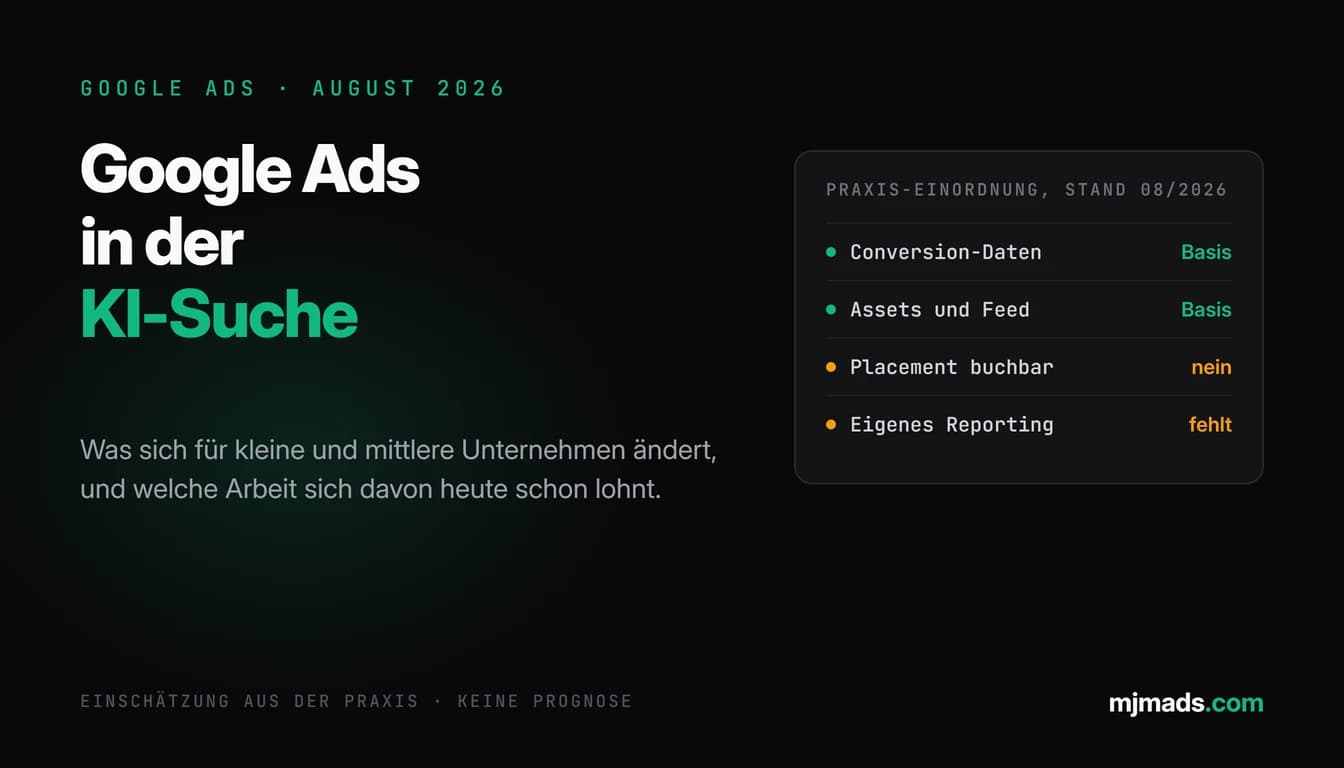
First, there is no bookable placement for AI surfaces. You do not create an AI campaign. Google serves these surfaces from what is already running. The lever is therefore not in booking but in supplying: how well does the system understand what you offer, for whom, at what price and in what location?
Second, according to the help page linked above, Google Ads currently does not offer segmented reporting for ads shown within AI Overviews. You keep steering by conversions, revenue and search terms, not by a new metric. Anyone selling you an AI visibility report for Google Ads should be able to show which field in the account the number comes from.
Which campaigns and match types are eligible
For ads inside AI Overviews, Google recommends broad match or AI Max in Search campaigns, plus Performance Max, Shopping and Dynamic Search Ads. For AI Mode, Google names Performance Max, Shopping and Search campaigns with broad match or AI Max. Accounts running exclusively on exact and phrase match are therefore largely left out of the surfaces inside AI answers. For the positions above and below AI Overviews, Google names no such restriction. What the individual match types mean is explained in the glossary entry on keyword match types.
The test with exact and phrase match
On 4 September 2026, Google Ads Liaison Ginny Marvin confirmed to Search Engine Roundtable that Google is also serving ads in AI Mode via exact and phrase match. She called it a "small experiment that recently kicked off". According to Marvin, text ads only appear for "explicit and direct user intent". According to Google, Highlighted Answers are designed for AI Max and Performance Max. Google did not name any markets for the test, and PPC Land does not report any either.
My assessment: this signals that Google does not want to open AI Mode only to fully automated campaigns. It is no more than that yet. I would not restructure an account because of a test whose markets and duration nobody knows. How broad and exact differ in practice is shown in the comparison broad match vs. exact match.
AI Max is already active in many accounts
Independently of AI Mode, Google has been switching Search campaigns using automatically created assets or the campaign-level broad match setting to AI Max since September 2026, and according to the Google blog Dynamic Search Ads follow from February 2027. Many accounts therefore already have a campaign that is eligible for AI surfaces without anyone having made that decision consciously. What the upgrade changes in detail and how to review it is covered in my article on the AI Max upgrade.
What this means for small and medium-sized businesses
Search campaigns. Queries are getting longer and closer to spoken sentences. Narrow keyword lists cover that increasingly poorly, broad match or AI Max with Smart Bidding increasingly well. The price is spread. That is why the search terms report is the most important weekly routine in my accounts, together with well-maintained negative keywords. The basics are in the keyword research guide.
Shopping and Performance Max. Here the product feed is the raw material. Titles, attributes, availability, price: whatever is missing there, no algorithm can guess. In my view, feed quality is now part of ad quality.
Brand campaigns. The underrated movement: someone reads an AI answer that mentions your company and then searches for your name. If you are not visible on your own name, you give away precisely the cheap click the AI answer just handed you. So brand campaigns are the last thing I would switch off, not the first.
Demand Gen. Demand often forms before someone knows your name or searches at all. Demand Gen covers that phase and is a sensible addition for offers that need explaining, as described in the guide to Demand Gen campaigns.
Whether your company is named in the AI answer itself is an organic question. So that no false expectation arises: I do not offer SEO. I mention the point because it affects brand searches and therefore the ads side. If you need support with it, a specialised partner is the right way to go.
With a budget of a few thousand euros a month, AI search changes your priority list less than the headlines suggest. The order stays the same in my view: first be able to measure, then supply material, then buy reach.
What you should check in your account now
These points pay off regardless of how quickly ads in AI Mode reach your market:
- Harden conversion tracking. Counting without duplicates, Enhanced Conversions, Consent Mode v2 and, where possible, conversion values instead of pure counts. The more automated delivery becomes, the more depends on this signal. How I set it up is described in the conversion tracking guide.
- Clarify your AI Max status. Which Search campaigns has Google already switched since September? Is that running the way you want, or do you need brand exclusions and tighter landing pages?
- Read search terms weekly. With broad match and AI Max, the variety of queries grows. Negative keywords are your most important brake.
- Complete your assets. Enough headlines and descriptions that make sense on their own, images in several formats and a landing page that speaks the same language as the ad.
- Check your ad language. Since September 2026, according to the Google Ads help centre, Google has been removing the campaign-level language setting from Search campaigns. Google then matches ads by their language. Your ads and landing page therefore belong in your customers' language.
- Maintain your feed and Merchant Center if you use Shopping or Performance Max.
- Keep your brand campaign running and once a month type in your three most important search terms yourself. Is there an AI Overview? Does your company appear in it, and who is named instead? That takes ten minutes and replaces every forecast with an observation.
If you would rather not set up tracking yourself, I handle it as part of my tracking service.
What I am not claiming
- I am not claiming that click prices rise by a specific amount because of AI surfaces. Less organic space suggests more pressure on paid surfaces, new surfaces suggest more inventory.
- I am not claiming that a specific share of searches is affected. I do not know that number.
- I am not claiming that I can place you inside AI answers. Nobody can commit to that.
- I am not claiming to know when ads inside AI Overviews or in AI Mode will launch in Germany or Poland. Google has not given a date.
What I am claiming: accounts with clean data and good material get through any format shift better than accounts without.
My conclusion
As of October 2026, Google has not named a launch date for ads in AI Mode in Germany or Poland, while ads above and below AI Overviews can already appear today. Access runs through broad match, AI Max, Performance Max and Shopping, and the exact and phrase match test shows that the rules are still moving. If your tracking is solid and you steer AI Max deliberately instead of just letting it run, you are prepared for both.
If you do not want to do this on the side, that is what ongoing Google Ads management is for, from €1,000 a month. Because I work in Google Ads accounts every day, I follow changes to formats and campaign types closely and adjust accounts as soon as something reaches the market. How much AI tools feature in my own work is documented openly on the AI in numbers page.
As of October 2026