

Tuesday morning, seven forty-one. Somewhere a pipe bursts, someone types "plumber Berlin" and hits enter. In that moment, before the results page has even loaded, Google runs an auction: businesses bid in real time for the right to show this person their ad right now. The whole thing takes a fraction of a second, by a rough estimate somewhere around 200 milliseconds, and it happens again for every single search.
The odd part: the highest bidder quite often does not win this auction at all. Why that is decides whether you buy clicks like a professional or pay a surcharge month after month to everyone who knows better.
If you would rather watch than read: the video above tells the same story in just under seven minutes, with all the worked examples from this article.
What happens in those milliseconds
Your search query lands in a data centre. In fractions of a second Google collects every ad that could match this search, checks them and weights them. Out of that candidate field comes the order on the results page, and with it the price every advertiser pays for their click.
There are two properties of this ad auction you need to know in order to understand Google Ads.
First: you almost never pay your maximum bid. The bid you enter is a ceiling. What you actually pay is only as much as it takes to defend your place against the next bidder. In that respect the auction is built fairly.
Second: it does not reward whoever brings the most money along. And that is the point where most accounts leave money on the table.
Ad Rank: bid, quality and context
Google weighs your bid against a second factor, the quality of your ad and your landing page. Both feed into Ad Rank, and only Ad Rank decides who sits on top. According to Google, more goes into it: minimum thresholds below which an ad does not show at all, the context of the search (such as the search terms, location, device and time of day), the expected impact of your assets such as sitelinks, and how competitive the auction is. Google does not publish an exact formula for it. You cannot buy your way upwards if your ad is poor.
Google measures quality on three things at its core:
- Expected click-through rate: how likely is it that someone clicks your ad?
- Ad relevance: how well does your ad match the search query?
- Landing page: how good is the page the click lands on?
You know the same three pillars from the Quality Score in your account. Google itself calls it a diagnostic tool, not a direct input in the auction. None of the three pillars is fate. Ads that pick up the search query word for word. Sorting out search terms that merely sound similar but carry a different intent. Landing pages that load fast and show immediately: you are in the right place. From my practice, a week of focused work on those three points pays off across months, on every single click.
The better advertiser pays less
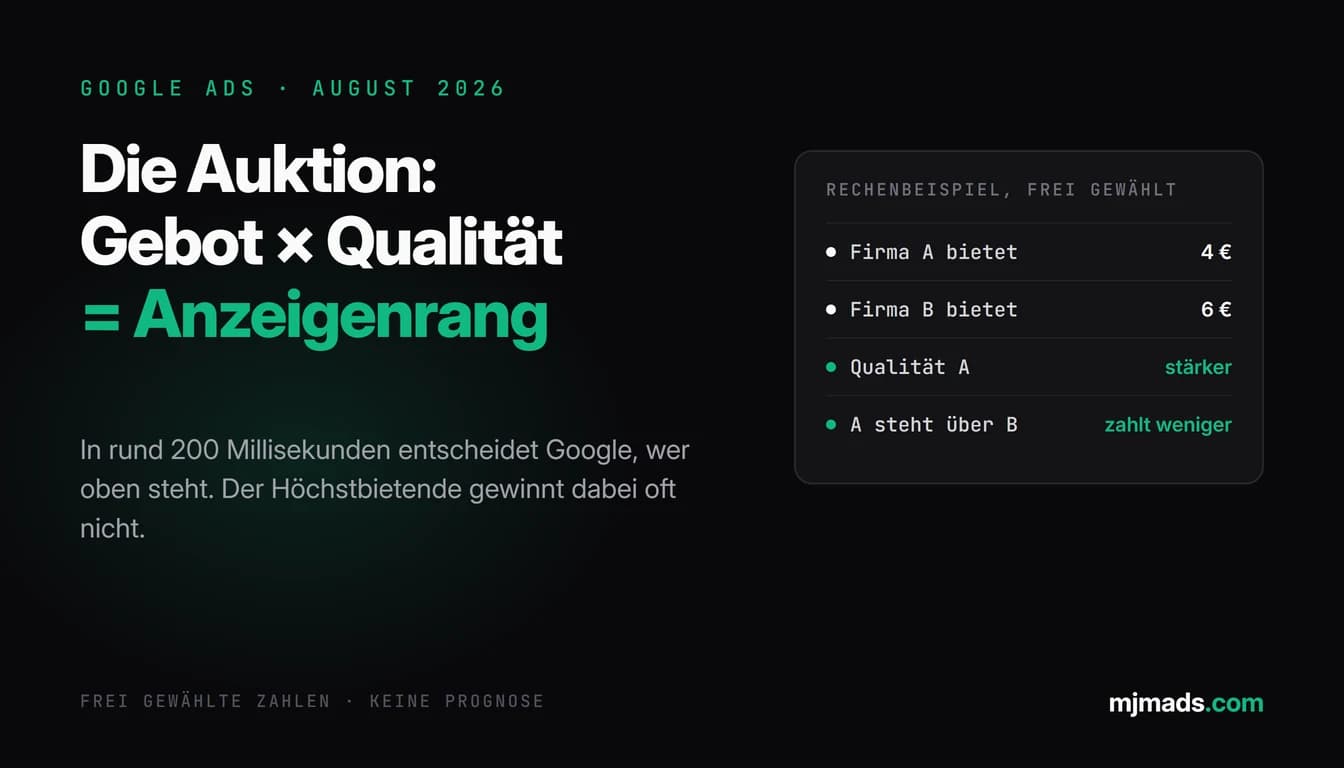
A worked example with freely chosen numbers, to show the mechanism: company A bids €4 and has a strong ad that matches the search. Company B bids €6, but ad and landing page are lifeless. Because the auction weighs quality alongside the bid, company A can end up above company B. With the smaller bid.
That is not an exception, that is the system. The better advertiser often pays less for the better spot, because their quality makes up for part of the bid. Turned around it means: whoever ignores the auction and only turns the bid dial subsidises the better positioned competition. Who you meet in your auctions shows up in Auction insights in your account; what those competitors advertise with, you can see in the Ads Transparency Center.
The three mistakes that make clicks expensive
If the auction rewards the better advertiser, why do so many accounts burn money? From my practice it is almost always the same three mistakes, and all three feed into the same bill: they make every single click more expensive.
One bucket for everything. One campaign, one ad group, fifty search terms mixed up together. The ad cannot possibly match all of it, relevance drops, and quality drops with it. Whoever separates cleanly by topic plays into the auction's hands.
The broken chain. The ad promises something the landing page does not deliver. Someone searches for an emergency service, clicks on an emergency service and ends up on a general homepage without a phone number. The chain of search, ad and page tears, and both ends push quality down: Google notices it, and users notice it too.
Flying blind without measurement. The most expensive of the three: no clean conversion tracking. If you do not measure which click turns into an enquiry, you leave Google's system optimising for the only thing it can see: clicks. You then pay for traffic instead of customers.
The last point weighs double, because in many accounts a machine has long been bidding alongside you. Smart Bidding adjusts the bid for every single auction, by device, time of day, location and behaviour. That works, but only under one condition: automated bidding strategies are exactly as clever as the data they are given. With clean conversions they find customers, without data they optimise into the void. Automation does not replace a strategy, it amplifies one.
What a click may carry in your business
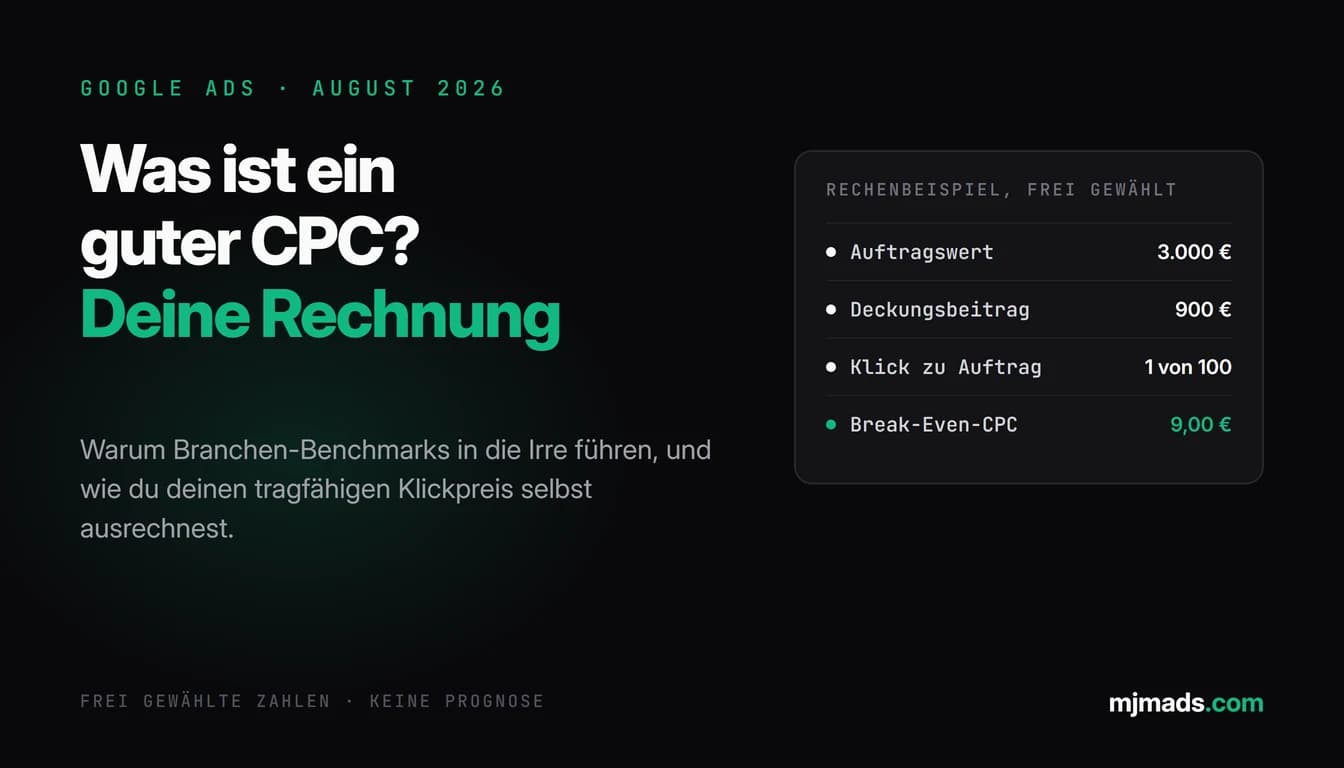
That leaves the question of what a good click price actually is. The honest answer: it is in your numbers, not in an industry table. Another worked example with freely chosen numbers: one job brings in €3,000, of which 30 percent stays with you. Out of 100 clicks four turn into an enquiry, and every fourth enquiry turns into a job. Then a click carries up to roughly €9, and only above that threshold do you lose money.
You can run this calculation for your own business in two minutes: with the free click price calculator, no sign-up. The detailed derivation with all the pitfalls is in the article what is a good CPC?, and how much budget you need for enough data to accumulate for learning in the first place is what the budget calculator works out.
The auction in three sentences
First: the auction rewards relevance, not the fattest budget. Second: your quality helps decide whether you pay less than your competition or more. Third: without clean measurement your account flies blind, no matter how good the rest is.
Anyone with those three points under control is, from my practice, already further along than a large part of the market. And if you have understood all of it but do not want to do it yourself: that is exactly my day job. I manage Google Ads accounts personally, with published fixed prices from €1,000 per month, a 3-month start phase, then cancellable monthly. The first step is a free initial consultation.