


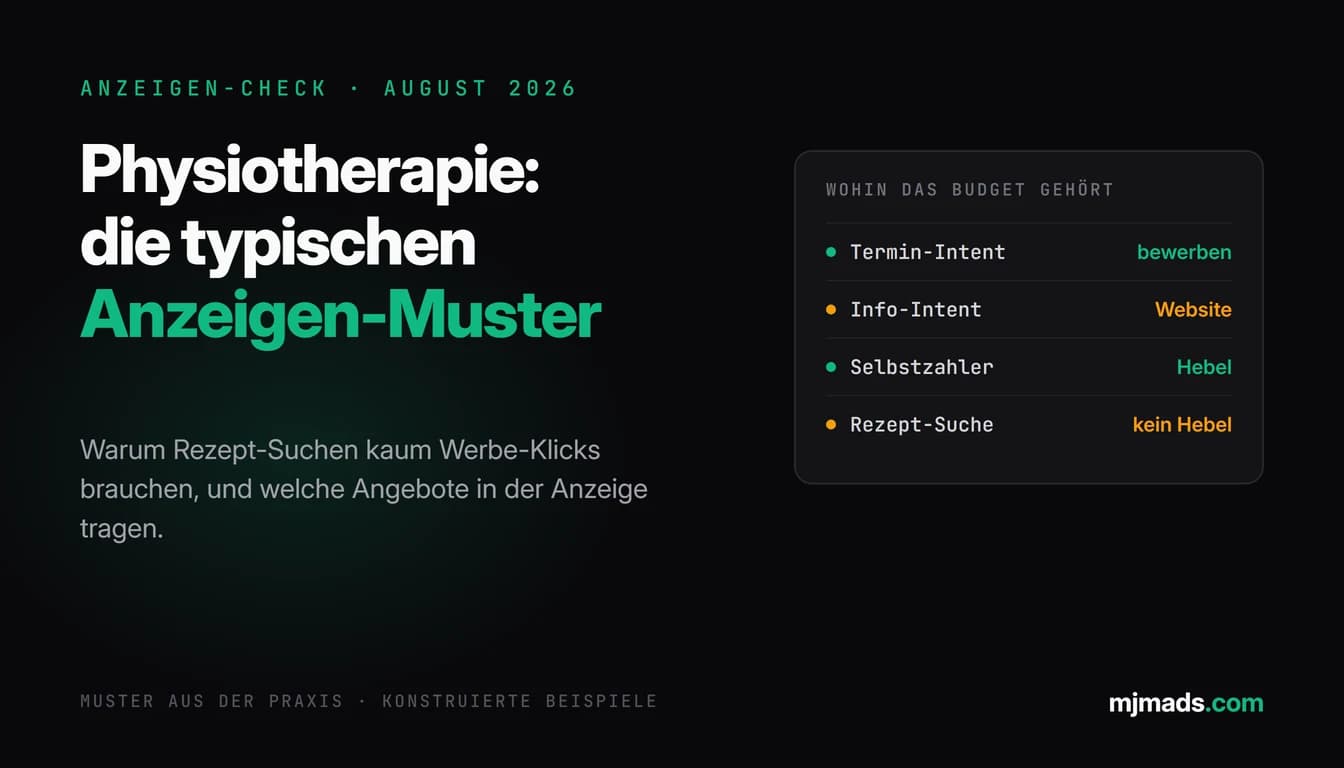
In this series I usually quote real ads from the Google Ads Transparency Center. For physiotherapy I'm doing it differently on purpose. Practices are small, often tied to one person's name, and a literal quote there hits a human being rather than a pattern. So this part is the pattern edition: the same analytical structure, just without third-party quotes.
Every example ad in this text is constructed. It matches no real practice, it is explicitly not a real ad, and it exists only to show the wording patterns that keep showing up in local healthcare campaigns in my experience.
What this check is, and what it is not
Basis: recurring patterns from working with local service providers, plus the demand logic of physiotherapy
Example ads: constructed, not real ads, no practice is named
Not included: no third-party quotes, no account data, no claims about results
Patterns are not measurements. This text shows you which wordings and structures are typical and where they fail. It says nothing about how a specific ad performs. That is decided by your location, your offer and your account.
Pattern 1: Appointment intent and information intent in one campaign
Physiotherapy has two search worlds that barely overlap. One is looking for knowledge, the other for an appointment.
Information intent sounds like this:
Sponsored
Constructed exampleBack pain? The 5 best exercises
See the exercises now and do something about the tension yourself.
Someone searching for "back pain exercises" or "what to do about a stiff neck" wants to read or watch a video in that moment, not to call. Those queries bring reach, occasionally a newsletter contact, but rarely an appointment. As a paid ad they are expensively purchased education.
Appointment intent sounds different:
Sponsored
Constructed exampleManual therapy without a prescription
Private service, book your appointment online, practice in the city centre.
Here the intent is already an action. That difference does not belong in the same ad group but in separate campaigns, and in case of doubt in no campaign at all: information topics are material for your website, not for your ad budget.
Pattern 2: The prescription logic gets skipped
This is where physiotherapy differs from almost every other local service. A large share of demand arrives with a prescription in hand. The decision to have treatment was made before the search began, and all that is left is finding the nearest practice with a free slot. That person does not need a paid click; they call the practice they already know, or the first one on the map.
Yet you keep seeing ads built exactly for them:
Sponsored
Constructed examplePhysiotherapy near you
Physical therapy, manual lymphatic drainage, all insurers welcome. Book now.
"All insurers welcome" addresses the group that finds its way into a practice anyway, and whose treatment is usually capped by the reimbursement rate. In my experience paid advertising carries where an offer is freely bookable: private manual therapy, sports physiotherapy, fascia therapy, pelvic floor training, massages without a prescription, personal training, or certified prevention courses, which health insurers may co-fund depending on the plan.
The same applies when a practice is new, opens a second location or wants to build up a treatment focus that still has capacity. If you already have weeks of waiting time, generic advertising mostly buys calls you have to turn down again.
Pattern 3: The interchangeable headline
The most common copy pattern is also the weakest:
Sponsored
Constructed exampleYour health in good hands
Competent, caring, individual. We look forward to seeing you.
The counter-test is quick: would any practice claim the opposite? Nobody advertises being "impersonal" or "inexperienced". Wording whose opposite is impossible carries no information, it only fills characters.
It gets concrete as soon as service, availability and location appear in the copy:
Sponsored
Constructed exampleSports physiotherapy after knee surgery
Guided return to training. Appointments from 7 a.m., near the main station.
A treatment focus, early hours, a location: those are details another practice cannot simply copy, because they would not be true for them.
Pattern 4: The radius is too wide
Therapy means repeat appointments over weeks, often twice a week, usually squeezed between work and the evening. Proximity is therefore not a soft criterion but the first hard one.
Even so, many campaigns run with a radius covering half the region, often combined with the default setting that also includes people merely interested in the area. The result is clicks from people who would never make that trip twice. Targeting tightly means a perimeter around the practice instead of the city limits, down to district level if in doubt, actively excluding places nobody realistically travels from, and carrying the place name in the ad copy too. I describe the underlying mechanics in more detail in my guide to Google Ads for local businesses.
Pattern 5: The click ends with no path to an appointment
The most expensive pattern is not in the ad copy but behind it. The ad promises an appointment, the landing page offers a contact form saying "we will get back to you", the phone number sits in the legal notice, and the opening hours live in an image in the footer.
In physiotherapy the close almost always happens two ways: a phone call or an online booking. Both belong visibly at the top, as a tappable number on mobile, and both belong in your measurement. Without call tracking and without a measured booking you optimise for clicks instead of appointments, and then every campaign looks good until somebody does the maths.
What regularly goes wrong
Broken placeholders. Dynamic building blocks are handy until they go out raw. If {KeyWord:Physiotherapy} or {LOCATION(City):your city} shows up visibly in the ad, no default text was set or the syntax was off. In a healthcare context that reads like a sign saying "nobody proofread this".
Promises of a cure. German advertising law for health services rules out promises of a cure and asks for factual copy. Lines like "pain-free in three weeks" are not just legally risky, they are also weak as advertising, because nobody can verify them upfront. Describing what you treat and how the process works carries further.
One ad group for everything. Physical therapy, lymphatic drainage, prevention and personal training in one group produce ads that fit none of the queries properly. One topic per ad group, one landing page per topic.
The practice name as a headline. The name appears in the ad anyway. A headline that repeats it wastes exactly the space where service, availability or location could stand.
How to do it better
- Advertise freely bookable services one by one. Every private service gets its own ad group and its own landing page with the process, the duration and your practice's terms. A prevention course is a different product from a sports physiotherapy session.
- Take information searches out of the account. Terms like "exercises", "what to do about" or "causes" belong in your negative keywords and on your website, not in your ad budget.
- Draw the radius tight. A perimeter around the practice, exclusions for places nobody realistically travels from, the place name in the ad copy.
- Make calls and bookings measurable. Set up call tracking, record the online booking as a conversion, and only then think about bidding strategies.
- Counter-test every headline. If the opposite is impossible, the headline says nothing. Replace it with service, availability or location.
- Read the preview before going live. Go through placeholders, stored default texts and the combinations of headline and description once. It takes five minutes and prevents exactly the errors from the section above.
How service providers like physiotherapy practices can structure their campaigns and turn clicks into bookings, I cover in my guide to Google Ads for service providers.
Conclusion
Typical physiotherapy ads rarely fail at the craft and almost always at the audience: they court people who come with a prescription anyway, with words any other practice could say just as well, in a radius nobody drives twice a week. Put a freely bookable offer front and centre instead, target tightly and measure the path to the appointment, and the same budget works far more precisely.
If you want your campaign set up exactly like that, I can take it on for you: managing your Google Ads from €1,000 per month, with a 3-month start phase and cancellable monthly after that.