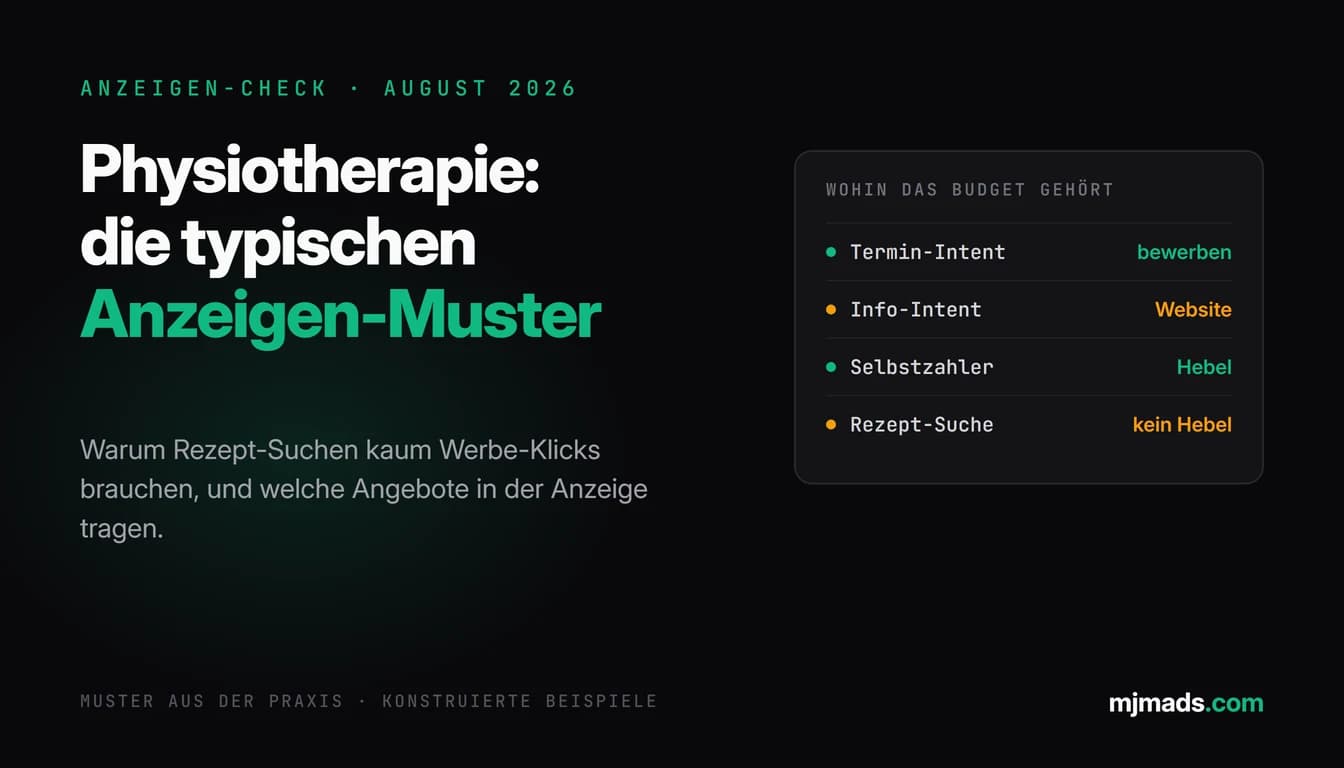

Dentist Ad Check: The Typical Patterns
How dental practices advertise on Google Ads: typical patterns, legal pitfalls and how to aim your ads at appointments instead of clicks.
TL;DR
This part of the series works without third-party quotes: every example ad is constructed and matches no real practice. They show five patterns that recur in dentistry in my experience: cosmetic promises that run into German health advertising law and Google's healthcare policies, pain ads with no short-notice appointment, interchangeable practice headlines, a click that ends with no path to a booking, and generic bids against chains and portals. Keeping copy factual, separating urgent from planned demand, measuring calls and bookings and advertising your own specialisation instead of generic terms makes the same budget work more precisely.
In this series we usually quote real ads from the Google Ads Transparency Center. For dental practices we are doing it differently on purpose. Practices are small, often tied to one person's name, and because health advertising also carries legal questions, a literal quote there hits a human being rather than a pattern. So this part is the pattern edition: the same analytical structure, just without third-party quotes.
Every example ad in this text is constructed. It matches no real practice, it is explicitly not a real ad, and it exists only to show the wording patterns that keep showing up in local healthcare campaigns in my experience.
What this check is, and what it is not
Basis: recurring patterns from working with local service providers, plus the demand logic of dentistry Example ads: constructed, not real ads, no practice and no brand is named Not included: no third-party quotes, no account data, no claims about results, no legal advice
Patterns are not measurements. This text shows you which wordings and structures are typical and where they fail. It says nothing about how a specific ad performs. That is decided by your location, your offer and your account. And it replaces no legal review: what is permitted in a specific case is for your dental association or a specialist lawyer to clarify.
Pattern 1: The cosmetic promise that tips over legally
Cosmetic dentistry is the field with the highest treatment value, and that is exactly where the copy gets boldest:
A perfect smile in just 7 days Veneers without pain, guaranteed brilliant white teeth. Book your appointment now. constructed example, not a real ad
Two lines, three problems. "Perfect" and "guaranteed" are promises of success, "in just 7 days" is a promise about time, and "without pain" commits to a course of treatment nobody knows in advance. German health advertising law demands factual copy for medical treatments, rules out misleading claims and guarantees of success, and restricts before-and-after imagery for certain procedures. On top of that come Google's healthcare advertising policies: ads in this space are reviewed more strictly, and a disapproval usually arrives at the worst possible moment, right after you go live.
The second argument against lines like that is purely commercial. A promise nobody can verify upfront looks like every other promise in the ad block. It gets concrete when you describe the process instead of the outcome:
Veneers: consultation with impression Process, alternatives and a cost plan in the first appointment. Afternoon slots too. constructed example, not a real ad
That is factual, it is verifiable, and it sells the next realistic step: the consultation, not the finished smile.
Pattern 2: Pain intent with no short-notice appointment
Dentistry has two search worlds that barely overlap. One is looking for help today, the other compares over weeks. Someone typing "toothache", "broken tooth" or "emergency dentist" usually does so on a phone, in the evening or at the weekend, and decides within minutes. Someone searching for implants or clear aligners reads, compares several practices and gets in touch weeks later.
Even so, the same ads often run for both:
Toothache? We are here for you Modern practice with the full range of treatments. Arrange an appointment. constructed example, not a real ad
This ad fails to answer the only question the searcher has right now: can I get an appointment today, and when can I call? "Arrange an appointment" reads in their head as: form, callback, sometime. Then there is the timing problem. Pain ads often run around the clock even though nobody picks up in the evening. An ad schedule that limits the campaign to the hours when somebody answers the phone costs nothing and saves exactly the clicks that never turn into an appointment.
With availability in the copy it reads differently:
Toothache: same-day appointment Emergency hours weekdays 8 to 11 a.m. Call us directly, practice on the market square. constructed example, not a real ad
What matters is that the claim holds. Emergency hours that do not exist produce disappointed calls and bad reviews, and both cost more than the click you saved.
Pattern 3: The interchangeable practice headline
The most common copy pattern is also the weakest:
Your dentist, in the best hands Competent, caring, modern equipment. We look forward to seeing you. constructed example, not a real ad
The counter-test is quick: would any practice claim the opposite? Nobody advertises "outdated equipment" or "impersonal". The same goes for "gentle dentistry", "the full range of treatments" and "your partner for dental health". Wording whose opposite is impossible carries no information, it only fills characters. In dentistry it stands out even more, because the ad block often stacks several practices using the same adjectives.
It gets concrete as soon as treatment, audience, availability or location appear in the copy:
Nervous patients: treatment under sedation First appointment without treatment in the chair. Slots from 7 a.m., near the main station. constructed example, not a real ad
A specialisation, a detail about the process, early hours, a location: those are details another practice cannot simply copy, because they would not be true for them.
Pattern 4: The click ends with no path to a booking
The most expensive pattern is not in the ad copy but behind it. The ad promises an appointment, the click lands on the practice homepage, there is a contact form saying "we will get back to you", the phone number sits in the legal notice, and the opening hours live in an image in the footer.
In dentistry the appointment almost always happens two ways: a phone call or an online booking. Both belong visibly at the top, as a tappable number on mobile, and both belong in your measurement. Without call tracking and without the booking as a measured conversion you optimise for clicks instead of patients, and then every campaign looks good until somebody does the maths.
Then there is the landing page question. Advertising implants and dropping people on the homepage forces them to search your own menu. One page per advertised treatment, with the process, the duration, aftercare, the team and an honest answer to the cost question, carries the longer decision path. For high-value treatments the measurable intermediate step is not "treatment booked" but "consultation booked".
Pattern 5: The competition from chains gets ignored
On generic terms a single practice is rarely alone. Bidding on "dentist" plus a city name you meet practice chains and investor-run care centres, comparison and booking portals, dental tourism providers and insurance comparison sites. Those accounts are larger, bid across regions and live on volume. Turning up with the same copy and a small daily budget buys expensive clicks with no profile of your own.
The way out is not more budget but more focus. Instead of "dentist city" the treatment you actually offer, instead of the whole city the district, instead of "for the whole family" the audience you serve better than a chain does: nervous patients, children, sports mouthguards, treatment in another language, appointments before work. Add a cheap campaign on your own practice name so people who already know you do not end up on a portal. How the underlying auction works and why the highest bid does not automatically win the best position, we explain without jargon in Google Ads explained simply.
What regularly goes wrong
Broken placeholders. Dynamic building blocks are handy until they go out raw. If {KeyWord:Dentist} or {LOCATION(City):your city} shows up visibly in the ad, no default text was set or the syntax was off. In a healthcare context that reads like a sign saying "nobody proofread this".
Job searches in the patient budget. "Dental assistant salary", "dental nurse training" or "dentist vacancy" have nothing to do with new patients. Those terms belong in your negative keywords from day one, unless you deliberately run a separate recruiting campaign with its own budget.
One ad group for everything. Check-ups, implants, aligners, whitening and paediatric dentistry in one group produce ads that fit none of the queries properly. One topic per ad group, one landing page per topic.
Remarketing thought through like an online shop. Google treats health topics as sensitive, and personalised advertising and audience lists around treatments are restricted. A remarketing list meant to re-engage visitors of your implant page is therefore not a standard building block but a case for the current policy and, in case of doubt, for a legal review.
The practice name as a headline. The name appears in the ad anyway. A headline that repeats it wastes exactly the space where treatment, availability or location could stand.
How to do it better
- Advertise self-pay services one by one. Every higher-value treatment gets its own ad group and its own landing page with the process, the duration, aftercare and an honest statement on cost. Whitening is a different product from implant care.
- Separate pain from planning. The pain campaign runs with a call extension, an ad schedule and a landing page that shows availability and opening hours immediately. The planning campaign can be calmer and more detailed.
- Write factually instead of promising. Describe the treatment, the process and the availability. Anything that promises guaranteed, perfect or pain-free goes out before it reaches review.
- Make calls and bookings measurable. Set up call tracking, record the online booking as a conversion, define the consultation as the goal for high-value treatments, and only then think about bidding strategies.
- Do not bid generically against chains. Specialisation, district, early or late hours and languages are your levers, plus a brand campaign on your own practice name.
- Read the preview before going live. Go through placeholders, stored default texts and the combinations of headline and description once, and have the sensitive wordings checked. It takes five minutes and prevents exactly the errors from the section above.
Which search intents matter elsewhere in dentistry and what a fitting campaign structure looks like, we have collected on our dentist industry page.
Conclusion
Typical dentist ads rarely fail at the craft. They promise a result that neither advertising law nor daily practice can cover, they send people in pain into a contact form, they sound like the three practices above them, and they bid on terms that chains and portals occupied long ago. Put a concrete treatment front and centre instead, keep the copy factual, target tightly and measure the path to the appointment, and the same budget works far more precisely.
If you want your campaign set up exactly like that, we take it on as a Google Partner: managing your Google Ads from €1,000 per month, with a three-month starting phase and cancellable monthly after that.
Frequently asked questions about the dentist ad check
Is Google Ads worth it for dental practices?
It depends on what you want to fill. Check-ups and standard insured treatments fill up by themselves in many practices, and there advertising mostly buys calls you have to turn down again. In my experience paid advertising becomes interesting for self-pay and private services with a higher treatment value, for a clear specialisation such as nervous patients or paediatric dentistry, for a new practice and for a second location. There is no guarantee of new patients, but there is a clear way to test it.
Are the example ads in this article real?
No. Every headline and description in this text is constructed and explicitly marked as a constructed example. Unlike the other parts of this series we quote no third-party ads here and name no practice and no brand. The patterns come from working with local service providers and from the demand logic of dentistry, not from a sample.
What must a dentist ad not claim?
German health advertising law requires factual copy and rules out misleading statements, promises of success and advertising that plays on fear, while before-and-after imagery is restricted for certain procedures. On top of that Google's healthcare and personalised advertising policies limit remarketing around treatments. Wording like "guaranteed pain-free" or "a perfect smile in one week" is therefore risky twice over. This is not legal advice: in case of doubt your dental association or a specialist lawyer will clarify it.
How does a single practice compete with dental chains?
Not on budget and not on generic terms. On "dentist city" you are bidding against chains, investor-run care centres, comparison portals and dental tourism providers, and keeping up there means paying for clicks with no profile. Narrowing down carries further: specialisation, district, early or late hours, languages in the team, one landing page per treatment. Plus a cheap campaign on your own practice name so people who already know you do not end up somewhere else.

Mijo Jurisic
Google Ads consultant & founder of MJ Marketing. Five-plus years of hands-on practice: from a self-taught start to the Google Premier Partner programme with 500+ direct Google Ads clients and €20M+ in managed media spend.
Share this article: