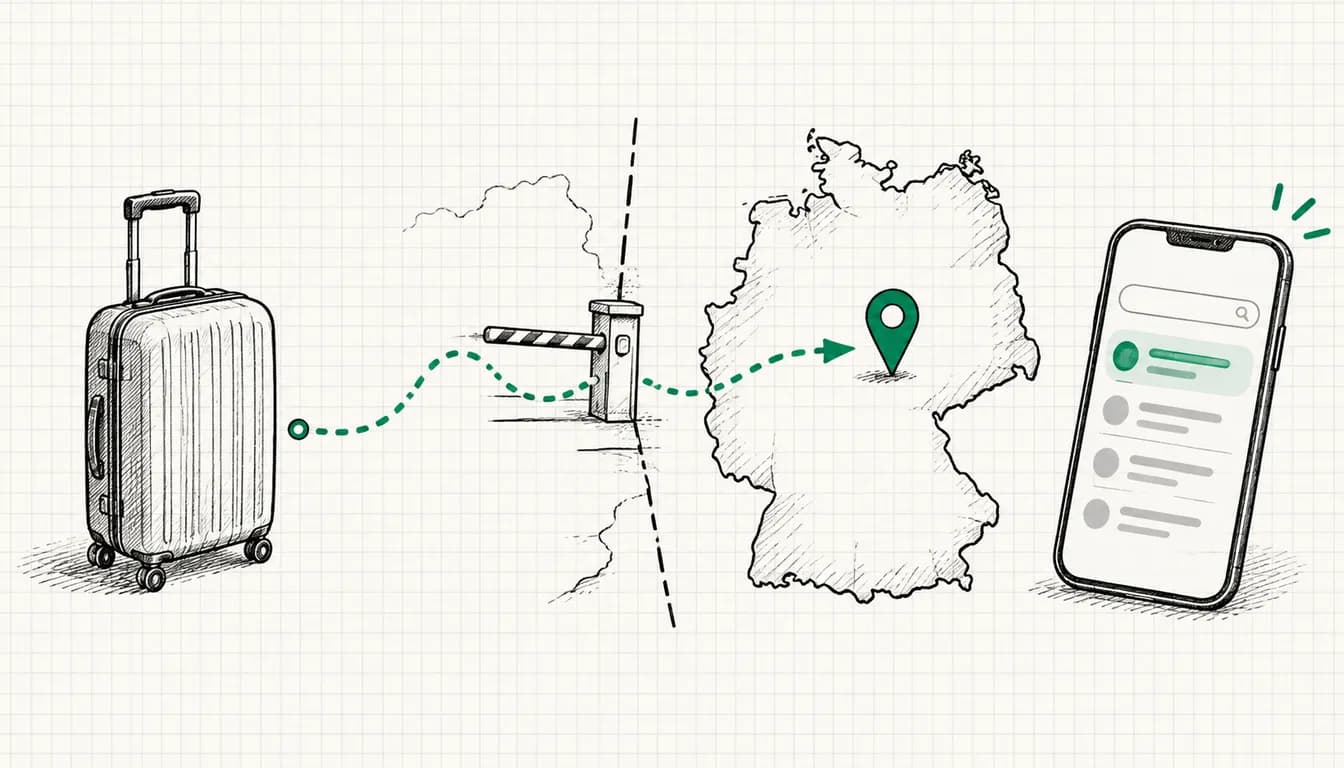


In the EU you may, as a rule, bid on a competitor's brand name as a keyword. What you may not do is advertise in a way that makes searchers believe your ad is an offer from the trademark owner. That is the core of the case law of the Court of Justice of the European Union (CJEU) since its Google France judgment of 23 March 2010. Germany's Federal Court of Justice (Bundesgerichtshof, BGH) has since spelled out this standard for Germany in several judgments.
The question “Can I bid on my competitor?” has several layers that often get mixed up, though: the invisible keyword, the visible ad text and the landing page including its domain. On top of that come two sets of rules that have nothing to do with each other. The law decides whether you can receive a cease-and-desist letter or be sued. Google's trademark policy decides whether Google restricts your ad. What Google lets through can still be unlawful. And some restrictions by Google hit an ad that would be perfectly fine legally.
In this guide I keep the two apart: first the short answer, then the law and the rulings with case numbers and full-text links, then Google's policy as it stands in October 2026. At the end you will find practical cases to classify your own ads and a section on protecting your own brand.
I work in Germany, so I explain German law as the national example. The CJEU rulings apply in every EU member state, because they interpret EU trademark law, which also harmonises the national trademark laws through an EU directive. The German judgments and the German Act against Unfair Competition are national law. If you advertise in another country, check the rules of that market.
As of: 8 October 2026. I read all rulings in full (EUR-Lex, the Federal Court of Justice, the court database of North Rhine-Westphalia) and the statutes on gesetze-im-internet.de and EUR-Lex. I checked Google's trademark policy in the English version, which Google itself names as the authoritative version for enforcement.
Not legal advice: I am an advertising practitioner, not a lawyer. This text classifies case law and policies for day-to-day work with Google Ads. It does not replace a legal review of your specific ad.
The short answer: keyword, ad text, landing page
| Layer | What the law says | What Google says |
|---|---|---|
| Keyword (invisible to searchers) | According to the CJEU a use in the course of trade, but infringing above all when the ad does not make its origin clear (CJEU Google France, BGH Bananabay II) | Google does not restrict trademarks as keywords |
| Ad text | Allowed, for example, when reselling genuine goods or referring to accessories and spare parts. Prohibited in case of likelihood of confusion, exploiting reputation, denigration or imitation claims | Restricted after a complaint for direct competitors and for confusing or misleading use. Exceptions for resellers, parts and informational sites |
| Domain in the display URL | A well-known trademark in your own domain can be unfair (BGH keine-vorwerk-vertretung) | Google does not restrict trademarks in the second-level domain |
| Landing page | Normal rules of trademark and unfair competition law | A trademark that appears only on the landing page is no reason for a restriction. But the landing page decides whether an exception applies |
Table scrolls sideways
The rule of thumb I work with: The keyword is rarely the problem, the ad text almost always is. If you bid on a competitor's name and talk only about yourself in the ad, case law generally puts you on the safe side. If you write the competitor's trademark into your ad text, you need a good reason and a landing page that supports it.
What the law says
Trade Mark Act and EU Trade Mark Regulation
Trademark law gives the owner an exclusive right. Section 14(2) of the German Trade Mark Act (Markengesetz, MarkenG; the link leads to the German text) distinguishes three cases in which third parties may not use a sign in the course of trade without consent:
- Double identity (no. 1): an identical sign for identical goods or services. This is the typical keyword case when a competitor books the exact brand name for the same products.
- Likelihood of confusion (no. 2): an identical or similar sign for identical or similar goods, if the public may confuse the signs or associate them with each other.
- Well-known trademark (no. 3): here it is enough if the use takes unfair advantage of, or is detrimental to, the distinctive character or the repute of the trademark without due cause.
For EU trademarks, which apply across the whole EU, the same principle is set out in Article 9(2) of the EU Trade Mark Regulation (EU) 2017/1001. Company names and other business identifiers are protected by Section 15 MarkenG. So a competitor's name can be affected even if it is not registered as a trademark.
In practice, the limitations matter at least as much. Under Section 23 MarkenG, the owner cannot prohibit someone from using a trademark descriptively or to refer to the owner's goods, in particular where this is necessary to indicate the intended purpose of a product as an accessory or spare part. According to subsection 2, this only applies if the use is in accordance with honest practices in industrial or commercial matters. The equivalent for EU trademarks is Article 14 of the Regulation. Section 24 MarkenG covers exhaustion: goods that the owner, or someone with the owner's consent, has put on the market in the European Economic Area may be resold and advertised by a dealer under the trademark. The exception: the owner has legitimate reasons to oppose it.
UWG: comparison, misleading practices, obstruction
Alongside trademark law, Germany's Act against Unfair Competition (Gesetz gegen den unlauteren Wettbewerb, UWG) applies. For competitor ads, these provisions are the most relevant:
- Section 6 UWG defines comparative advertising as any advertising that directly or indirectly identifies a competitor or the goods or services it offers. An ad that names a competitor is therefore almost always comparative advertising. It is allowed as long as it stays within the limits of subsection 2. The comparison is unfair, among other things, if it does not objectively refer to material, verifiable features or the price (no. 2), leads to confusion (no. 3), takes unfair advantage of the reputation of the competitor's trademark (no. 4), denigrates the competitor (no. 5) or presents your own goods as an imitation of branded goods (no. 6).
- Section 5(3) no. 1 UWG covers advertising that creates a likelihood of confusion with a competitor's trademark or other identifier. On top of that come misleading statements about relationships and approvals under Section 5(2) nos. 3 and 4, such as falsely claiming to be an authorised partner.
- Section 4 no. 4 UWG prohibits the targeted obstruction of competitors. This also concerns trademark owners who abuse their complaint option at Google. More on this below in the Uhrenankauf im Internet ruling.
The origin function as the key test
In keyword advertising almost everything revolves around one question: does the ad adversely affect the origin function of the trademark? A trademark is meant to guarantee that a product comes from a specific company. The CJEU therefore examines whether a normally informed and reasonably attentive internet user can tell from the ad whether the offer comes from the trademark owner, from a company economically connected to it or from a third party. If that is impossible or difficult to tell, an infringement is likely.
In 2025, following Interflora, the Higher Regional Court (Oberlandesgericht, OLG) Düsseldorf summarised this test in two steps. First, the court asks whether, based on generally known features of the market, the user knows anyway that the advertiser and the trademark owner are not connected but competitors. If not, what matters is whether the ad itself makes the different origin recognisable.
According to the Interflora judgment, the investment function can also be adversely affected, meaning the owner's ability to use the trademark to acquire or preserve a reputation. That requires the keyword advertising to substantially interfere with exactly that. Well-known trademarks are additionally protected against free-riding, dilution and tarnishment. The CJEU does not, however, consider the advertising function to be adversely affected by keyword advertising.
Case law: the rulings you should know
The chronology covers the leading decisions on keyword advertising and the rulings on resellers, spare parts and domains that matter for ad texts. Each entry links to the full text on EUR-Lex (available in all EU languages), at the Federal Court of Justice or in the court database of North Rhine-Westphalia. The German judgments are only available in German.
Keyword advertising and trademark use in court
CJEU BMW/Deenik (C-63/97)
A garage may advertise repair and maintenance of a brand's cars as long as it does not suggest a commercial connection or affiliation with the dealer network.
View sourceCJEU Gillette (C-228/03)
A third party's trademark may be used to indicate the intended purpose of your own product if that is practically the only means of providing understandable information and complies with honest practices.
View sourceCJEU Google France (C-236/08 to C-238/08)
The trademark owner can prohibit keyword advertising if the average user cannot tell, or can tell only with difficulty, whether the offer comes from the owner or a third party, and Google itself does not use the trademark.
View sourceCJEU BergSpechte (C-278/08)
The same standard also applies to keywords that are merely similar to the trademark.
View sourceCJEU Portakabin (C-558/08)
A reseller of genuine goods may advertise with the trademark unless a legitimate reason such as the impression of an economic link stands in the way, and additions such as used do not in themselves create such a reason.
View sourceBGH Bananabay II (I ZR 125/07)
No use of the trademark within the meaning of Section 14(2) no. 1 MarkenG if the ad in the labelled ad block contains neither the trademark nor a reference to the owner and the domain points to a different origin, because the origin function is then not adversely affected.
View sourceCJEU L'Oréal/eBay (C-324/09)
A marketplace operator that books brand names as keywords for branded goods on its platform must also make the origin of the advertised goods clearly recognisable.
View sourceCJEU Interflora (C-323/09)
The owner of a well-known trademark cannot prohibit keyword advertising that offers an alternative without imitation, dilution or tarnishment and without adversely affecting the functions of the trademark.
View sourceCJEU Wintersteiger (C-523/10)
For keyword advertising on a Google site of another EU country, the owner can sue in the member state where the trademark is registered or in the member state where the advertiser is established.
View sourceBGH MOST-Pralinen (I ZR 217/10)
If the ad appears in a separate, labelled ad block without the trademark and without any reference to the owner, the origin function is in principle not adversely affected.
View sourceBGH Beate Uhse (I ZR 172/11)
With well-known trademarks, the choice of keyword alone can infringe, for example with imitations, but whoever merely offers an alternative without adversely affecting the functions of the trademark generally does not act without due cause.
View sourceBGH Fleurop (I ZR 53/12)
If a well-known distribution system makes it likely that users assume a partnership, the origin function is already adversely affected when the ad does not point out the lack of an economic connection.
View sourceBGH Uhrenankauf im Internet (I ZR 188/13)
If a trademark owner, after a trademark complaint to Google, refuses consent for an ad that does not infringe the trademark, it obstructs the competitor in a targeted way.
View sourceBGH keine-vorwerk-vertretung (I ZR 236/16)
A well-known trademark in the domain of a dealer that also sells compatible third-party products takes unfair advantage of the trademark's repute, because gentler references are possible.
View sourceBGH ORTLIEB II (I ZR 29/18)
Dealers may advertise with the trademark even if they also sell competing products, as long as the owner's legitimate interests are preserved, but not with Google ads that misleadingly lead searchers to third-party products.
View sourceOLG Düsseldorf (20 U 73/24)
On an online marketplace, listings do not infringe the trademark even if a trademark keyword is assumed, as long as statements such as suitable for and not an original make clear that the goods do not come from the trademark owner.
View source
What the rulings mean for your ads
The keyword alone is usually allowed. Google France and BergSpechte set the standard, which the CJEU confirmed shortly afterwards in a reference from the BGH in the Bananabay case (order of 26 March 2010, C-91/09). The BGH made it more concrete with Bananabay II and MOST-Pralinen: if the ad appears in the labelled ad area, names neither the trademark nor the owner and the domain points to a different company, the origin function is in principle not adversely affected. Incidentally, in the MOST-Pralinen case the advertiser had not bid on the trademark at all but on “Pralinen” (chocolates) with the broad match option. That is why the ad also appeared for searches for “most pralinen”.
Well-known trademarks and partner networks are the exception. Interflora and Beate Uhse show that with well-known trademarks the choice of keyword alone can be an infringement if the advertiser offers imitations or presents the branded goods in a negative light. Whoever offers an alternative without adversely affecting the functions of the trademark generally does not act “without due cause”, according to Beate Uhse. Fleurop is the special case where many get stuck. If a well-known distribution system of the trademark owner makes searchers likely to assume the advertiser is a partner company, the ad has to point out the lack of an economic connection. Silence is not enough in that case.
Dealers, repair shops and accessory sellers may name the trademark. BMW/Deenik, Gillette and Portakabin allow you to use a competitor's trademark when you resell genuine goods, repair them or offer matching accessories. The condition is that no commercial relationship or partnership is suggested. In the car repair shop ad check I show with constructed examples how an independent car repair shop puts this into its ad text. ORTLIEB II draws the line at Google ads with the trademark that misleadingly lead searchers to third-party products. In 2025 the OLG Düsseldorf considered marketplace listings with “suitable for” and “not an original” sufficiently clear.
Marketplaces are not a lawless space. L'Oréal/eBay and ORTLIEB II concern platforms that run Google ads themselves. They carry over to you as a dealer because they apply the same standard: if you advertise with a trademark, you must make clear whose goods are behind it, and you must not lure searchers with the trademark only to show them something else.
Trademark complaints are not a blank cheque. According to the BGH's Uhrenankauf im Internet ruling, a trademark owner may file a general complaint with Google. But if it refuses consent for a specific ad that does not infringe its trademark, it obstructs the competitor in a targeted way (then Section 4 no. 10 UWG, today Section 4 no. 4 UWG). In the case decided, a dealer in used watches wanted to advertise with the watch brand for buying watches. The trademark owner had to give Google its consent to exactly this ad.
A foreign Google site does not protect you. According to Wintersteiger, the owner of a trademark registered in an EU member state can sue before the courts of that state even if the ad ran on the Google site of another EU country. Alternatively, the courts of the member state where the advertiser is established have jurisdiction.
Google's trademark policy (as of October 2026)
Google states the principle in its trademark policy as follows: Google Ads abides by local trademark laws and protects the rights of trademark owners, so ads that infringe trademark rights are not allowed. Advertisers may, however, use trademarks that belong to others in certain situations, for example to identify a product for sale. If a trademark owner submits a complaint, Google reviews it and may restrict the use of the trademark. According to the policy, violations do not lead to an account suspension without prior warning.
- Minimum warning before an account suspension
- 7 days
- according to the trademark policy
- Since then, complaints only against specific advertisers
- 24 Jul 2023
- no more industry-wide complaints
- Phase-out period for older restrictions
- 12 to 18 months
- for most advertisers
Source: Google trademark policy and policy change log, retrieved on 8 October 2026
Keywords: no special EEA rule any more
According to the current version, Google does not restrict the use of trademarks as keywords. The policy no longer contains a separate rule for the European Economic Area or a country list for keywords. It was not always like this: according to Google's page on country requirements, Google updated its trademark policies in more than 100 countries in 2009 and made similar changes across Europe in 2010. Google had announced the date for Europe, 14 September 2010, on the Inside AdWords blog. On 23 April 2013, Google aligned the rules for Australia, Brazil, China, Hong Kong, Macau, New Zealand, South Korea and Taiwan with its global policy. Since then, according to Google, one policy instead of several applies to keyword selection.
Google's keyword rule for trademarks
New trademark policies in more than 100 countries
Google harmonises its trademark rules step by step
View sourceOne policy instead of several
Alignment for Australia, Brazil, China, Hong Kong, Macau, New Zealand, South Korea and Taiwan
View sourceComplaints only against specific advertisers
Google no longer accepts industry-wide complaints
View source
This does not mean that keywords are legally assessed the same way everywhere. Google explicitly refers to local trademark laws. In the EEA, the CJEU standard described above applies; outside it, the respective national law. If you advertise in several countries, clarify this for each target market.
Ad text: when Google restricts
According to the policy, the trademark must be used in the ad itself. If it appears only on the landing page, that is no reason for a restriction. Two cases are restricted:
- the use of trademarks in ads from a direct competitor
- ads that use the trademark in a confusing, deceptive or misleading way
In practice this means: if a competitor writes “The alternative to Brand A” in its ad and Brand A complains, Google restricts the ad. Legally, the same text can be permissible comparative advertising. But Google decides according to its policy, not according to Section 6 UWG.
Watch out for two traps that bring a trademark into your text unintentionally. Keyword insertion places the triggering keyword into the ad. If a competitor's brand name sits as a keyword in the same ad group, it ends up in the ad text this way. And when Google adapts texts automatically, for example through text customisation in AI Max, check the generated variants for competitors' brand names. How to structure ad texts in general is covered in my guide Writing Google Ads ad copy.
The exceptions: resellers, parts, informational sites
According to the policy, ads with the trademark are not restricted if their landing page primarily serves to sell products or services related to the trademark, as well as components, replacement parts or compatible products. Google attaches two conditions:
- The landing page must offer a clear way to buy and show commercial information such as prices or costs.
- The ad and the landing page must make clear whether the advertiser is a reseller or runs an informational site.
Also not restricted are ads whose landing page primarily provides information about products or services related to the trademark or offers an index of search results for the trademark, and ads that use the trademark term descriptively in its ordinary meaning. For an online shop this means: an ad “Brand A coffee machines” leading to a category page with Brand A machines and prices fits the exception. The same ad leading to the home page of a shop that mainly carries other brands does not.
The exceptions only apply to Google's review. Legally, you also need exhaustion under Section 24 MarkenG (genuine goods from the EEA) or the reference to intended purpose under Section 23 MarkenG (accessories, spare parts, service).
Domain and display URL
According to the policy, Google does not restrict trademarks in the second-level domain of the display URL. A domain like brand-a-accessories.de therefore does not lead to a restriction at Google. Legally, that is a different question: in its keine-vorwerk-vertretung ruling, the BGH considered a well-known trademark in the domain of a dealer that also sells compatible third-party products to be an unfair exploitation. This is exactly where Google's rule and the law diverge.
Conversely, the domain plays a central role in a complaint. If Google decides to restrict a trademark, according to the policy this usually applies on an ongoing basis to all ads that use the same second-level domain in the final URL.
Complaint, appeal and authorisation
- Complaint: Trademark owners submit it via the form Report content on Google. Google only accepts complaints against specific advertisers, identified by their URLs, and only for countries and industries in which the owner has demonstrated its trademark rights. This has applied since 24 July 2023. According to the policy change log, older restrictions are phased out over 12 to 18 months for most advertisers.
- Appeal: If you think a restriction is wrong, you appeal by following the instructions in the notification. If you then create new ads that violate the policy, the restrictions will usually stay in place, according to Google. How to deal with disapproved and restricted ads in general is covered in my article Google Ads ad disapproved.
- Authorisation: Via Google's troubleshooter for trademark issues, trademark owners can authorise individual advertisers to use their trademark in ads or revoke a previous complaint. If you are an authorised dealer, ask the manufacturer for this authorisation before you write the trademark into your ad text.
In practice: allowed, risky, prohibited
All examples are constructed. “Brand A” stands for a fictitious manufacturer of fully automatic coffee machines, “Brand C” for a fictitious flower delivery service with a well-known partner network, “Shop B” for you as the advertiser. The assessment is my classification based on the rulings above, not a guarantee for the individual case.
| Case | Constructed ad (excerpt) | Assessment | Basis |
|---|---|---|---|
| Keyword “brand a”, ad only about you | “Coffee machines from Shop B. 2-year warranty” | Allowed | Google France, Bananabay II, Google does not restrict keywords |
| Keyword “brand a”, trademark in the text | “The alternative to Brand A” | Risky | Comparative advertising under Section 6 UWG, Google restricts after a complaint |
| Price comparison with the trademark | “30 % cheaper than Brand A” | Risky to prohibited | Section 6(2) no. 2 UWG requires an objective, verifiable comparison |
| Dealer with genuine goods | “Brand A coffee machines in stock”, landing page with Brand A machines and prices | Allowed | Section 24 MarkenG, Portakabin, Google exception for resellers |
| Dealer, landing page shows almost only other brands | “Brand A coffee machines cheap” | Risky | ORTLIEB II, Google requires a landing page that primarily sells the trademark's products |
| Accessories | “Descaler suitable for Brand A. Not original accessories” | Allowed | Section 23(1) no. 3 MarkenG, Gillette, OLG Düsseldorf 2025 |
| Independent repair shop | “Repair of Brand A machines. Independent specialist workshop” | Allowed | BMW/Deenik |
| Repair shop without a contract | “Official Brand A service” | Prohibited | Section 5(2) no. 3 UWG, origin function |
| Keyword “brand c”, ad without a note | “Have flowers delivered today” | Risky | Fleurop: without a note on the lack of a connection, an infringement is likely |
| Replica with brand reference | “Brand A quality at half the price” | Prohibited | Section 6(2) no. 6 UWG, Beate Uhse, Interflora |
| Denigration | “Brand A is overpriced” | Prohibited | Section 6(2) no. 5 UWG, Section 4 no. 1 UWG |
| Trademark in the domain | brand-a-shop.de for a shop with many third-party products | Risky | BGH keine-vorwerk-vertretung, even though Google does not restrict the domain |
Table scrolls sideways
This is what a competitor ad looks like that I consider defensible when you bid on a competitor's name:
constructed example, not a real ad
Shop B: Coffee Machines With Our Own Workshop
shop-b.de/coffee-machines
Over 40 models, personal advice and a 2-year warranty. Independent specialist dealer since 2009.
The ad names neither Brand A nor its products, the domain makes clear who is advertising, and “independent specialist dealer” removes the ground for any assumption of a partnership. I recommend this note especially when the brand you bid on has a well-known dealer or partner network.
Broad match and exclusions
The MOST-Pralinen case shows a trap that many underestimate: with broad match keywords, your ad can appear on brand searches you never booked. For most trademarks this is unproblematic under case law as long as your ad makes its origin clear. For brands with a well-known partner network, or for competitors you do not want a dispute with, it is wiser to add their names as negative keywords. You will find a ready-made template in my negative keywords list. In Performance Max and in Search campaigns with AI Max, you can also work with brand exclusions.
Checklist before bidding on other brands
- The ad does not name the competitor's trademark, or there is a clear reason for it (genuine goods, accessories, repair, information).
- The domain and the ad text make it unmistakable that you are advertising and not the trademark owner.
- For brands with a well-known partner network, the ad contains a note on the lack of a connection, or you exclude the brand.
- No words like “official”, “authorised” or “partner” without a corresponding contract.
- Price and performance comparisons are objective, up to date and verifiable.
- No wording that presents your goods as an imitation of branded goods or denigrates the competitor.
- Keyword insertion and automatically adapted texts do not bring a competitor's trademark into the ad text.
- The landing page matches the ad: if you advertise with Brand A, you show Brand A with prices.
This is not legal advice. The rulings above concern specific cases, and whether your ad is allowed depends on the trademark, the industry, the ad text and the landing page. If in doubt, have a lawyer specialising in intellectual property and unfair competition law (in Germany a Fachanwältin or Fachanwalt für gewerblichen Rechtsschutz) clarify the question before the campaign goes live, not after the cease-and-desist letter arrives.
Protecting your own brand
A brand campaign instead of a ban
In the EU you can generally not prohibit competitors from bidding on your name. The most effective response is therefore to be present yourself. A brand campaign on your company name, your product names and common spelling variants ensures that your ad comes first when people search for you. Because ad and search match perfectly, these clicks tend to be cheap in my experience. Whether a brand campaign pays off when you already rank at the top organically depends on how many competitors bid on your name.
Monitoring via auction insights and the Ads Transparency Center
In the auction insights of your brand campaign, you can see which other advertisers appear in the same auctions. If a new name shows up there, someone is bidding on your brand or on terms very close to it. What this competitor writes in its ads you can check in the Ads Transparency Center, Google's public ad database. How to search and filter for advertisers there is shown in my article Ads Transparency Center.
For an emergency, I recommend documenting findings immediately: a screenshot of the search results page with date, time, search term and location. Ads change quickly, and without evidence any complaint becomes difficult.
Trademark complaints and legal action
A trademark complaint to Google only helps against the use of your trademark in ads. According to the policy, Google does not restrict simple bidding on your name, so a complaint against it goes nowhere. If a direct competitor uses your trademark in its ad text, the complaint is the fastest route. You need the advertiser's URL and proof of your trademark rights in the countries and industries concerned.
Keep two things in mind. First: do not block legitimate dealers. Whoever sells your genuine goods or offers matching accessories may name the trademark under the conditions above, and according to the BGH's Uhrenankauf im Internet ruling, refusing consent can itself be unfair. You can approve authorised partners via Google's troubleshooter. Second: if a competitor creates the impression of being connected with you or uses your trademark in a misleading way, that is a case for a lawyer. A Google complaint then only removes the symptom on a single advertising platform.
Methodology
- Legal sources
- German Trade Mark Act (Sections 14, 15, 23, 24) and Act against Unfair Competition (Sections 4, 5, 6) on gesetze-im-internet.de, EU Trade Mark Regulation (EU) 2017/1001 on EUR-Lex, retrieved on 8 October 2026
- Case law
- judgments of the CJEU, the BGH and the OLG Düsseldorf in full text from EUR-Lex, bundesgerichtshof.de and nrwe.justiz.nrw.de, key statements taken from operative parts and headnotes
- trademark policy (English version authoritative), page on country requirements, change log of June 2023, troubleshooter for trademark issues, Inside AdWords blog of 4 August 2010
- Selection
- leading decisions on keyword advertising plus rulings on resale, accessories, repair shops and domains where transferable to Google Ads, with no claim to completeness
- Examples
- all ads and brands constructed, the assessments are my classification as an advertising practitioner
- Limits
- rulings decide individual cases, I have not checked whether the 2025 OLG judgment is final
- As of
- 8 October 2026
Conclusion
Bidding on a competitor's name is, as a rule, allowed in the EU and explicitly not restricted by Google. The risks lie in the ad text, the domain and the landing page: as soon as the competitor's trademark becomes visible, you need a reason that both the law and Google accept, and a page that supports this reason. In my experience, most problems do not arise from deliberate decisions but from keyword insertion, broad match keywords and ads written without looking at the landing page.
If you want to know whether your campaigns are set up cleanly here, I check that in a Google Ads audit from €500. Ongoing Google Ads management costs from €1,000 per month, with a 3-month start phase and cancellable monthly after that. Legal questions about your trademark belong with a lawyer specialising in intellectual property law.