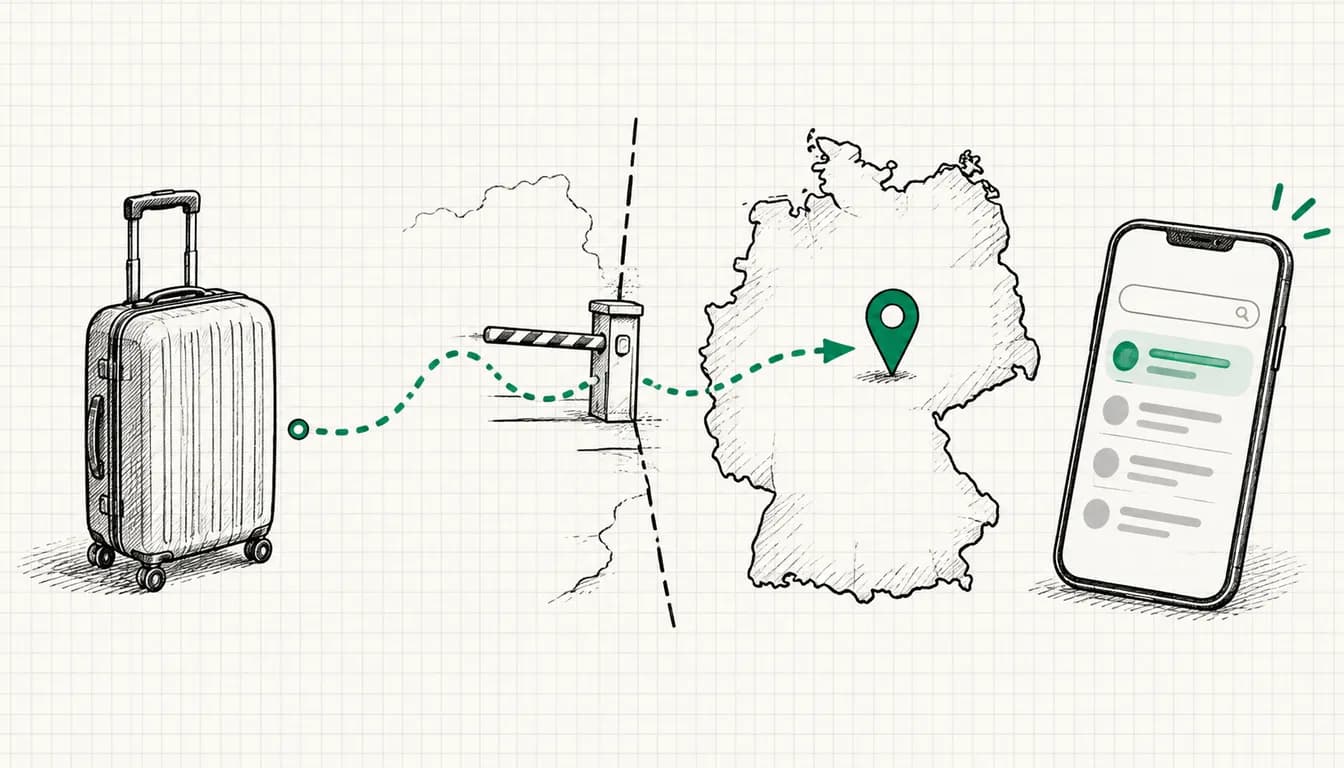
For many businesses from Poland and other EU countries, Germany is the obvious next market: right next door, large, and part of the same single market. Google Ads looks like the easiest way in. Copy the campaign, set the location to Germany, done. In practice, these launches rarely fail because of the technology. They fail because of language, settings and trust.
This guide shows what you should settle before you launch in Germany: how German ads come about, which account settings you only get to choose once, which legal questions you should have checked, and how German customers judge a provider from abroad. Facts about Google are backed by Google Ads Help, and laws by their wording on gesetze-im-internet.de. This is not legal advice: a lawyer settles the individual case.
Why Germany is a market of its own
Even within the EU, Germany is not an extension of your home market. The search terms are different, the expectations of a provider are different, and alongside EU law there are German rules that German customers and competitors know well. A campaign that works in Poland is therefore not a finished concept for Germany but a starting point.
And Germany is not the whole German-speaking region. Austria and Switzerland have their own terms, their own prices and their own rules; Switzerland is not part of the EU and uses the Swiss franc. If you later want to advertise there too, my practice is to plan separate campaigns per country rather than throwing Germany, Austria and Switzerland into one pot.
Language: think in German, do not translate
The most common mistake in market entry is the translated campaign. The Polish ad is carried over into German, the keywords along with it, and the result is a campaign that is roughly correct grammatically but misses what people actually search for.
What is changing at Google around language
The language of your ad is becoming more important at Google. According to Google Ads Help, the way language targeting works changes from September 2026: for Search campaigns, the language targeting setting is removed at campaign level, and the language of your ads is taken into account automatically when Search ads are selected. For Performance Max, the language setting no longer applies to ads served on the Google Search Network, but it still applies to YouTube, the Display Network, Discover and Gmail. According to Google, Shopping ads in Performance Max are not affected by the language settings.
According to Google Ads Help, Google determines which language a user understands from the language of the search term, the user's language settings and other settings. Part of this is whether the user understands the language of the ad and of the landing page. My conclusion: a German ad that leads to a Polish or English landing page is a contradiction. For Germany, both the ad and the page belong in German.
Research keywords for Germany from scratch
Keywords are researched for Germany from scratch, not translated. A dictionary tells you what a word means, but not how people in Germany search for it. Whether your customers type “Kunststofffenster” or “PVC-Fenster” (both mean uPVC windows) is answered by Keyword Planner with Germany as the location, not by the translation.
There are regional differences within Germany too. A well-known example: in the south and west, people tend to say “Schreiner” for a carpenter or joiner, in the north and east “Tischler”. If you only book one variant, you give away part of the demand depending on the target region. Then there are German compound nouns: a Polish expression of three words often becomes a single long word in German, and that single word is what people type in.
What the difference looks like in the ad
Example, freely chosen: a Polish window manufacturer that wants to reach German homeowners. I keep both ads in German here, because that is the language they would run in. This is the literally translated version:
Sponsored
Constructed exampleFenster PVC Hersteller | Beste Qualität und Preis
Wir sind Produzent von Fenster in Polen. Bitte kontaktieren Sie für Angebot über Formular.
In English it reads roughly: “Windows PVC manufacturer | Best quality and price. We are producer of window in Poland. Please contact for offer via form.” German readers spot the grammar mistakes immediately, and the text describes the provider instead of the benefit. This is the same ad written for Germany:
Sponsored
Constructed exampleKunststofffenster nach Maß | Deutschsprachige Beratung
Gefertigt nach Ihren Maßen, Lieferung nach Deutschland. Jetzt Angebot anfordern.
Roughly: “Made-to-measure uPVC windows | German-speaking advice. Made to your measurements, delivered to Germany. Request a quote now.”
Formal or informal address
German has two ways of saying “you”: the formal “Sie” and the informal “du”. In ads for the German market, “Sie” is in my experience the safe default, especially in B2B and for higher-priced services. “Du” fits young consumer brands better. More important than the choice is that the ad, the landing page and your emails use the same form of address. Switching between “du” and “Sie” quickly looks unprofessional to German readers.
My advice: have the ads and the landing page written, or at least reviewed, by someone with native-level German. Machine translation is a good draft, but not a finished text.
Account settings you only choose once
Some decisions are made when the account is created and cannot be corrected afterwards. I would settle the following before the first click.
Time zone and currency
According to Google Ads Help, the time zone and the currency are set permanently when the account is created, and neither setting can be changed afterwards. Poland and Germany share the same time zone, so that question is relaxed. The currency is not: you choose the account currency once during setup, it is fixed permanently after that, and which currencies are offered depends on the country. In my view, the account belongs in the currency in which your accounting wants to process the Google invoices. You can run campaigns for Germany regardless of the account currency, because location targeting is set at campaign level.
Tax details and account purpose
Caution is needed here, because the rules are described differently from country to country. In the EU country sections of Google's tax help that I checked (for example Spain and Luxembourg), the gist is this: Google needs your VAT ID, does not add VAT charges to your account unless you selected the non-business option, and you are responsible for self-assessing VAT, with reference to Article 44 of Directive 2006/112/EC. Account type, account purpose and tax status are also final there once billing setup is complete. For a company based in Germany, my post on VAT and reverse charge on the Google Ads invoice shows how this self-assessment ends up in the German VAT return.
I have not verified the section for your own country; check it yourself in the help centre. Google states explicitly there that it cannot give advice about VAT and refers you to your local tax authority. That is exactly what I would do: go through the settings with your tax adviser before creating the account.
Payment methods
According to Google Ads Help, which payment methods are available for Google Ads depends on your country, your currency and your payment settings. What a German company can use does not necessarily apply to your account. Check this when you create the account, not once the first campaign is ready to launch.
Location: presence or interest
The location option decides who sees your ads. According to Google Ads Help, “Presence or interest” is the default and the recommended setting: you then reach people who are likely to be in, or regularly in, your target locations, but also people who have shown interest in those locations. With “Presence”, only people who are likely to be in, or regularly in, those locations remain.
For market entry, this makes a real difference. With the default setting, your Germany campaign can also reach people outside Germany who are interested in Germany, for example in your home market. If you only sell or deliver to customers in Germany, “Presence” is in my practice usually the cleaner choice.
Legal: what I would have checked before launch
I am not a lawyer, and this section is not legal advice. I name the provisions with sources so that you know what to ask about. The answer for your business comes from a lawyer who knows German law and the law of your own country.
Provider information and the Impressum
The German rule is in Section 5 of the German Digital Services Act (Digitale-Dienste-Gesetz, DDG), formerly in the Telemedia Act. Under it, service providers offering digital services on a business basis, usually for payment, must keep certain information easily recognisable, directly accessible and permanently available, including name and address, an email address, register details and, where applicable, the VAT identification number. In Germany, this page is called the Impressum.
For companies from other EU member states, Section 3 DDG matters: the country of origin principle. Under subsection 2, the free movement of digital services offered on a business basis in Germany by service providers established in another member state is not restricted, subject to subsections 5 to 7. Subsection 3 excludes, among other things, consumer contracts and data protection. As I understand it, a company based in Poland is therefore first of all subject to the information requirements of its own country. Whether that is enough in your case is for your lawyer to decide.
Regardless of the legal question, my practice shows: German users look for a link called “Impressum” in the footer. If it is missing, the site looks untrustworthy, even if the details are shown elsewhere.
Consent: GDPR, TDDDG and Consent Mode v2
The GDPR applies across the EU. For cookies and similar technologies, Germany additionally has Section 25 of the Telecommunications Digital Services Data Protection Act (TDDDG). Under subsection 1, storing information on the end user's device, or accessing information already stored there, is only permitted if the end user has consented on the basis of clear and comprehensive information. Which national rule applies to your website exactly is a question for your lawyer.
For Google Ads, the matter is clear regardless: for users in the European Economic Area, Google requires advertisers to comply with its EU user consent policy in order to use personalised ads and measurement. That depends on the users, not on where your company is based. Technically this means Consent Mode v2 with the parameters ad_user_data and ad_personalization. I explain how this works in detail in my article on Google Ads Consent Mode v2.
Price information in online shops
If you sell to German consumers, they expect prices to be shown the German way. The German rule is the Price Indication Ordinance (Preisangabenverordnung, PAngV): under Section 3(1), anyone who offers goods or services to consumers as a business, or advertises to them stating prices, must state the total prices. Section 4 governs the unit price for goods offered by weight, volume, length or area. Whether and how the PAngV applies to your shop is for your lawyer to clarify.
For Shopping ads, a Google rule comes on top: according to Merchant Center Help, the unit pricing measure attribute is required, in line with local regulations, for certain products advertised in the EU, the EFTA countries and the United Kingdom. So check before launch whether your products fall under this, rather than waiting for notifications in Merchant Center.
Trust: how German customers judge you
A provider from abroad starts in Germany with a trust handicap that even the best ad cannot make up for. The following points are not legal obligations but lessons from my work with clients in the German-speaking region:
- Complete provider information. Company name, address, contact details and the “Impressum” link in the footer.
- A contact person in German. Phone or email with someone who speaks German, and a realistic statement of when you will reply.
- Familiar payment methods. In my experience, many shop customers expect payment methods they know, such as invoice, PayPal or direct debit. Which ones you can offer depends on your payment provider.
- Clear delivery terms. Delivery time, shipping costs to Germany and returns are described in German on the landing page, not only at checkout.
- Reviews from Germany. Reviews from German customers in German carry more weight than many reviews in a language the reader does not understand.
- Be open about where you are from. Hiding your origin rarely works. In my view, it is better to state it openly and say what the customer gains from it, for example your own production or short routes across the border.
Competition and click prices: calculate, do not guess
The honest answer to whether clicks in Germany are more expensive than in your home market is: it depends on the industry and the keyword. I deliberately do not quote an average figure, because any blanket number misleads more than it helps for your particular offer.
What you can do instead:
- Get estimates for Germany. Keyword Planner shows you search volume and bid estimates for your researched keywords with Germany as the location. These are estimates, not prices.
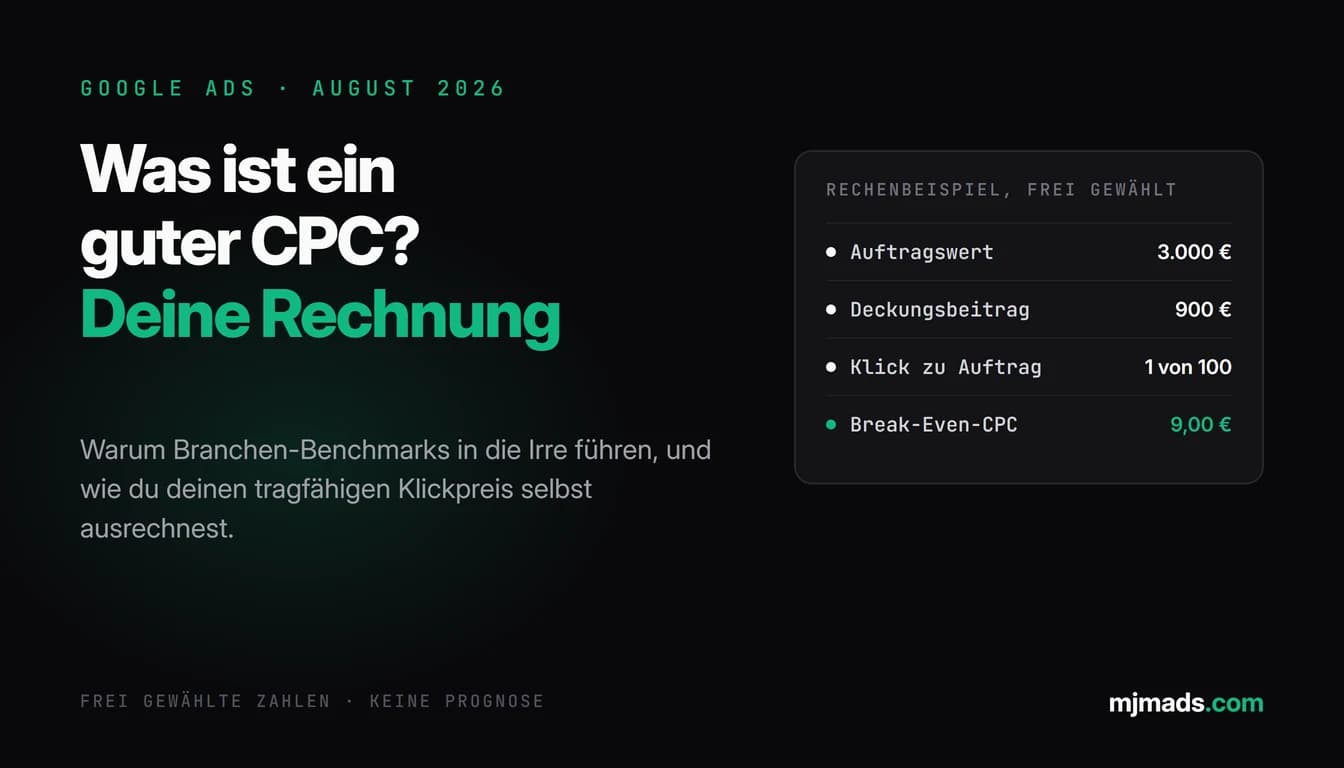
- Work out the sustainable cost per click. With the Google Ads CPC calculator, you work backwards from order value, contribution margin, conversion rate and close rate to the cost per click your business can sustain.
- Start regionally. If you cannot deliver or install equally well everywhere in Germany, start in the regions you serve best, for example close to the border. That keeps the budget manageable and the analysis clean.
- Judge per enquiry, not per click. In my experience, an expensive click that leads to an enquiry is worth more than three cheap clicks on a page nobody understands.
How I support your launch in Germany
I live in Kraków and work remotely for clients in the German-speaking region. I hold calls in German, Polish or English, so we can talk in your language about a market whose ads run in German. MJ Marketing is a Google Partner.
- Setup for Germany. My Google Ads setup builds the account, the tracking with Consent Mode v2 and the first campaigns for the German market, from €1,500 as a fixed price. What matters in a setup in general is described in my article on hiring a Google Ads setup.
- Ongoing management. Google Ads management starts at €1,000 per month, with a 3-month starting phase as the minimum term and cancellable monthly after that.
- German landing pages. If the page for Germany is still missing, I build it as part of web development.
What I do not do: legal or tax advice. For the Impressum, consent, price information and VAT, you need a lawyer and a tax adviser. I tell you which questions to ask them, and I implement the answers in the account and on the page.
Sources
- Google Ads Help, language targeting: support.google.com/google-ads/answer/1722078
- Google Ads Help, language targeting for Search campaigns: support.google.com/google-ads/answer/2740757
- Google Ads Help, account time zone and currency: support.google.com/google-ads/answer/9842104
- Google Ads Help, taxes and VAT by country: support.google.com/google-ads/answer/2375370
- Google Ads Help, available payment methods: support.google.com/google-ads/answer/2375433
- Google Ads Help, location options: support.google.com/google-ads/answer/1722038
- Google Ads Help, consent mode for users in the EEA: support.google.com/google-ads/answer/13695607
- Merchant Center Help, unit pricing measure: support.google.com/merchants/answer/6324455
- Section 5 DDG, general information requirements (German): gesetze-im-internet.de/ddg/__5.html
- Section 3 DDG, country of origin principle (German): gesetze-im-internet.de/ddg/__3.html
- Section 25 TDDDG, protection of privacy in terminal equipment (German): gesetze-im-internet.de/ttdsg/__25.html
- Section 3 PAngV, total price (German): gesetze-im-internet.de/pangv_2022/__3.html
- Section 4 PAngV, unit price (German): gesetze-im-internet.de/pangv_2022/__4.html
As of: October 2026