
Since 2 August 2026, you have to disclose realistic AI content in your advertising. That is what Article 50 of the EU AI Act requires. But the obligation does not cover every use of AI. Ad copy that a language model suggested to you usually needs no label. A photorealistic AI model, an avatar that poses as a real employee, a cloned voice or a product image that looks better than the actual goods, on the other hand, do. And a chatbot on your landing page has to identify itself as AI.
On top of that, unfair competition law keeps applying, regardless of any label. An AI image that promises more than the product remains misleading, even with “AI-generated” written on it. And Google, Meta, YouTube and TikTok have their own rules with their own labels, which only partly overlap with the legal obligation.
In this guide I sort it out for advertisers: which provision requires what, what the European Commission clarified in its July 2026 guidelines, what the Digital Omnibus changed (not much for Article 50) and how to classify typical advertising cases. I work in Germany, so I use German law as the national example and explain it for readers elsewhere. At the end you will find a downloadable decision table, wording examples and a checklist.
As of: 8 October 2026. I retrieved all legal texts, guidelines and platform pages on that day. The Commission's guidelines on Article 50 of 20 July 2026 have been approved in substance; according to the Commission, formal adoption will follow once all language versions are available. By their own account they are not binding. Only the Court of Justice of the EU can interpret the AI Act authoritatively.
Not legal advice: I write as an advertising practitioner who works with ads every day. This text does not replace a legal review of your specific campaign.
From the AI Act to labelling duties in advertising
First draft of the code of practice
marking and labelling of AI-generated content, draft stage
View sourceHamm court on chatbot statements
company liable for false statements made by its chatbot, not yet final
View sourceDigital Omnibus enters into force
Regulation (EU) 2026/1744, Article 50(1) to (6) unchanged
View sourceDeadline for legacy systems
machine-readable marking under Article 50(2) for systems placed on the market before 2 August 2026
View source
Article 50 AI Act: who has to disclose what
Article 50 of the AI Act sets transparency obligations for certain AI systems and distinguishes two roles. Providers develop an AI system, or have it developed, and place it on the market under their own name, for example the maker of your image generator or language model. Deployers use an AI system under their own authority in a professional capacity. If you create an AI image for an ad, you are a deployer. Purely personal use is exempt. As an EU regulation, the AI Act applies directly and in the same wording in every member state.
| Paragraph | Who | Obligation | What it means for advertising |
|---|---|---|---|
| Art. 50(1) | provider | people are informed that they are interacting with an AI, unless this is obvious | chatbots, voicebots and AI agents on your website and landing page |
| Art. 50(2) | provider | outputs marked in a machine-readable format as artificially generated | watermarks and metadata such as SynthID or C2PA, supplied by the tool |
| Art. 50(3) | deployer | inform people about emotion recognition and biometric categorisation | rare in day-to-day advertising |
| Art. 50(4), first subparagraph | deployer | disclose deepfakes as artificially generated or manipulated | AI models, avatars, cloned voices, misleading product images |
| Art. 50(4), second subparagraph | deployer | disclose AI text published to inform the public on matters of public interest | for example health advice articles without human review |
| Art. 50(5) | both | clear and distinguishable, at the latest at first interaction or exposure, accessible | how and when the label has to appear |
Table scrolls sideways
For you as an advertiser, Article 50(4) is the core. Article 50(2) is the tool provider's job, and Article 50(1) concerns you as soon as you run a chatbot. Article 50(6) clarifies that other transparency obligations under EU or national law remain unaffected, and according to the guidelines (paragraphs 50 and 129), consumer protection and unfair competition law apply alongside. That is why national unfair competition law gets its own section in this guide.
Provider or deployer: who is responsible for agencies and chatbots
The Commission's guidelines answer several questions that come up constantly in advertising practice (paragraphs 12 to 14):
- An advertising agency that creates a creative with AI is the deployer. Its employees are not; the company is responsible.
- If you have freelancers create AI content under your own control, you remain the deployer.
- If you merely commission an agency and do not decide on the AI use yourself, the guidelines say you are not the deployer. The obligation then lies with the agency.
- A company outside the EU that serves an ad with a deepfake of a well-known person to people in the EU is a deployer as well.
A practical tip on the third point: still put in writing who handles the labelling. Your name is on the ad, and in Germany, for example, Section 8(2) UWG extends cease-and-desist claims to the owner of the business when staff or a person acting on its behalf commits the infringement.
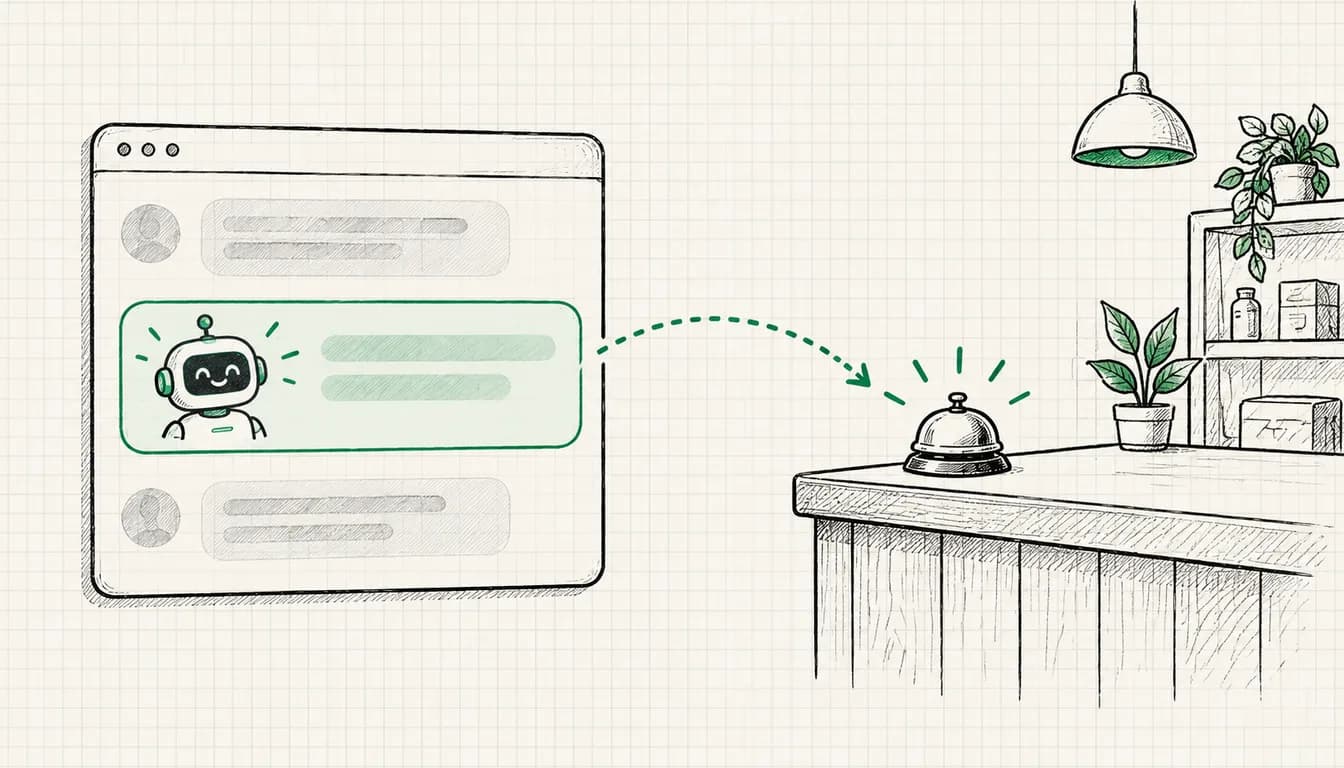
For chatbots, it depends on who builds them. According to the guidelines (paragraph 11), if you develop an interactive system yourself and deploy it under your own name, you are the provider and have to meet the notice obligation under Article 50(1) yourself. If you modify an existing system, for example with new training data, and run it under your own name, you also become the provider. If you embed a finished chat product unchanged, my reading is that the obligation stays with the manufacturer. Where exactly the line runs if you only write a system prompt and add your own content, the guidelines do not say explicitly. So I recommend the notice in every case: it costs one line of text and takes the edge off the question.
The same applies to AI agents that talk to people on behalf of a company. According to the guidelines (paragraph 31), they should disclose that they are an AI and on whose behalf they act. This becomes relevant for formats like Sponsored Agents in ChatGPT, where users chat directly with a brand's AI representative.
What a deepfake is, and why the term reaches further than it sounds
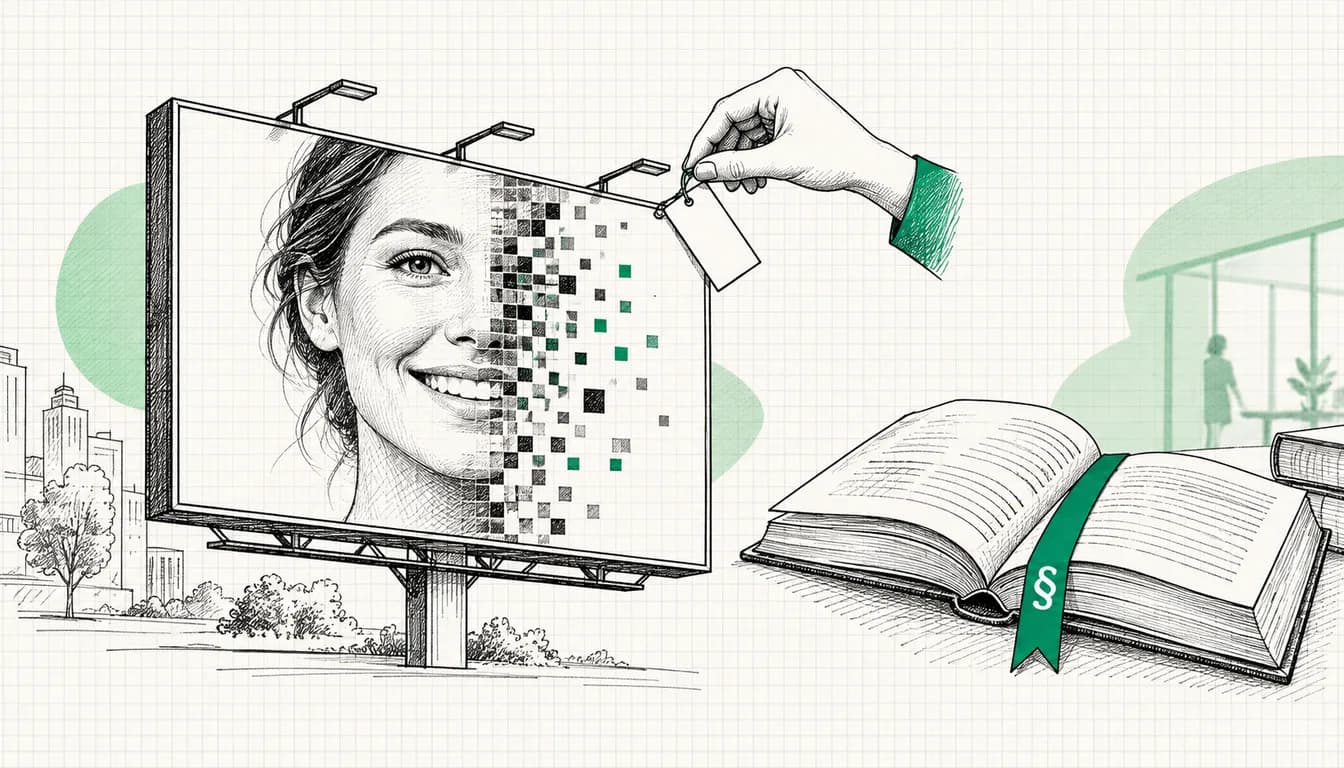
When people hear “deepfake”, most think of a fake politician video. The definition in Article 3(60) of the AI Act is broader: AI-generated or manipulated image, audio or video content that resembles existing persons, objects, places, entities or events and would falsely appear to a person to be authentic or truthful.
Two clarifications from the guidelines (paragraph 113) are decisive for advertising. First, the person shown does not have to exist. It is enough that they could plausibly exist. A photorealistic AI model is therefore covered even though this human does not exist. Second, realistic AI avatars, personas and personal features such as a voice are expressly included, and “events” also covers the depiction of services. No intent to deceive is required; the test is objective (paragraph 114). The benchmark is the audience realistically reached, including children and older people who are less able to recognise AI content (paragraph 115).
The guidelines give examples straight from advertising:
| Deepfake according to the guidelines | Not a deepfake according to the guidelines |
|---|---|
| AI video with an AI depiction of a celebrity influencer in an advertising context | AI video of mice arguing over the best type of cheese in a cheese maker's campaign |
| realistic synthetic avatar of a CEO congratulating employees on the annual results | real product, such as a car, against an AI background, as long as the ad does not mislead about its appearance, characteristics or use |
| AI product image in an ad or on packaging that shows the product as more appealing or of higher quality than in real life | AI voices for fictional characters, as long as nobody is misled about who the narrators are |
There is also an important relief (paragraph 116). Colour correction, background extensions, swapping backgrounds for clearly aesthetic purposes, arranging existing products and re-scaling images in product advertising are, according to the Commission, likely to have only a minor impact on whether someone perceives the ad as authentic. A classic product photo, cut out and placed against an AI background, is therefore usually not a deepfake. What matters is whether the product itself looks the way it will be delivered.
The creative exception is narrow
For evidently artistic, creative, satirical or fictional works, Article 50(4) only requires disclosure in a way that does not hamper the display or enjoyment of the work, for example in the closing credits. According to the guidelines (paragraph 122), advertising qualifies only in certain situations. “Evidently” is to be read narrowly, and where content is both informative and creative, the informative character prevails. The guidelines expressly name as not creative work:
- an AI video in the style of a teleshopping channel in which simulated consumers use a product to persuade viewers to buy it,
- a video in which a realistic synthetic influencer tests a sponsored real product.
A surreal spot with talking animals, on the other hand, often needs no label at all, because nobody takes it for real.
What the disclosure has to look like
Article 50(5) requires the information to appear in a clear and distinguishable manner at the latest at the first interaction or exposure, and to be accessible. The guidelines get specific here:
- The label must be visible or audible. The machine-readable marking embedded by the tool is not enough for you as a deployer (paragraph 117).
- A notice that is easily overlooked is not clear, for example one only in a manual, hidden in menu layers or in terms of use (paragraph 142).
- For deepfakes, the obligation applies to every output and every person exposed to the content (paragraph 143). If people are likely to join a video halfway through, a notice only at the beginning is not enough.
For chatbots, the guidelines (paragraph 37) name as appropriate a clear sentence such as “You are interacting with an AI system” in the first message, combined with a persistent badge near the input field, and for voice systems a spoken notice at the start. Considered insufficient (paragraph 38): a notice only in terms and conditions or documentation, metadata alone, a vague term like “assistant”, and blanket statements such as “Services on this website use AI”.
Code of practice and EU icons
For implementation there is a voluntary code of practice on marking and labelling AI-generated content. After two drafts of 17 December 2025 and 5 March 2026, the Commission published the final version on 10 June 2026, with one section for providers and one for deployers. On 8 July 2026 it assessed the code as adequate in an opinion. By 31 July 2026, according to the Commission, around 190 organisations had signed it, including Google, Meta, Microsoft, OpenAI and Anthropic in the provider section and Lufthansa, Lenovo and Getty Images in the deployer section. Signing and complying makes it easier to demonstrate compliance, according to the guidelines (paragraphs 147 to 149). But according to the recitals of the Digital Omnibus, the code does not create a presumption of conformity, and signing it is not mandatory.
The Commission has also published EU icons for AI content: a base icon plus variants for fully AI-generated and partly AI-modified content. They are free to use. The Commission's message, in short: using the icons is voluntary, the labelling obligations under Article 50 are not.
What the Digital Omnibus changed, and what it did not
For advertisers, one question about the Digital Omnibus matters most: does it postpone the labelling obligation? No. Regulation (EU) 2026/1744 of 8 July 2026, in force since 27 July 2026, leaves Article 50(1) to (6) unchanged. What it did change:
- Article 50(7): The Commission encourages codes of practice and assesses, taking utmost account of the opinion of the AI Board, whether they are adequate for paragraphs 2 and 4. It only adopts an implementing act if a code is inadequate.
- Transition for Article 50(2): AI systems placed on the market before 2 August 2026 have until 2 December 2026 to implement machine-readable marking (Article 111(4)). This concerns tool providers, not your obligation as a deployer.
- High-risk deadlines: postponed to 2 December 2027 (Annex III) and 2 August 2028 (Annex I). Mostly irrelevant for advertising.
- Fines: the relief for SMEs now also covers small mid-cap companies (Article 99(6a)).
According to the guidelines (paragraphs 153 and 154), Article 50 applies from 2 August 2026 also to systems already in use before that date. You do not have to label deepfakes created before that date retroactively, although the Commission recommends it. Packaging that has already been printed does not have to be changed.
Fines and supervision
- maximum fine for breaches of Article 50
- €15m or 3%
- whichever is higher, for SMEs the lower amount
- Article 50 applies
- 2 Aug 2026
- also to AI systems already in use before
- deadline for machine-readable marking
- 2 Dec 2026
- legacy systems of providers only
Source: Regulation (EU) 2024/1689, Art. 99, Art. 111(4) as amended by Regulation (EU) 2026/1744
The framework is set out in Article 99(4): up to 15 million euros or 3 % of total worldwide annual turnover for the preceding financial year, whichever is higher. For SMEs including start-ups, Article 99(6) applies the lower of the two. These are ceilings; the authority takes into account the nature, gravity and duration of the infringement (Article 99(7)).
Each member state designates its own market surveillance authority. In Germany, under Section 2 KI-MIG, in force since 29 July 2026, this is generally the Federal Network Agency (Bundesnetzagentur), and BaFin for the financial sector.
This is not legal advice. Whether your specific use falls under Article 50 is best clarified by a lawyer specialising in IT or competition law in the country where you advertise.
German law: a label does not make misleading advertising lawful
The AI Act only governs whether and how you disclose AI. Whether your advertising is lawful in substance is decided by unfair competition law. The guidelines say so themselves (paragraph 129): labelling does not mean that unlawful deepfakes, such as misleading advertising, may be created and distributed.
In Germany that law is the Act against Unfair Competition (UWG). It implements the EU Unfair Commercial Practices Directive 2005/29/EC, so the core rules exist in similar form in every member state, but the wording and case law are national. I link to the German original and to the official English translation by the Federal Ministry of Justice; only the German text is legally binding.
Section 5 UWG: the image must not promise more than the product
Section 5 UWG prohibits misleading commercial practices. A practice is misleading if it contains false statements or information likely to deceive, among other things about the main characteristics of the goods such as their nature or composition (subsection 2 no. 1) or about the trader's person, qualifications and status (subsection 2 no. 3). Under subsection 4, pictorial representations also count as information.
For AI images this means: a sofa that shows a fabric texture in the AI image it does not have, a dish that looks larger than the portion, or a generated bathroom renovation presented as your own reference project can all be misleading. With a label just as much as without. The same goes for AI ad copy: language models like to invent awards, years of experience or product features. Every claim has to be true, no matter who wrote it. How I build and check ad copy is explained in my practical guide to writing ad copy. Prompts that restrict the model to a list of facts you provide, plus a checklist for every output, are in ChatGPT prompts for Google Ads.
Sections 5a, 5b and 3a UWG: when the missing AI notice becomes a problem in itself
Under Section 5a(1) UWG, it is unfair to omit material information that consumers need to take an informed decision and whose omission is likely to make them decide differently. Whether the AI origin of an image is such information depends on the case: rather yes for the reference photo of a tradesperson, rather no for an obvious mood illustration.
Section 5b(4) UWG is interesting: information that may not be withheld from consumers under EU regulations for commercial communications is deemed material. In my assessment, a breach of the Article 50 disclosure obligation can thereby also become relevant under competition law, as can the breach-of-law provision in Section 3a UWG. As far as I can see, no court has decided this yet. In practice it would mean that, besides the authority, those entitled under Section 8(3) UWG could send cease-and-desist letters: competitors, qualified trade and consumer associations, and chambers such as the chambers of industry and commerce (IHK) and the chambers of crafts.
Section 5a(4) UWG: labelling advertising is not the same as labelling AI
Two obligations get mixed up all the time. Section 5a(4) UWG requires the commercial intent to be identified, unless it is directly apparent from the context. This is about “ad” or “advertising”. Article 50 requires the AI origin to be disclosed. A post by an AI influencer promoting a product needs both. On Google and Meta, the platform makes the advertising character visible with “Sponsored”, but not automatically the AI origin of your creative.
The blacklist: AI testimonials
The annex to Section 3(3) UWG lists commercial practices that are always unlawful towards consumers, regardless of the individual case. It mirrors Annex I of the Unfair Commercial Practices Directive, a single list that under Article 5(5) of the directive applies in all member states. For AI advertising, no. 23c is the most important. The official English translation reads: “Forwarding or commissioning false consumer reviews or endorsements by consumers and misrepresenting consumer reviews or endorsements in social media in order to promote goods or services”.
An AI-generated “customer” raving about their experience in a video is, in my assessment, a false consumer endorsement. An AI label does not change that, and misleading advertising under Section 5 comes on top. Putting a real customer quote into the mouth of an AI avatar is also risky, because the image shows a person who never said it.
Case law: what exists so far
Up to the date of this article, I have not found a published decision on whether AI images in advertising must be labelled under the UWG. Three German judgments do show the direction:
- Higher Regional Court (OLG) Hamm, judgment of 12 May 2026, case 4 UKl 3/25: The website chatbot of a provider of aesthetic treatments described the two doctors behind the company as “specialists in plastic and aesthetic surgery”. They did not hold these titles. The court classified the answers as misleading under Section 5(1) and (2) no. 3 UWG. The company is liable even if the chatbot was programmed with correct data, because the chatbot is not a “third party”. An appeal to the Federal Court of Justice has been allowed, so the judgment is not final. Source: press release of the North Rhine-Westphalia judiciary (German).
- Regional Court (LG) Berlin II, judgment of 20 August 2025, case 2 O 202/24: YouTube videos with links to an online shop used an AI imitation of the voice of a well-known German dubbing actor. The court found a violation of his right to his own voice and awarded him 4,000 euros as a notional licence fee, 2,000 euros per video. It rejected the defence that the videos were satire. I did not find a primary source and rely on the report by Legal Tribune Online (German). I do not know whether the judgment is final.
- Federal Court of Justice (BGH), judgment of 21 January 2021, case I ZR 120/19 (“Clickbait”): Using a celebrity's picture as click bait without any connection to them infringes their right to their own image and triggers a notional licence fee. No AI involved, but in my assessment the same logic carries over to AI doubles of well-known faces. Source: BGH press release (German).
Image rights and personality rights: consent first, then AI
As soon as a real person is recognisable, you need their consent. Under Section 22 of the German Art Copyright Act (KUG), portraits may only be distributed or publicly displayed with the consent of the person depicted. I would not rely on the exceptions in Section 23 KUG for advertising. They target contemporary events, incidental appearances, gatherings and art, not sales promotion, and subsection 2 excludes them where legitimate interests of the person depicted are harmed. The voice is protected by the general right of personality, as the Berlin judgment shows.
This also applies in-house. If you want your managing director to speak as an avatar or want to clone an employee's voice, get consent explicitly for the AI use and document it in writing, with purpose, channels and duration. For identifiable living persons, data protection law applies as well, which the guidelines also point out (paragraph 127).
DSA: what the platform has to show
A quick distinction: Article 26 DSA requires online platforms to show, in real time for every ad, that it is an ad, on whose behalf it runs, who paid for it and the main parameters used to target it. That obligation falls on the platform, not on you. Under Article 35(1)(k) DSA, very large platforms are also expected to prominently mark generated content that appears authentic. According to the guidelines (paragraph 126) you may use their labelling tools, but your responsibility as a deployer remains.
This is not legal advice. For specific creatives and campaigns, a lawyer specialising in competition law can help; in Germany, the chambers of industry and commerce and the chambers of crafts also offer initial guidance. If you advertise in another EU country, ask about that country's implementation of the Unfair Commercial Practices Directive.
Platform rules: Google, YouTube, Meta, TikTok, LinkedIn
The platforms have their own rules, some stricter and some looser than the law. Important: a platform label is a help, not proof that you comply with Article 50.
| Platform | AI label | What applies to you | Particularly strict |
|---|---|---|---|
| Google Ads | AI label setting per asset, visible overlay for EU targeting | set the label yourself, Google labels some assets automatically | impersonating public figures: account suspension without prior warning |
| YouTube | AI use disclosure in YouTube Studio | disclose realistic AI content | label in the player for photorealistic content |
| Meta | “AI info” for ads made with Meta's AI tools, detection of third-party AI rolling out | label sometimes only in the three-dot menu, own label advisable | no political or social issue ads in the EU |
| TikTok | AIGC label or clear disclaimer | label significantly AI-altered content | likeness of public figures without permission prohibited |
| no specific AI rule | general rules on deception and substantiation | no implied endorsements without permission |
Table scrolls sideways
Google Ads
Google describes the feature on the help page “Use AI content label settings and disclosures”. For existing campaigns, go to Asset studio in the Tools menu, select Asset library, choose an asset and select “Label this asset as created or edited with AI” or “Don't label this asset”. You can see the status in the “AI label” column. During campaign creation, Google prompts you to “Review assets” if your ads may require an AI label.
The effect: the disclosure appears globally in the “How this ad was made” section of the My Ad Center panel, which users open via the three-dot menu on Search, YouTube and Discover. For campaigns targeting the European Union, India or New York, Google also adds visible overlays on the ad itself. In some cases Google labels assets itself, for example where it is legally required to or when it receives signals from other platforms. With fully automated features, which I cover in my guide to AI and automation in Google Ads, assets may also be labelled on your behalf. These labels cannot be overwritten.
Your own labels in the creative are expressly allowed and, according to Google, do not violate the policies on text overlays and watermarks. Google advises not to place the label in the very corners or edges and to opt out of image enhancements, because cropping can cut the label off. Google embeds SynthID watermarks and C2PA metadata into images and videos generated within Google Ads tools. And the help page itself warns: the AI label setting does not guarantee your compliance with specific regulations, so seek legal guidance.
Two policies are particularly sharp for AI creatives. Under the Unacceptable business practices policy, Google prohibits pretending to be a public figure or implying a connection that does not exist. One of Google's examples: AI-generated videos of popular YouTubers that appear to endorse a get-rich-quick scheme. Violations are treated as egregious: accounts are suspended upon detection and without prior warning, and you must be able to prove consent from the person, including for their voice. What to do after a suspension is covered in my post on a suspended Google Ads account. The Misrepresentation policy also prohibits manipulated media intended to deceive, defraud or mislead. If only individual ads are disapproved, that is a different problem, covered in the post on disapproved ads.
According to its political content policy, Google no longer allows political advertising within the meaning of Regulation (EU) 2024/900 in the EU, so its AI disclosure rule for election ads only matters for campaigns outside the EU.
YouTube
According to the page “Disclosing use of GenAI content”, YouTube requires a disclosure when realistic content was generated or meaningfully altered with AI: when a real person appears to say or do something they did not say or do, when footage of a real event or place is altered, or when a realistic scene is shown that never happened. The example with an advertising angle: AI-generated extra footage of a real place, like a surfer in Maui for a promotional travel video. You make the disclosure during upload in YouTube Studio, in the Attributes section under “AI use”.
YouTube does not require a disclosure for beauty filters, colour adjustment, AI help with a script or thumbnail, or cloning one's own voice for voice-overs, among other things. This shows how platform rules and the law can diverge: whether a cloned own voice is a deepfake under Article 50, the guidelines do not answer explicitly. By the way, if you upload video ads to YouTube from within Google Ads, you are asked directly about AI use.
Meta
According to its newsroom post on AI transparency in ads, Meta labels ads created or significantly edited with Meta's own AI tools with “AI info”. In the original February 2025 version of the post, the label sits next to “Sponsored” for an AI-generated photorealistic human, and otherwise sometimes only in the three-dot menu. With the update of 1 June 2026, Meta bundles the labels in a new “About this ad” section in the three-dot menu and starts detecting third-party AI automatically via industry-standard signals. Meta itself writes that the presentation may vary by region due to legal requirements.
My take: a label that sits only in the three-dot menu is hardly what the Commission means by clear and distinguishable (paragraph 142). For deepfake cases on Meta, I therefore put my own visible label into the creative or the first sentence of the ad copy. Meta has stopped political, electoral and social issue ads in the EU since early October 2025.
TikTok
In its ad policy on misleading and false content, TikTok allows significantly AI-altered content if the AIGC label is applied or a clear disclosure is included, for example as a disclaimer, caption, watermark or sticker. Minor edits such as lighting, background or noise reduction are exempt. The likeness of public figures without permission and false endorsements are prohibited. Undisclosed AI can lead to rejection or restriction of the ad.
The LinkedIn advertising policies, in the version of 18 November 2025, contain no specific rule on AI content. The general requirements under “Fraud and Deception” apply: no misleading content, claims must be substantiated, and you may not imply an endorsement by people or organisations you do not have. For LinkedIn, that means Article 50 and unfair competition law are the benchmark.
Decision table: seven everyday advertising cases
The classification is my assessment based on Article 50, the guidelines and the platform rules, as of 8 October 2026. The UWG column uses German law as the example. It does not replace a review of the individual case.
| Case | AI Act | Unfair competition risk (UWG) | Platform rule | My recommendation |
|---|---|---|---|---|
| AI ad copy | no obligation: not a deepfake, and according to the guidelines ad copy falls outside Art. 50(4) second subparagraph, except for claims related to health, consumer safety or sustainability | Section 5: every claim must be true | no AI label needed | check the facts, no label |
| AI product image | deepfake if it can mislead about appearance, characteristics or use, real product against AI background usually not | Section 5(2) no. 1 and (4): the image counts as information | Google: AI label via setting, TikTok: label significant changes | photograph the real product, background may be AI, label fully generated product images and compare them with the goods |
| AI model or avatar | deepfake if realistic, even if the person does not exist | Section 5(2) no. 3 if presented as a real employee or customer | Meta: “AI info” for Meta's own AI tools, sometimes only in the menu, YouTube: AI use disclosure | label visibly, in videos continuously or repeatedly |
| AI voice in a spot | neutral narrator voice: grey area, the guidelines count realistic voices as personal features, cloned voice of a real person: deepfake | right to one's own voice, Section 5 if an identity is faked | YouTube: disclosure for realistic content, own voice exempt | short notice “Narrator voice AI-generated”, for clones also written consent |
| Deepfake of a real person | deepfake, disclose | Section 22 KUG, personality rights, Section 5 for a faked endorsement | Google: without provable consent, suspension without prior warning, TikTok: prohibited without permission | only with written consent and a visible label, with celebrities practically never |
| AI testimonial | a realistic invented customer is a deepfake | annex no. 23c: false consumer endorsement, a label does not help | TikTok and LinkedIn: no false endorsements | do not do it, show real customers with consent |
| Chatbot on the landing page | Art. 50(1): notice of AI interaction, obligation on the provider, if you build or modify it you are the provider | OLG Hamm: liability for false chatbot statements | no ad platform rule | notice in the first message plus a badge at the input field, limit the chatbot to verified facts |
Table scrolls sideways
The table, with a wording example for each case, is also available as a file:
Wording examples
A good label is short, specific and placed where people are looking anyway. I use these wordings as a starting point:
| Situation | Wording | Placement |
|---|---|---|
| image fully AI-generated | “AI-generated image” | in the creative, clearly legible, not in a corner that gets lost when cropped |
| image partly edited with AI | “Edited with AI” | in the creative |
| AI model or avatar in a video | “This person is AI-generated” | shown at the start and again while the person is on screen |
| cloned voice with consent | “Voice AI-generated, with the speaker's consent” | as an overlay or spoken at the end, for audio also at the start |
| AI narrator voice in an audio spot | “Narrator voice AI-generated” | spoken, for long spots at the start and the end |
| chatbot, first message | “Hi, I'm the AI assistant of Example Ltd, not a human. I answer questions about appointments and services.” | first message plus a persistent “AI” badge at the input field |
| voicebot on the phone | “You are speaking with an AI assistant.” | spoken at the start of the call |
Table scrolls sideways
What this can look like in a social ad:
Sponsored
Constructed exampleThe new autumn collection
Presented by an AI-generated model. Fabrics, colours and cuts match the real garments.
The second sentence matters to me. It discloses the AI and at the same time says what is real. That part is what protects you under unfair competition law; the label alone does not.
What is not enough:
- “This website uses AI.” Too generic, as the guidelines expressly say (paragraph 38).
- A notice only in the terms and conditions, privacy policy or legal notice (paragraphs 38 and 142).
- “#ai” among twenty other hashtags. In my assessment easy to miss and therefore not clear.
- A label only in the first two seconds of a 30-second video that many people join halfway through (paragraph 143).
- A chatbot with a human name and portrait photo but no AI notice. The guidelines expressly name human-like representations without a notice as insufficient (paragraph 38).
Checklist before going live
- Go through every creative: does it show realistic people, voices, places, products or scenes that AI generated or significantly altered?
- If yes: a visible or audible label in the creative itself, not only in metadata or the platform menu.
- For videos: a label at the start and, for longer clips, again while the AI content is on screen.
- Compare product images with the real goods: colour, material, size, what is included.
- No invented customers or reviews, not even with a label.
- Documented consent for every recognisable real person and every cloned voice, explicitly covering the AI use.
- In Google Ads, set the AI label per asset and check image enhancements so your own labels are not cropped.
- Fill in the AI use disclosure for YouTube uploads, apply the AIGC label on TikTok.
- Chatbot: AI notice in the first message, a badge at the input field, answers limited to verified facts.
- Agree in writing with your agency and freelancers who labels and who obtains the consents.
- Have AI texts with claims on health, consumer safety or sustainability reviewed by a qualified person, including a fact check.
- If in doubt, get a legal review before launch.
Methodology
- Legal sources
- Regulation (EU) 2024/1689 (AI Act) as amended by Regulation (EU) 2026/1744, the German UWG, KUG and KI-MIG, the DSA and Directive 2005/29/EC, each in the official text on EUR-Lex and gesetze-im-internet.de, plus the official English translation of the UWG.
- Interpretation
- Commission guidelines C(2026) 5054 of 20 July 2026 (paragraph numbers in the text), the code of practice of 10 June 2026, the Commission opinion of 8 July 2026 and the Commission's page on the EU icons.
- Platforms
- help pages and policies of Google Ads, YouTube, TikTok and LinkedIn as well as Meta's newsroom posts, each in the version available on the reference date.
- Case law
- OLG Hamm and BGH via the courts' press releases, LG Berlin II only via a Legal Tribune Online report because no primary source could be found.
- As of
- 8 October 2026, all sources retrieved on that day.
- Classification
- the assessment of the seven cases is my view as an advertising practitioner, not legal advice. Where the sources give no clear answer, the text says so.
- Updates
- on formal adoption of the guidelines, new court decisions and changes to platform rules.
Conclusion: label where reality is simulated
The rule of thumb is simpler than all these provisions suggest. You have to label where AI simulates reality: people, voices, products, places and scenes that look real and are not. Where AI only assists, suggesting copy, correcting colours or swapping a background, a label is usually not needed. And unfair competition law stays untouched by all of this: your advertising has to be truthful either way.
In practice that means setting up a fixed routine once, covering who checks which creatives, where the label goes and where the consents are filed, instead of rethinking it for every campaign. With advertising in AI assistants, a new channel is arriving where exactly these questions come up again. If you want to advertise in ChatGPT, I handle the setup as ChatGPT Ads from €1,500.
If you want to use AI systematically in your marketing and build a clean labelling routine along the way, I can look at it as part of my AI consulting: as an AI audit for €700 or as an implementation sprint from €3,500. The legal sign-off for individual creatives still belongs with a lawyer.