
As of 8 October 2026, four major providers show ads in or directly next to AI answers: OpenAI in ChatGPT, Google with AI Overviews and in AI Mode, Microsoft in Copilot and Amazon in its shopping and voice assistants. Only one of them, ChatGPT Ads, can be booked as a separate channel with its own budget. Everywhere else, ads reach AI surfaces automatically from existing campaigns, and most of the new conversational formats run in the US only. Every detail below comes from the provider's official page or is labeled as a media report, linked with the date I retrieved it.
I built this overview because the line “AI assistants now show ads too” appears in a lot of coverage, but rarely with the details: which format, whether it is a US-only test, and what an advertiser can actually buy. So every provider gets the same profile: format, status, markets, booking, targeting, labeling and sources. If you want to go deeper on ChatGPT Ads, my guide to ChatGPT Ads in Germany covers setup, costs and policies with a European focus.
As of: 8 October 2026. All provider pages retrieved on that day. I only cite media reports where a provider has published nothing itself. I update this overview when a provider launches or discontinues a format or expands to new countries.
- providers with ads in or next to AI answers
- 4
- OpenAI, Google, Microsoft and Amazon
- of them also serve in Germany
- 3
- ChatGPT, Copilot and Google above and below AI Overviews
- countries in the ChatGPT Ads Manager
- 63
- self-serve, including the US, the UK, Germany and Poland
- countries with ads inside AI Overviews
- 12
- English only, no EU country among them
- minimum daily budget for ChatGPT Ads in euros
- 15 EUR
- 25 USD or 15 GBP for accounts billed in those currencies
Source: Official provider pages, retrieved 8 Oct 2026
Ads in AI assistants: the comparison
The table covers every provider and surface I checked. Details and sources follow in the profiles below.
| Provider and surface | Format | Status (as of 8 Oct 2026) | Markets | Booking | Labeling |
|---|---|---|---|---|---|
| ChatGPT (OpenAI) | Ad below the answer with name, favicon, title, copy, image and link | Live as beta, test since 9 Feb 2026, Europe since August 2026 | 63 countries, no personalized ads in the EEA and Switzerland | Self-serve Ads Manager, from 25 USD or 15 EUR per day | “Sponsored”, visually separated |
| ChatGPT Sponsored Agents | Conversation with an advertiser's AI agent after clicking an ad | Alpha test since 16 Sep 2026 | US only | Selected advertisers only | Clearly labeled, according to OpenAI |
| Google AI Overviews, above and below | Text, Shopping, local and app ads around the AI summary | Live in 200+ markets | All AI Overviews markets, including Germany | Automatic from existing campaigns | Same as regular search ads |
| Google AI Overviews, inside | Text and Shopping ads within the AI answer | Live since 3 Oct 2024, now 12 countries, English only | Australia, Canada, India, Indonesia, Kenya, Malaysia, New Zealand, Nigeria, Pakistan, Philippines, Singapore, US | Automatic, no direct targeting, no opt-out | “Sponsored” |
| Google AI Mode | Ads below and within answers, new formats in testing | Test since 21 May 2025 | US | Automatic via Performance Max, Shopping, broad match or AI Max | “Sponsored” |
| Microsoft Copilot | Ad block below the answer with a short intro (“ad voice”) | Live since 2023, fully ramped in English, French and German speaking markets since March 2025 | English, French and German speaking markets, Spanish and Japanese announced | Automatic from Microsoft Advertising campaigns, no opt-out | Distinctly marked, according to Microsoft |
| Amazon Sponsored Prompts | Sponsored questions in search results and on product pages that open the shopping assistant | Generally available since 25 Mar 2026 | US only | Automatic in Sponsored Products and Sponsored Brands campaigns, CPC | Not described in the announcement |
| Amazon Alexa+ | Sponsored products in conversation, sponsored tiles and Agentic Ads on Echo Show | Test since 15 Aug 2025, more formats since October 2025 | US named, no markets named for Agentic Ads | Automatic from Sponsored Products, Amazon DSP, Agentic Ads with launch partners | Not described in the announcements |
| Perplexity | Sponsored follow-up questions and ads next to the answer | Being phased out since 2025, no further ad plans, per FT report | Launched in the US | No longer offered, per report | “Sponsored” |
| Gemini app (Google) | No ads | No ads and no current plans, according to Google (December 2025) | None | Not available | n/a |
| Claude (Anthropic) | No ads | Ad-free, according to Anthropic (4 Feb 2026) | None | Not available | n/a |
| Meta AI | No in-assistant ad format found, AI chats used as a signal for ads on Meta's platforms | Signal since 16 Dec 2025 | Most regions, not the EU, UK or South Korea per TechCrunch | Not available | n/a |
Table scrolls sideways
Two things stand out. First, except for ChatGPT, the provider decides whether your ad ends up on the AI surface. Google and Microsoft serve ads automatically from existing campaigns, and both state explicitly that there is no opt-out for ads in AI Overviews or in Copilot respectively. Second, almost everything beyond a classic ad below the answer is US-only so far: conversations with brand agents, offers inside the answer, purchases within the conversation.
The providers in detail
Every profile follows the same structure. “Live” means the provider describes the format as available, even if it calls it a beta. “Test” means the provider itself calls it a test, pilot or alpha.
OpenAI: ChatGPT Ads
- Format: The ad appears below the end of a response. According to OpenAI, it consists of the advertiser's name, a favicon, title, copy, landing page and image.
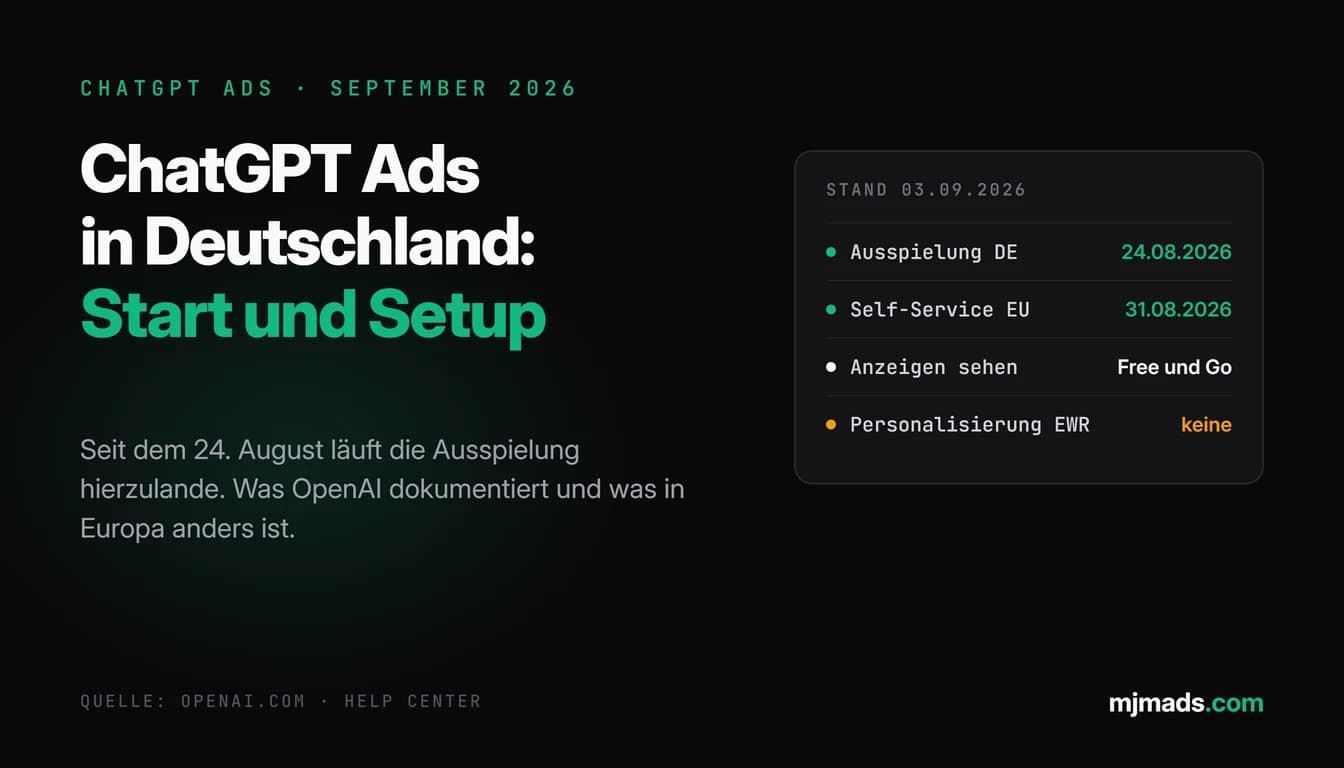
- Status: Live, officially a beta “in the early stages of scaling”. The test started in the US on 9 February 2026. After a pilot from February through April, OpenAI is expanding access through self-serve onboarding in Ads Manager, according to its FAQ. In the six months after launch, OpenAI added eight more markets. On 18 August 2026 it announced the launch in 31 European countries for the following week, including Germany, France, Spain, Italy and the Netherlands. Since 31 August 2026, self-serve access has been open in all 31 markets.
- Markets: The availability page lists 63 countries for self-serve, including the US, Canada, the UK, Germany, France, Poland, Japan, India and Australia. What counts is where the legal entity that advertises and gets billed is based.
- EU and Germany: Yes. According to OpenAI, personalized ads are not initially available in the European Economic Area or Switzerland.
- Booking: Self-serve in Ads Manager, larger advertisers through the sales team. Campaign objectives are Views (CPM), Clicks (CPC) and Conversions. Conversion campaigns are billed via oCPC or oCPM, so per click or per 1,000 impressions, never per conversion. The minimum daily budget is 25 US dollars, 15 euros, 15 pounds, 65 zloty or 20 Swiss francs. Some new accounts can initially advertise only in their home country until identity verification is approved and a spend threshold is reached.
- Targeting and signals: Context hints at ad group level, which OpenAI explicitly says are not exact-match keywords. Plus countries and, where available, states or regions, cities and postal codes, as well as platforms. Custom audiences need at least 25,000 matched users for inclusion and should not be used for the EEA and Switzerland. On the user side, ChatGPT considers the current conversation, general location and language, and with personalization turned on also past chats and memories. A relevance-weighted, second-price auction decides which ad is shown.
- Labeling: Labeled as “Sponsored” and visually separated from the response. No ads for users under 18, none in the Plus, Pro, Business, Enterprise and Edu plans, none in Temporary Chats and, during the test, none in the Atlas browser.
- Sources: Ads in ChatGPT, Ads Manager Availability, Create campaigns, The basics, Expansion across Europe
For planning, the industry question matters most. During the test phase, OpenAI's ad policies (version 1.6, September 2026) primarily admit consumer verticals such as lifestyle and household goods, local services, travel, and digital products and education. Ads for financial and health services are “generally prohibited” outside the US, and legal services are only permitted in the US. The glossary entry on ChatGPT Ads sums up what the channel is in a few lines.
OpenAI gives two figures itself: ChatGPT reaches 1.2 billion people each week, and tens of thousands of marketers have already advertised there. Both are the provider's own numbers. According to OpenAI's FAQ, there are no performance benchmarks for advertisers yet. Two further OpenAI formats, Sponsored Agents and ads during image generation, are covered further down under announced formats.
Google: AI Overviews and AI Mode
Google has two AI surfaces in Search with different rules. The Gemini app is a third one, and it has no ads (more on that in the section on assistants without ads).
- Format: Text, Shopping, local and app ads can appear above or below an AI Overview. Inside AI Overviews, Google shows Text and Shopping ads within the AI answer, matched to both the query and the content of the summary. In AI Mode, ads may appear below and integrated into responses, according to Google.
- Status: Above and below AI Overviews: live. Inside AI Overviews since 3 October 2024, first on mobile in the US, on desktop since 21 May 2025. Google has been testing ads in AI Mode in the US since 21 May 2025, and new test formats were added on 20 May 2026.
- Markets: Above and below in all 200+ markets where AI Overviews are available. Inside only in English and in twelve countries: Australia, Canada, India, Indonesia, Kenya, Malaysia, New Zealand, Nigeria, Pakistan, Philippines, Singapore and the US. For AI Mode, Google names the US.
- EU and Germany: Above and below AI Overviews, yes. Inside AI Overviews and in AI Mode, no EU country is included, and Google has not given a date.
- Booking: No dedicated placement. Above and below AI Overviews, ads from Search, Shopping, Performance Max and App campaigns serve under the normal auction system. Inside AI Overviews, Text and Shopping ads from Search, Shopping and Performance Max campaigns are eligible. You cannot target or exclude this placement, Google reports these ads as “Top Ads” and offers no segmented reporting. For AI Mode, Google names Performance Max, Shopping and Search campaigns with broad match, including AI Max.
- Targeting and signals: No dedicated settings. Google uses its existing auction system. Inside AI Overviews, the content of the AI answer and detected commercial intent also count, which is why Google relies on broad match, AI Max, Performance Max, Shopping or Dynamic Search Ads there.
- Labeling: Google cites the “Sponsored” label for ads in AI Overviews and for the new AI Mode formats. Inside AI Overviews, Google currently shows no ads for sensitive verticals such as adult, alcohol, gambling, finance, healthcare and politics.
- Sources: Google Ads Help on ads in AI Overviews, launch in October 2024, desktop and AI Mode test in May 2025, Google Ads Highlights 2025, Google Marketing Live 2026
What this means for your campaigns, which keyword options are eligible and what to check in your account is covered in detail in my article on Google Ads in AI Mode.
Microsoft: Copilot
- Format: Ads appear in a block below the organic response. Since October 2024, Copilot introduces this block with a short sentence explaining how the following ads connect to the conversation. Microsoft called this “ad voice”. Eligible are Multimedia ads, Product ads from Shopping and Performance Max campaigns, Search ads with a logo, and two vertical formats for property promotion and tours and activities.
- Status: Live. According to Microsoft, Search ads have run in Copilot since its launch in 2023. On 5 March 2025, Microsoft reported that ads in Copilot had fully ramped in all English, French and German speaking markets.
- Markets: English, French and German speaking markets. According to the March 2025 announcement, Spanish and Japanese were to follow that month, with other languages later.
- EU and Germany: Yes, Germany is among the German speaking markets.
- Booking: Through Microsoft Advertising. All eligible campaign and ad types are automatically opted in to Copilot, there is no opt-out and no guarantee that ads will be shown. Search ads need a logo to be eligible. Microsoft Advertising does not currently offer Copilot-specific metrics.
- Targeting and signals: Microsoft considers the entire conversation, not just the last prompt, and after Copilot has resolved the initial query it uses user information to select ads. Negative keywords apply in Copilot just as they do in web search.
- Labeling: According to Microsoft, organic responses are never influenced by sponsored content, which is “distinctly marked”. Copilot shows no ads in conversations that its AI models flag as potentially harmful.
- Sources: Microsoft Help, About ads in Copilot, Microsoft Advertising, October 2024, Microsoft Advertising, March 2025
For restricted industries, one line in the help page matters: if an ad can serve on Bing, it can also serve in Copilot, and ad copy is not truncated, so required disclaimers stay visible.
Amazon: Alexa for Shopping and Alexa+
On 13 May 2026, Amazon introduced “Alexa for Shopping” in the US, bringing together its previous shopping assistant Rufus and Alexa+. The ad formats are split between this assistant in the Amazon app and Alexa+ on Echo Show.
- Format: Sponsored Products prompts and Sponsored Brands prompts are sponsored questions in shopping results and on product detail pages. A click opens a conversation with the assistant or answers directly on the page. On Alexa+, there are sponsored products in shopping conversations, sponsored tiles for streaming content and, since June 2026, Agentic Ads, which let customers buy within the conversation, for example a pizza or concert tickets.
- Status: Prompts launched in open beta in November 2025 and have been generally available in the US since 25 March 2026. Amazon has been testing sponsored products in Alexa+ since 15 August 2025. Entertainment ads arrived on 25 October 2025 for managed-service clients and on 17 June 2026 for self-serve. Agentic Ads launched on 23 June 2026 with partners such as Papa Johns.
- Markets: For prompts, sponsored products in Alexa+ and entertainment ads, Amazon names only the US. For Agentic Ads, Amazon names no countries.
- EU and Germany: No. Amazon names no EU country for any of these formats.
- Booking: Prompts run automatically within existing Sponsored Products and Sponsored Brands campaigns, billed per click, and individual prompts can be paused. Sponsored products in Alexa+ also come automatically from active Sponsored Products campaigns, while entertainment ads are booked through Amazon DSP.
- Targeting and signals: Prompts use the campaign's targeting and draw on data from detail pages, the Brand Store and the campaign. For Agentic Ads, Amazon says Alexa can draw on past conversations, such as a customer's favorite pizza toppings.
- Labeling: Amazon does not describe the labeling of prompts or Alexa+ formats in its announcements. Branded Conversations, announced for January 2027, are to be “clearly marked as Sponsored”.
- Sources: Sponsored prompts generally available, Alexa for Shopping, Sponsored Products in Alexa+, entertainment ads, managed service, entertainment ads, self-serve, Alexa+ Agentic Ads
Perplexity: sponsored follow-up questions
- Format: Sponsored follow-up questions below an answer and paid media next to it. Answers to sponsored questions were still generated by Perplexity, not written by the brand.
- Status: Perplexity announced the experiment on its blog, with partners such as Indeed, Whole Foods Market, Universal McCann and PMG. According to a Financial Times report from 17 February 2026, Perplexity began phasing out ads in 2025 and has no plans to pursue further advertising. I found no statement from Perplexity itself on the exit, so this rests on the report.
- Markets: US at launch.
- EU and Germany: No.
- Booking: No longer offered, according to the report. The announcement did not describe how advertisers could buy.
- Targeting and signals: Not described in the announcement. Perplexity promised never to share users' personal information with advertisers.
- Labeling: Marked as “sponsored”.
- Sources: Perplexity blog, “Why we're experimenting with advertising”, PYMNTS on the FT report
Assistants without ads: Gemini app, Claude, Meta AI
A complete overview also needs the major assistants that show no ads. The evidence here varies in strength.
Gemini app (Google): Dan Taylor, Vice President of Global Ads at Google, said in December 2025, as quoted by Search Engine Journal: “There are no ads in the Gemini app and there are no current plans to change that.” On the Q1 2026 earnings call, Google's Chief Business Officer Philipp Schindler said Google was “open-minded” about ads in the Gemini app, according to Android Headlines. I found no ad format for the app in Google's own announcements up to 8 October 2026.
Claude (Anthropic): On 4 February 2026, Anthropic announced in “Claude is a space to think” that Claude will remain ad-free: no sponsored links next to conversations, no advertiser influence on responses. Should Anthropic need to revisit this, the company says it will be transparent about its reasons.
Meta AI: I found no ad format inside Meta AI in Meta's own announcements. Since 16 December 2025, however, Meta has used interactions with its AI features as a signal for content and ads across its platforms, as announced in its newsroom. Someone who chats with Meta AI about hiking may then see ads for hiking boots. Meta says it does not use sensitive topics such as religious views, health or political views for ads. According to TechCrunch, the change does not apply in the EU, the UK and South Korea.
Announced or in testing, not generally available
Providers have officially presented these formats, but they only run as tests, only for selected advertisers or not at all yet.
- OpenAI, ads during image generation: Announced on 5 October 2026. A visual format shown during image generation to Free and Go users, clearly labeled and separate from the generated image. On 5 October 2026, OpenAI announced that testing would begin later in October in the US with an initial group of advertisers (as of 8 October 2026).
- OpenAI, Sponsored Agents: In testing with selected US advertisers since 16 September 2026. After clicking an ad, the user can start a clearly labeled conversation with the brand's AI agent, separate from the original chat. According to OpenAI Help, it is a “limited alpha test”, and OpenAI is not accepting early access requests.
- Google, new formats in AI Mode: At Google Marketing Live on 20 May 2026, Google presented two test formats. Conversational Discovery ads answer a person's specific question, and Highlighted Answers place an ad in an AI Mode list of recommendations. Both are to include an independent AI explainer and be labeled “Sponsored”. Direct Offers, deals shown within the AI Mode response, have been running as a pilot since January 2026. Google names no countries in the post.
- Microsoft, Showroom ads: Announced in March 2025, with a pilot for select clients due to start in April 2025. Users who express purchase intent can enter an interactive product experience in Copilot. I found no general launch in Microsoft's sources.
- Microsoft, Offer Highlights: Introduced on 21 April 2026. Copilot highlights specific aspects of an offer in the conversation, such as free shipping or in-store pickup. Microsoft names no markets or availability.
- Amazon, Branded Conversations: Announced on 29 September 2026. Brands provide their own product expertise, which the assistant uses after a shopper taps a prompt. Launch in January 2027 in the US, marked as “Sponsored”.
Timeline
The key launches, announcements and turning points, each with a source.
When each kind of AI advertising launched
Microsoft: ad voice in Copilot
new ad experience below the answer, rollout from October 2024
View sourceOpenAI: launch in 31 European countries announced
including Germany, ads from the following week
View source
Labeling and law in brief
The platform sets the label on the ad. As an advertiser, you still face two questions. The first concerns your content: if you use AI images, cloned voices or an AI agent in ads, separate disclosure duties can apply, for example under Article 50 of the EU AI Act. That can affect chat agents that talk to users on behalf of a brand. The second concerns platform rules: OpenAI may remove ads that imitate the appearance, functionality or voice of ChatGPT in a way that could make users believe the ad is part of the product.
I have covered what applies when, and how to label AI content in ads properly, in my guide on labeling AI advertising, so I will not repeat it here. It focuses on EU and German rules. This is not legal advice. For a specific case, a lawyer specializing in competition or IT law can help.
What you can actually book today
In short: for most advertisers, ChatGPT Ads is currently the only AI ad channel you can deliberately control. On two other surfaces you appear automatically if you already advertise with Microsoft or Google.
Available today:
- ChatGPT Ads, self-serve: your own account, your own budget from 25 US dollars or 15 euros per day, billed per CPM, CPC or optimized for conversions. Your company has to be based in one of the 63 supported countries.
- Copilot through Microsoft Advertising: if you run Search, Shopping or Performance Max campaigns with Microsoft, you can appear in Copilot in English, French and German speaking markets. Search ads need a logo, and there are no Copilot-specific metrics.
- Google around AI Overviews: your running Search, Shopping, Performance Max and App campaigns can appear above and below AI Overviews in all AI Overviews markets. Inside AI Overviews, this applies only in English in the 12 countries listed above. You cannot control or report on either separately.
Not available, or US only:
- Ads in AI Mode, which remain a US test
- Sponsored Agents and ads during image generation in ChatGPT
- Amazon's prompts, the Alexa+ formats and the announced Branded Conversations
- Ads in Perplexity, the Gemini app, Claude and Meta AI
- Personalized ChatGPT ads based on past chats in the EEA and Switzerland, which are not initially available there
Before you put budget into ChatGPT Ads, check your industry first. Outside the US, financial and health services are generally prohibited and legal services are not allowed at all. Next comes tracking: without properly measured conversions, you cannot evaluate a new channel, and OpenAI itself has no benchmarks yet. For CPC campaigns, OpenAI recommends starting with a maximum bid of 3 to 5 US dollars per click. My advice is to set up a test like any new channel, with a fixed time frame and a clear success metric, rather than pulling budget from a Google Ads campaign that works. Whether your offer fits the current policies at all takes a few minutes to find out with the ChatGPT Ads check.
Paid ads are only one way into AI answers, by the way. Which sources AI search engines actually cite for Google Ads questions is something I measured in my citation study with 372 answers.
The full table as CSV
All 18 surfaces from this article with format, status, date, markets, booking, targeting, labeling and source URL are available as a CSV, for filtering in Excel or citing with a source.
Methodology
- Sources
- Official provider pages, meaning help centers, advertising blogs, policies and newsrooms, each linked in the source list
- As of
- 8 October 2026, all pages retrieved on that day
- Inclusion
- A format is listed if the provider describes it itself. Media reports only where the provider published nothing, and then labeled as a report (Perplexity, Gemini app, Meta outside the EU)
- Status
- Live means the provider describes the format as available, including as a beta. Test means the provider calls it a test, pilot or alpha. Announced means it has not launched yet
- Markets
- Only countries or language markets the provider names itself. Where it names none, I say so
- Limits
- No test bookings of my own and no performance data, only provider statements. Snapchat My AI and Grok on X were not checked against primary sources for this edition and are therefore not included
- Updates
- On launches, discontinuations and new countries. Changed details are replaced and the as-of date is updated
Conclusion
Ads in AI assistants are an everyday reality in October 2026, but the market is still narrow. Four providers sell ads in or next to AI answers. The formats getting the most attention, brand agents, offers inside the answer and purchases within the conversation, are almost all US-only. Outside the US, there is one channel you book on its own, ChatGPT Ads, plus surfaces you reach automatically through existing Microsoft and Google campaigns. My overview of the online advertising market in Germany shows how large the market is that these new formats are growing into. Because things are changing quickly, I keep this overview up to date.
If you want to test ChatGPT Ads for your business, I set up the account, tracking and first campaigns from €1,500. Ongoing management starts at €1,000 per month, with a 3-month start phase and cancellable monthly after that. You will find the details on the ChatGPT Ads service page.
Sources
All pages retrieved on 8 October 2026.
- OpenAI Help, Ads in ChatGPT: test start on 9 February 2026, plans, placement below the response, labeling, no personalization in the EEA and Switzerland, signals
- OpenAI Help, Ads Manager Availability: 63 self-serve countries, legal entity requirement
- OpenAI Help, Create campaigns: objectives, minimum daily budgets, location targeting, custom audiences, home-country rule
- OpenAI Help, The basics: ad components, context hints, auction, recommended starting bid
- OpenAI Help, FAQ: beta status, pilot February through April, no benchmarks
- OpenAI Help, Sponsored Agents: alpha test, no early access
- OpenAI, ChatGPT Ads expands across Europe: 31 countries, update of 31 August 2026, eight additional markets, tens of thousands of marketers
- OpenAI, Reimagining advertising with AI: Sponsored Agents in testing in the US
- OpenAI, Building advertising for the way people use AI: ads during image generation, 1.2 billion people per week
- OpenAI, Ad Policies: version 1.6, permitted verticals, finance, health, legal, interface imitation
- Google Ads Help, ads and AI Overviews: markets, twelve countries, formats, sensitive verticals, Top Ads, no opt-out
- Google, October 2024: launch on mobile in the US, “Sponsored” label
- Google, May 2025: desktop, AI Mode test, eligible campaigns
- Google Ads Highlights 2025: AI Mode test in the US
- Google Marketing Live 2026: Conversational Discovery ads, Highlighted Answers, Direct Offers
- Microsoft Help, About ads in Copilot: formats, automatic opt-in, no opt-out, logo requirement, no dedicated metrics, signals
- Microsoft Advertising, October 2024: ads since 2023, ad voice, placement below the answer
- Microsoft Advertising, March 2025: full ramp in English, French and German speaking markets, labeling, Showroom ads
- Microsoft Advertising, April 2026: Offer Highlights
- Amazon Ads, Sponsored prompts: beta in November 2025, generally available from 25 March 2026, US, CPC
- Amazon, Alexa for Shopping: Rufus and Alexa+ combined, 13 May 2026, US
- Amazon Ads, Sponsored Products in Alexa+: test since 15 August 2025
- Amazon Ads, entertainment ads and self-serve: 25 October 2025 and 17 June 2026, US
- Amazon Ads, Alexa+ Agentic Ads: launch on 23 June 2026, Echo Show
- Amazon Ads, Branded Conversations: launch in January 2027 in the US, labeling
- Perplexity blog: formats, partners, labeling, US launch
- PYMNTS: report on the FT article about Perplexity's retreat (secondary source)
- Anthropic, Claude is a space to think: Claude remains ad-free
- Search Engine Journal: Dan Taylor's statement on the Gemini app (secondary source)
- Android Headlines: Philipp Schindler's statement on the Gemini app (secondary source)
- Meta Newsroom: AI interactions as a signal from 16 December 2025
- TechCrunch: exception for the EU, the UK and South Korea (secondary source)
All product and brand names belong to their respective owners. They are mentioned for editorial purposes.