


Shortly after eight someone types into ChatGPT: "My heating has been making odd noises since last night and it is not getting warm any more." The answer explains what might be behind it. Underneath it, clearly labelled as sponsored and visually separated from the answer, sits an ad.
Whether that ad is yours is decided to a large extent by one field that almost everyone fills in too quickly during their first campaign setup: the context hints. They are what keywords would be in Google Ads. Except they work differently, and treating them like keywords throws away exactly the strength that makes ChatGPT Ads interesting.
What context hints are, and what they are not
Context hints sit at ad group level, one step below the campaign and one above the individual ad. There you describe, in plain language, which conversations, topics and needs this ad group is about.
OpenAI is unmistakable on three points in its help centre:
- They are not exact match keywords. No match types, no brackets, no quotation marks.
- They are not a guarantee. A hint does not make your ad appear in a particular conversation.
- They are one signal among several. Selection runs on expected relevance and expected outcome, and what counts there is the context and intent of the running conversation, your landing page, headline, text, the context hints and your targeting selection. OpenAI describes the auction itself as a relevance-weighted second-price auction.
OpenAI supplies the example that makes the difference obvious right away: instead of "running shoes", write "cushioned everyday running shoes for beginners training for their first 5K". A product label turns into a situation with a person inside it. That is exactly the job.
Why this matters even more in Europe
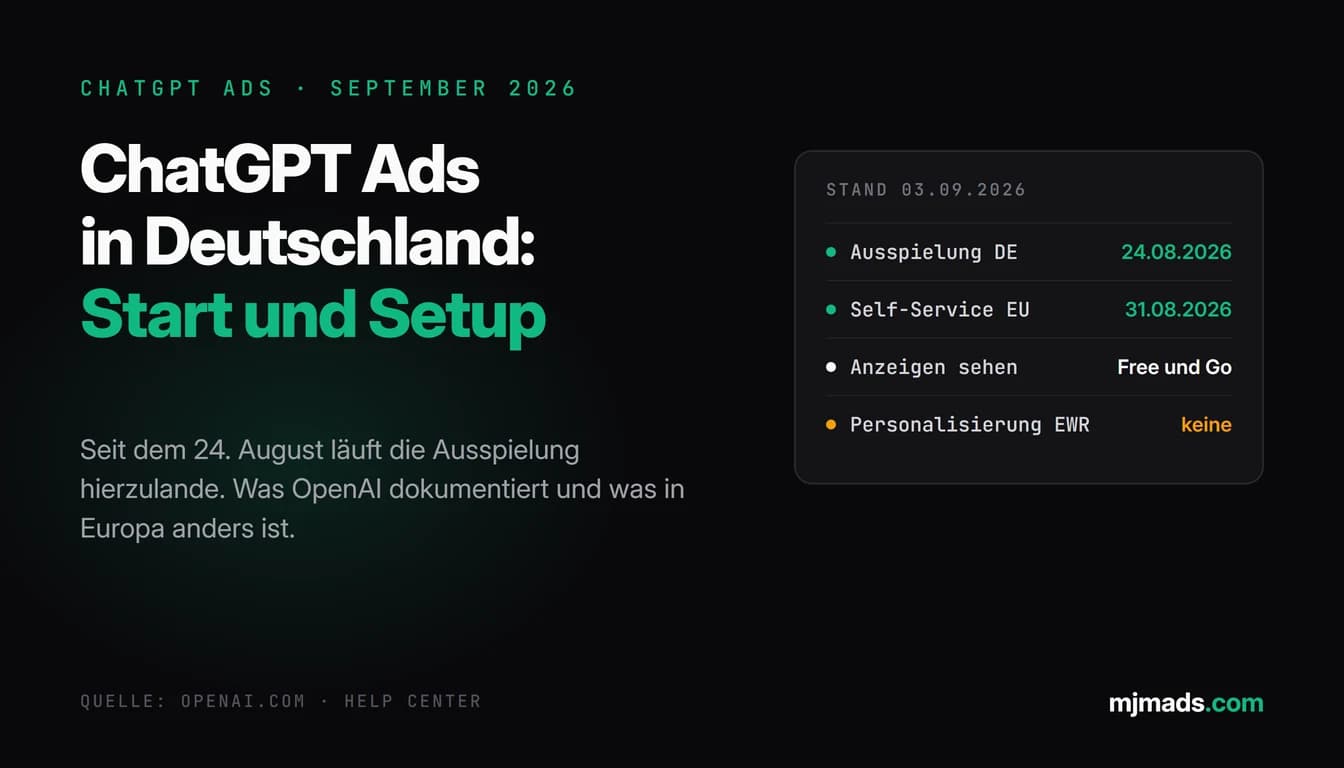
In the US, advertisers can additionally work with custom audiences. According to OpenAI's developer documentation that does not apply to campaigns targeting the EEA or Switzerland: custom audiences are not supported there, because personalised ads are not yet available.
On top of that comes the statement from OpenAI quoted by the outlet Trending Topics: in the EEA and Switzerland, ads are not personalised at launch. No past chats, no saved memories. What remains as signals is the topic of the current conversation, approximate location, device type, time of day and language.
For you that means the conversation itself carries almost all of the targeting. No audience backup, no CRM lists to catch a weak hint. Here the hint is not a detail in the setup, it is the main lever.
The seven rules
1. Describe the need, not the label
"Heat pump" is a product name. "Detached house from 1960, owner wants out of gas heating and is asking whether a heat pump even fits the building" is a situation. Only the second version contains what a person is actually up to. Write the hint the way a customer would describe their problem on the phone, not the way it appears in your price list.
2. One topic per ad group
The hierarchy is campaign, ad group, ad. That structure is not a filing system for your convenience, it is the bracket around the signal. As soon as one ad group describes emergency call-outs, bathroom renovations and maintenance contracts at the same time, no ad can match everything the hint opens up. Separate the topics, even if that leaves you with more ad groups than planned.
3. Write several variants instead of one perfect one
For ads, OpenAI explicitly recommends many different headline and text variants per offer. The same principle carries over to hints: one need can be described factually, urgently, with a price angle or with an outcome angle, and you do not know in advance which phrasing the system places better. Four to six variants per topic are a good starting point from my own practice.
4. Benefit before slogan
Benefit-oriented language sits right at the top of OpenAI's best practices for ads, and hints, ad and landing page should all speak the same language. "Market leader since 1998" describes no need. "Appointment within 24 hours, fixed price before we start" describes one. Slogans belong to the brand, if anywhere, not to the description of a conversation.
5. The landing page has to deliver on the hint
OpenAI recommends a specific landing page rather than the homepage, requires consistency all the way through to the landing page in its ad policies, and reserves the right to reject any ad. There is also a technical condition: your landing page must not block OAI-AdsBot and OAI-SearchBot, otherwise OpenAI cannot evaluate it. If your hint describes an emergency situation, the landing page has to serve exactly that, visibly and without searching.
6. Only use cases you genuinely serve
It is tempting to open the topic field wide. It backfires twice over: ads are reviewed before delivery, and clicks from conversations you cannot serve still cost money. Then there are the policy limits: in sensitive contexts such as mental and personal health, political content or gambling, no ads are served at all. Ads for financial, health and legal services are prohibited outside the US, and that includes all of Europe.
7. Test and observe instead of believing
The platform is officially in beta, and OpenAI states itself that it does not yet have performance benchmarks across advertisers, industries or campaign types. So there is no table to check your hints against, only your own numbers.
One single observation as a pointer: writing at Search Engine Land, John Horn describes from his own US test that keyword-style context hints delivered more impressions and a higher click-through rate at a lower cost per click than narrative phrasings. That is one test account, one market, one period, so it is not a law. But it is a good reason to deliberately run both styles against each other inside one ad group. The precondition is that your conversion tracking is in place, otherwise you are comparing clicks instead of outcomes. How to set up the pixel and the conversions API is covered in ChatGPT Ads tracking.
Three worked example sets
Plumbing emergency service, ad group "heating failure"
- Heating fails in the middle of winter, the flat is getting cold, help is needed today
- No hot water since this morning, family with small children in the house
- Water damage in the bathroom, someone is looking for a tradesperson who can come at short notice
- Question about roughly what a weekend emergency call-out costs and how long the journey takes
- Tenant urgently needs written confirmation for the property management after a heating failure
Local services are among the verticals OpenAI explicitly plans for at launch. For trade businesses that is the friendliest starting position in the whole channel.
Tax consultancy with an online course, ad group "bookkeeping for the self-employed"
- Newly self-employed and unsure which receipts really need to be collected for the books
- Looking for an online course that explains the simple cash-basis accounts step by step
- Small business owner wants to file the VAT advance return without help and needs an understandable guide
- Wish to get the monthly paperwork in order and spend less time on it
- Question about when accounting software starts to pay off for a sole trader
One thing matters with this set: digital products and education are one of the intended verticals, and finance education without financial services is generally permitted under the ad policies. Financial services themselves, however, are prohibited outside the US. And if your core business itself falls into a restricted category, OpenAI may reject you as an advertiser under the policies, even if the course on its own would be allowed. Phrase it conservatively, sell a course rather than advice, and expect a closer review.
Furniture online shop, ad group "furnishing a small flat"
- First flat of one's own, small living room, looking for a sofa that does not swallow the entire space
- Moving into a period building with an awkward floor plan, asking about flexible shelving systems
- The home office has to fit into the kitchen-diner, looking for a desk that disappears in the evening
- Wish for solid wood furniture with a short delivery time rather than months of waiting
- Question about how to make a small living room look bigger
The usual mistakes
Copying the keyword list from Google Ads. The field accepts it, but a description of a conversation does not come out of it. What used to be a neatly trimmed phrase match in Google Ads is at best a keyword without context here.
Five offers in one ad group. The most common structural mistake, and it costs twice: the signal gets diluted, and your ad copy can no longer match everything the hint opens up.
Promises the landing page does not keep. The policies require consistency through to the landing page, and OpenAI can reject ads. A hint describing same-day appointments and a landing page with a contact form but no phone number do not go together.
Blocked crawlers. If OAI-AdsBot or OAI-SearchBot are locked out by robots.txt or a firewall, the selection is missing a building block that OpenAI explicitly says it needs. You check that once and then have peace.
Throwing everything out after two days. The channel is young and the data volumes are correspondingly small. Rewriting every day means measuring noise.
Where good hints really come from
The best context hints are not produced in a brainstorm, they are sitting in your inbox. From my own practice this is the most reliable route: take the last twenty genuine enquiries, by email, phone note or contact form, and read only the first sentence. That is where customers describe their situation, not your product category.
Those sentences are your raw material. You strip out names and places but leave the wording exactly as it arrived, then group by topic. Each group becomes an ad group, the sentences become the hints. Anyone already running Google Ads will find the same language in the search terms report: the long, unusual queries are almost always the most honest ones.
Then a second filter: delete every hint where you cannot immediately say which landing page belongs to it. If you do not know, the system certainly will not.
In short
Context hints describe conversations, not search terms. One topic per ad group, several variants, benefit instead of slogan, and a landing page that delivers on the hint. Everything beyond that is observation, because reliable comparison figures for this channel simply do not exist yet.
How ChatGPT Ads works overall, from the auction to campaign structure, is covered in the overview of ChatGPT Ads in Germany. If you want to know whether your offer fits this channel at all, the ChatGPT Ads check answers that in a few minutes. Example hints for six industries, from trades to online shops, are in the overview by industry. And if you would rather hand the campaigns over: I set them up and run them at published fixed prices. The details are on the ChatGPT Ads service page.
Sources
- OpenAI Help Center, Ads in ChatGPT, The Basics: help.openai.com/en/articles/20001207-ads-in-chatgpt-the-basics
- OpenAI Help Center, Create Ad Groups for ChatGPT Ads: help.openai.com/en/articles/20001211-create-ad-groups-for-chatgpt-ads
- OpenAI Help Center, Create Ads for ChatGPT Ads: help.openai.com/en/articles/20001212-create-ads-for-chatgpt-ads
- OpenAI Help Center, Create Campaigns for ChatGPT Ads: help.openai.com/en/articles/20001210-create-campaigns-for-chatgpt-ads
- OpenAI Help Center, Frequently asked questions: help.openai.com/en/articles/20001220-frequently-asked-questions
- OpenAI Help Center, Advertiser Guidance for Allowing OpenAI Web Crawlers: help.openai.com/en/articles/20001243-advertiser-guidance-for-allowing-openai-web-crawlers
- OpenAI, Ad policies: openai.com/policies/ad-policies
- OpenAI Developers, Custom Audiences: developers.openai.com/ads/custom-audiences
- Trending Topics on OpenAI's statements about personalisation in the EEA and Switzerland: trendingtopics.eu
- Search Engine Land, John Horn, How to run ChatGPT ads: searchengineland.com/run-chatgpt-ads-484513