
Since 24 August 2026 an ad can appear inside a ChatGPT answer in Germany too. For businesses that means an additional channel where people arrive with a concrete question.
This article collects what OpenAI has officially documented, what runs differently in Europe than in the US, and what you can already act on today. Every figure comes from a named source linked at the end. Where I speak from my own experience, I say so.
What has happened since 24 August 2026
The timeline is short enough to read in one go:
- 9 February 2026: OpenAI starts the advertising test in the US. The pilot from February to April is followed by self-serve onboarding.
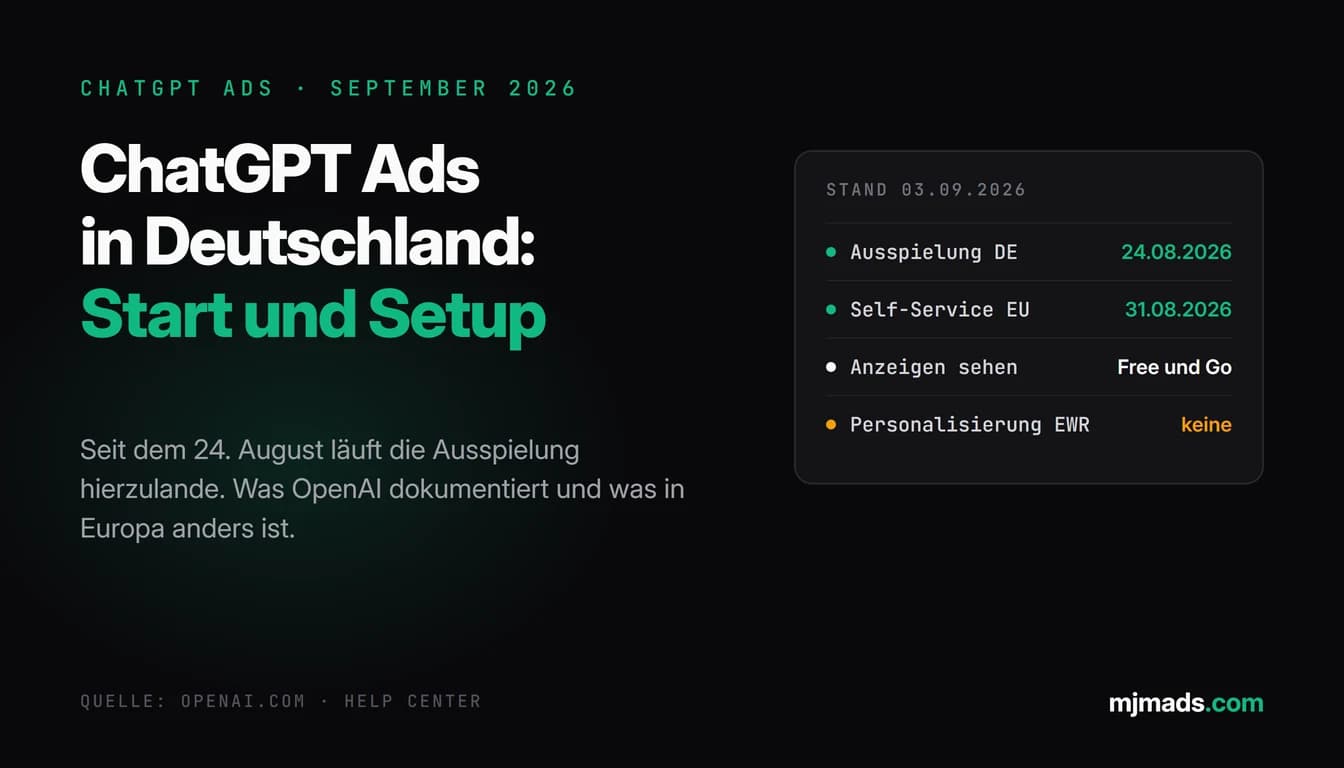
- 18 August 2026: OpenAI announces the expansion to 31 European markets, among them Germany, Austria, France, Spain, Italy, the Netherlands, Sweden, Norway and Denmark.
- 24 August 2026: HORIZONT and OnlineMarketing.de report the first ad placements in Germany.
- 31 August 2026: OpenAI opens self-service in the Ads Manager for all 31 markets. The availability help page now lists Germany, Austria, Switzerland and Poland as available, 63 countries in total.
- 16 September 2026: OpenAI introduces Sponsored Agents, for now as a test with select advertisers in the US.
You sign up at ads.openai.com. According to OpenAI, creating an account and being enabled for self-service are two separate steps. One point for your expectations: OpenAI calls the platform a beta in an early scaling phase in its own FAQ.
Two figures from around the launch show how fast it is moving anyway. OpenAI writes that "tens of thousands of marketers" have now advertised on ChatGPT. The trade publication Digiday reported on 31 August that the ads business had reached an annualised run rate of one billion US dollars in under 200 days.
Who sees the ads
Not everyone. According to OpenAI only users on the Free and Go plans get advertising. Plus, Pro, Business, Enterprise and Edu stay ad free. ChatGPT Go costs 7.99 euros a month in Germany according to iphone-ticker.
Two further limits: OpenAI serves no ads to accounts recognised as under 18. And there is no advertising in the ChatGPT Atlas browser during the test either.
That leaves the question of whether the people there are ready to buy. David Dugan, Head of Global Ads Solutions at OpenAI, said in Cannes in June 2026, as quoted by Marketing Dive: "Roughly 20% of queries in ChatGPT have a direct commercial intent." Users arrive "with a job to be done", and ChatGPT has "nearly 1 billion users". Those are vendor statements, not independent measurements, and they deserve to be read exactly that way.
What a ChatGPT ad looks like
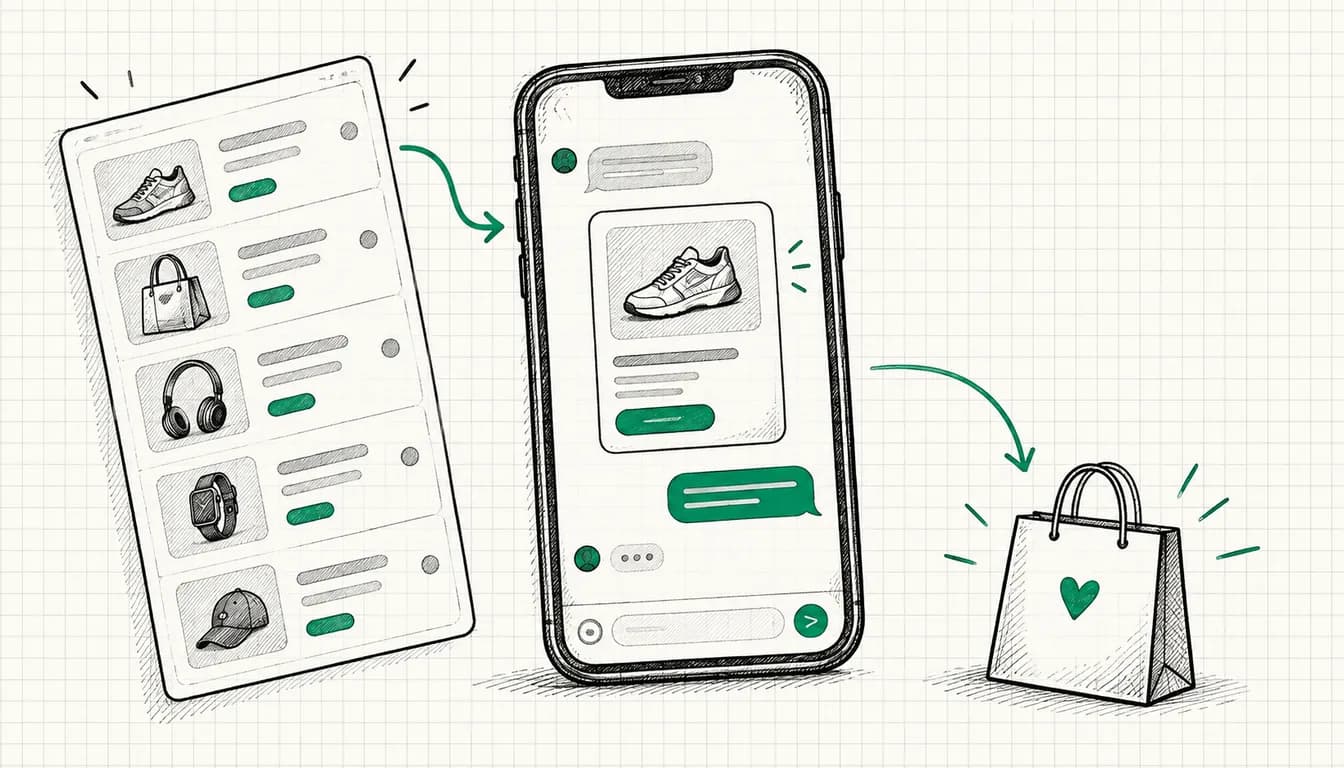
According to OpenAI an ad consists of the advertiser name, the favicon, a title, a piece of text, the landing page and an image. It appears below the end of the answer, clearly marked as sponsored and visually separated from the answer itself.
The most important sentence in the documentation for anyone worried about customer trust: ads do not influence the answers. These are separate systems, and advertisers can neither shape nor rank nor change responses. Conversations stay private from advertisers, and customer data is not sold. For the organic side, my 2026 citation study, measured via API, shows which sources AI search tools cite and how much that fluctuates.
On formats, the OpenAI help centre gives no hard numbers, only "recommended limits". Search Engine Land read them out of the Ads Manager in a hands-on report on 10 August: title up to 50 characters, description up to 100 characters, image at least 256 by 256 pixels. For shops there are additional campaigns built from product feeds.
One small thing that saves time: the Ads Manager suggests ad drafts and pre-fills them from your website metadata. According to OpenAI this feature does not generate new copy or images. Separately, on 16 September OpenAI announced AI assistance that suggests copy and imagery while you draft an ad, based on your landing page and campaign objective, which you review and edit before adding them. OpenAI gives no country details for it. Either way, responsibility for the copy stays with you.
How ChatGPT decides which ad runs
This is where the real difference to everything you know from search marketing sits: there is no keyword list. OpenAI selects ads by expected relevance and expected outcome, drawing on the context and intent of the current conversation plus your landing page, your title, your text, your context hints and your targeting choices.
Context hints live at ad group level. They describe conversations, topics and needs in ordinary language. OpenAI states explicitly in its own documentation that these are not exact match keywords and that there is no guarantee of appearing in particular conversations. The example from the docs shows the direction. Instead of "running shoes", the intended shape is "cushioned everyday running shoes for beginners training for their first 5K".
The decision then happens in what OpenAI calls a relevance weighted second price auction. Anyone who knows the Google Ads auction will recognise the principle immediately: the highest bid does not win, the best combination of bid and relevance does. The mechanics of this kind of ad auction are the same, except that the fit with the running conversation takes the place of ad quality.
How to word context hints best is still an open question. John Horn described a US test for Search Engine Land in which keyword-like hints produced more impressions and a higher click-through rate at a lower cost per click than fully worded descriptions. That is one author's single observation, not a law, but a good reason to run both variants against each other.
What ChatGPT Ads cost
First, because it is the most common question: OpenAI publishes no rate card, and there is no official figure for euro accounts. What does exist is a clear billing logic.
| Objective | What you pay for | What it is meant for |
|---|---|---|
| CPM | per thousand impressions | reach and visibility |
| CPC | per valid click | visitors on the landing page |
| oCPC | per valid click, optimised towards a conversion event | enquiries, appointments, orders |
| oCPM | per thousand impressions, optimised towards a conversion event | enquiries, appointments, orders |
Table scrolls sideways
You set the maximum bid at ad group level. For a start with click objectives OpenAI suggests 3 to 5 US dollars per click, and the Ads Manager adds bid strength hints. Search Engine Land reports actual click prices between 2 and 5 US dollars from the US test, and that below 3 US dollars the Ads Manager warns your ad may not deliver. That too is a single observation from a different market.
Conversion optimised campaigns come with rules worth knowing before you start. The bid there is a bid cap, meaning the maximum bid per conversion. According to the OpenAI Help Center, billing runs either per valid click (oCPC) or per thousand impressions (oCPM), your choice, never per conversion. The pixel and/or the Conversions API plus a standard event are a prerequisite. Objective and event cannot be changed after creation, and existing CPM or CPC campaigns cannot be converted afterwards. Miss that and you build your campaign twice.
On budgets OpenAI works with a weekly average: the daily budget is an average across seven days. On a single day up to twice that amount can be spent, across seven days at most seven times the daily budget. Alternatively you set a total budget for the campaign. The minimum daily budget depends on your billing currency. According to the OpenAI Help Center it is €15 for euro accounts, 65 PLN for złoty accounts and 20 CHF for Swiss franc accounts as of October 2026.
Payment runs postpay by credit card, with a billing profile on file, a temporary authorisation and a charge once a payment threshold is reached, at the latest at the end of the month.
As a bid strategy, new ad groups default to "Maximize results", meaning automated bidding. OpenAI explicitly promises no particular CPA or ROAS for it. If you want to steer yourself, you choose manual maximum bids.
The most important sentence on costs sits in OpenAI's own FAQ: there are no performance benchmarks across advertisers, industries or campaign types yet. So any table of alleged ChatGPT Ads benchmarks crossing your feed right now is guesswork.
What is different in Europe
The biggest difference concerns personalisation. According to OpenAI statements quoted by Trending Topics, ads in the EEA and Switzerland are not personalised at launch: no past chats, no saved memories. What is used is the topic of the current conversation, the approximate location, the device type, the time of day and the language.
Consistent with that, OpenAI does not support custom audiences for campaigns targeting the EEA or Switzerland. The developer documentation puts it literally as "where personalized ads are not yet available".
In practice that means everything the audience data carries in other channels is carried here by your context hints and your creatives. That is inconvenient, but it is also the fair version, because it depends on work rather than on data holdings.
Tracking: pixel, Conversions API and consent
Without measurement the channel cannot be judged, and OpenAI supplies exactly the building blocks you know from other systems.
There is a browser pixel with the SDK name oaiq and a server side Conversions API. Both can be combined, with deduplication through the same event_id. On a click OpenAI appends a reference called oppref to your landing page URL, and the pixel stores it as a first party cookie.
Measurement runs through standard events, among them lead_created, appointment_scheduled, registration_completed, order_created, checkout_started, subscription_created, trial_started and page_viewed. For service businesses the first two are usually the relevant ones, for shops the order events.
Two details for everyone who takes data protection seriously. First, the pixel comes with automatic advanced matching: it recognises form data and hashes it with SHA-256 in the browser already, and according to OpenAI raw data does not reach OpenAI. Second, there is a consent switch, oaiq("consent", false), that you wire to your consent solution. The thinking is the same as with Consent Mode v2, and the fundamentals of clean conversion tracking apply unchanged.
Two things get forgotten regularly in practice. UTM parameters are preserved on clicks, so you see the channel in your own analytics as well. And your landing page must not block the OpenAI crawlers OAI-AdsBot and OAI-SearchBot, otherwise the ad goes nowhere. A look at robots.txt takes two minutes and saves a rejection cycle.
In the reporting itself you see impressions, clicks, spend, click-through rate, average cost per click, average cost per thousand impressions and conversions.
Who is allowed to advertise and who is not
OpenAI's ad policies, as of 10 September 2026, are narrower than what you know from Google, and that is deliberate.
No ads run in sensitive contexts at all. That includes mental and personal health, suicide, political content, weapons, gambling contexts and conversations involving emotional dependency.
What is allowed at this stage is mainly consumer territory: lifestyle and household, local services, travel and experiences, digital products and education. Finance, health and legal are restricted categories; what that means for Germany is covered in the next section. Not permitted are, among others, adult and dating, alcohol and tobacco, counterfeits, gambling and political advertising.
On top of that come the baseline standards: truthful claims, no imitation of the ChatGPT interface, a promise that stays consistent all the way to the landing page. OpenAI explicitly reserves the right to reject any ad, reviews ads before delivery and may require account verification.
Finance, health and legal: what applies in Germany
OpenAI treats these three areas separately, and this is where the situation in Germany differs clearly from the US. The OpenAI ad policies in the version of 10 September 2026 say:
| Area | US | Outside the US, including Germany |
|---|---|---|
| Financial services | case by case approval for approved advertisers, for example credit cards, loans, mortgages, insurance and investment services | generally prohibited |
| Health services | case by case approval, for example dental services, health insurance, hospitals, diagnostics and consumer medical devices | generally prohibited |
| Legal services | permitted when the advertiser is licensed to practise law in the jurisdiction where the ad is shown | currently prohibited |
Table scrolls sideways
"Outside the US" works in both directions. A company based outside the US, including in Germany, cannot run ads in these areas. And a company based in the US cannot serve them outside the US, for example to users in Germany. A US subsidiary or a US agency is therefore no way around the rule.
For financial and health ads OpenAI may require proof of licensure. Completely excluded are, among others, credit repair, debt settlement and alternative investments such as bullion, and in health also unapproved products, experimental therapies and unsupported treatment claims.
According to the policy, a few edge areas stay open: financial tools such as budgeting apps and finance education that do not promote financial products are generally permitted. General fitness and wellness products without medical claims may be allowed, as may legal education or media, as long as no legal services are offered.
Separately, OpenAI governs which conversations ads can appear next to. Since April 2026, conversations involving medical, legal or financial questions are no longer blocked from ads by default, while conversations about mental and personal health still are.
For medical practices, law firms, insurance brokers or financial advisers in Germany, ChatGPT Ads is therefore not a channel as things stand. For borderline cases such as tax advice the policy names no category of its own, so I would clarify admissibility before any setup. The policy also changes quickly: since the first version in March 2026 OpenAI has revised it six times, and US approval for legal services only came in August. So check the current version right before you launch. Which industries fit ChatGPT Ads today and where the limits are is something I show in the overview by industry. How law firms advertise on Google Ads instead is covered in the ad check for law firms.
Sponsored Agents: so far only a test in the US
On 16 September 2026 OpenAI introduced Sponsored Agents. After seeing an ad, a user can start a clearly labelled conversation with an agent sponsored by the advertising business, ask follow-up questions there and continue to the website when ready. According to OpenAI, this conversation is distinct from ChatGPT's independent answers and separate from the original chat.
So far it is only being tested with select advertisers in the US. According to the Help Center the format runs as a limited alpha, and OpenAI is not accepting early access requests at the moment. OpenAI names no date for Germany. For your planning that means Sponsored Agents are not a building block you can count on here today. What OpenAI has documented about the format so far and how I assess it is covered in my post on ChatGPT Sponsored Agents.
ChatGPT Ads or Google Ads?
Short version: today this is not an either or question. Google Ads is a mature channel with keywords, search term reports and complete reporting, while ChatGPT Ads is a beta without keywords, without benchmarks and with a different user situation. If you depend on a steady flow of enquiries, you do not dismantle one to test the other. The full side by side comparison, with all the differences in auction, targeting and measurement, is in the ChatGPT Ads and Google Ads comparison.
What I advise businesses to do now
From my practice with auction channels, transferred to this one, without promises:
Be able to measure before you advertise. The pixel or the Conversions API come before the first campaign, not after it. Without a standard event the conversion optimised objective is not even selectable, and without numbers a test is not a test but an opinion.
Test small, with a stop criterion. Decide up front how much budget you are willing to lose and how you will recognise that it is not working. Because there are no benchmarks, your own viable click price is the only sensible yardstick. You can work it out in two minutes with the click price calculator, no sign-up needed.
Many variants instead of one perfect ad. In its creative guidance OpenAI explicitly recommends several different titles and texts per offer, written around the benefit, pointing at a specific landing page rather than the home page. With 50 characters in the title the wording decides, and nobody knows in advance which one wins.
Do not touch what already works. The new channel is paid from a test budget, not from the budget that is currently producing enquiries.
If you want to know whether your offer is even admissible under the current policies and what your setup would have to look like, the ChatGPT Ads check walks through the points from this article for you. And if you would rather hand over the build: I usually set up ChatGPT Ads including tracking within seven days of the order and account access, setup from €1,500, ongoing management from €1,000 a month. I work in Google Ads accounts every day, ChatGPT Ads is a new channel for me too, and that is exactly how I put it: with transferable auction and tracking experience, without promises nobody can keep.
Further reading: How to write strong hints, with examples, in Context Hints for ChatGPT Ads: 7 rules. The measurement setup step by step in ChatGPT Ads tracking: setting up the Pixel and Conversions API. Which other AI assistants show ads, and which of them you can book in Germany, is covered in my overview of ads in AI assistants.
Frequently asked questions
Are ChatGPT Ads available in Germany?
Yes. OpenAI announced the expansion to 31 European markets on 18 August 2026, and the trade titles HORIZONT and OnlineMarketing.de reported the first German placements on 24 August. Self-service in the Ads Manager has been open in all 31 markets since 31 August, and OpenAI's availability help page lists Germany, Austria, Switzerland and Poland as available. OpenAI still calls the platform a beta.
Who sees ads in ChatGPT?
Only users on the Free and Go plans. Plus, Pro, Business, Enterprise and Edu stay ad free according to OpenAI, as do accounts recognised as under 18 and the ChatGPT Atlas browser during the test. ChatGPT Go costs 7.99 euros a month in Germany according to iphone-ticker.
What do ChatGPT Ads cost?
OpenAI does not publish a rate card. You pick a campaign objective and pay per thousand impressions or per valid click, depending on the objective. When optimising towards a conversion event, billing runs either per valid click (oCPC) or per thousand impressions (oCPM), your choice, never per conversion. On top of that you set a maximum bid at ad group level. For a start with click objectives OpenAI suggests 3 to 5 US dollars per click. There is no official figure for euro accounts, and OpenAI writes itself that it does not yet have performance benchmarks across advertisers, industries or campaign types.
How does targeting work in ChatGPT Ads?
Through context instead of keywords. In what OpenAI calls context hints you describe at ad group level which conversations, topics and needs you want to reach, and you add target countries plus optional platforms. OpenAI then selects by expected relevance and decides in a relevance weighted second price auction. There are no exact match keywords and no guarantee of appearing in specific conversations.
How do I measure conversions from ChatGPT Ads?
With the OpenAI pixel, the Conversions API or both together, deduplicated through the same event_id. Every click appends a reference called oppref to your landing page URL, which the pixel stores as a first party cookie. You map your goal with standard events such as lead_created, appointment_scheduled or order_created. For conversion optimised campaigns at least one of the two connections is mandatory.
Can banks, medical practices or law firms advertise in ChatGPT?
Not in Germany as things stand. Under OpenAI's ad policies (as of 10 September 2026), ads for financial and health services are generally prohibited outside the US, and ads for legal services outside the US are currently prohibited. This applies to companies based outside the US and equally to ads that would be served outside the US, even if the company is based in the US. In the US these areas get case by case approvals. According to the policy, financial tools such as budgeting apps that do not promote financial products are generally permitted, and legal education without legal services may be allowed.
Are ChatGPT Ads worth it for small businesses?
There is no honest general answer yet, because reliable comparative figures do not exist. From my own practice the sensible route is a small, clearly limited test with stop criteria defined up front, clean tracking and several ad variants, while the existing Google Ads account keeps running untouched. For financial, health and legal service providers in Germany, however, ChatGPT Ads is not a channel under the current ad policies.
Sources
- OpenAI, "ChatGPT Ads expands across Europe": openai.com/index/chatgpt-ads-expands-across-europe
- OpenAI, Ad policies (as of 10 September 2026): openai.com/policies/ad-policies
- OpenAI, "Reimagining advertising with AI" (16 September 2026): openai.com/index/reimagining-advertising-with-ai
- OpenAI Developers, ads documentation on pixel, Conversions API, events and custom audiences: developers.openai.com/ads
- OpenAI Help Center, "Ads in ChatGPT: The Basics": help.openai.com/en/articles/20001207
- OpenAI Help Center, "Ads in ChatGPT": help.openai.com/en/articles/20001047
- OpenAI Help Center, "Ads Manager Availability": help.openai.com/en/articles/20001245
- OpenAI Help Center, "Create Campaigns for ChatGPT Ads": help.openai.com/en/articles/20001210
- OpenAI Help Center, "Create Ad Groups for ChatGPT Ads": help.openai.com/en/articles/20001211
- OpenAI Help Center, "Create Ads for ChatGPT Ads": help.openai.com/en/articles/20001212
- OpenAI Help Center, "Conversion-optimized Campaigns": help.openai.com/en/articles/20001412
- OpenAI Help Center, "Daily Budgets": help.openai.com/en/articles/20001413
- OpenAI Help Center, "Billing & Payment": help.openai.com/en/articles/20001216
- OpenAI Help Center, "Conversion Measurement": help.openai.com/en/articles/20001409
- OpenAI Help Center, "Maximize Results Bid Strategy": help.openai.com/en/articles/20001425
- OpenAI Help Center, "Frequently asked questions": help.openai.com/en/articles/20001220
- OpenAI Help Center, "Sponsored Agents in ChatGPT Ads": help.openai.com/en/articles/20001524
- OpenAI Help Center, "Advertiser Guidance for Allowing OpenAI Web Crawlers": help.openai.com/en/articles/20001243
- HORIZONT, "OpenAI: ChatGPT zeigt Werbung jetzt auch in Deutschland": horizont.net/medien/nachrichten
- OnlineMarketing.de, "ChatGPT Ads ab jetzt in Deutschland": onlinemarketing.de/technologie
- Digiday, ChatGPT Ads business hits a 1 billion US dollar run rate: digiday.com/media-buying
- Marketing Dive, quotes from David Dugan on the ChatGPT Ads debut in Cannes: marketingdive.com/news
- Search Engine Land, John Horn, "How to run ChatGPT ads": searchengineland.com/run-chatgpt-ads-484513
- iphone-ticker, ChatGPT Go available in Germany for 7.99 euros a month: iphone-ticker.de
- Trending Topics, OpenAI statements on personalisation in the EEA and Switzerland: trendingtopics.eu
As of: October 2026